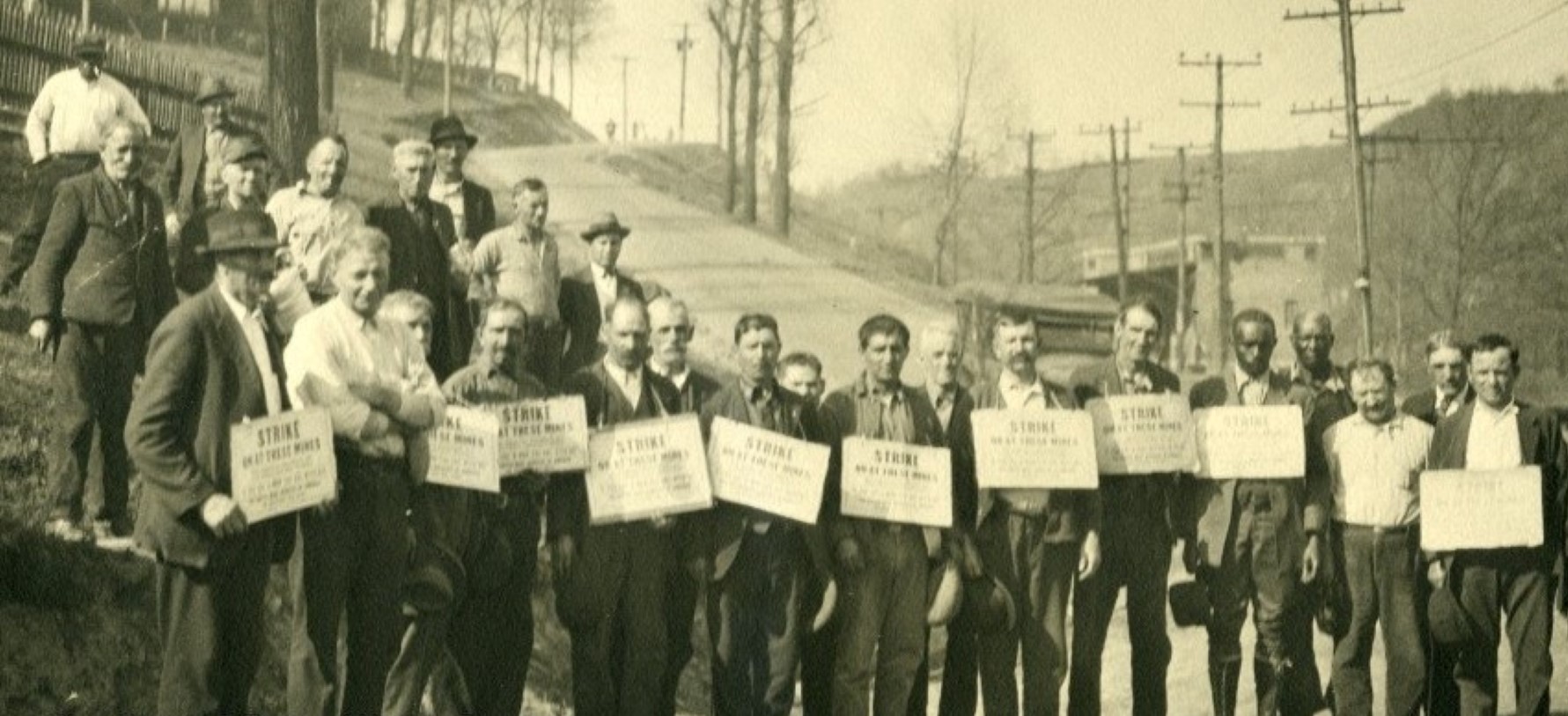
Occasionally a Labor Day can have real meaning, as in this case from 1924 of 10,000 miners gathering to rededicate their union hall in Brady, West Virginia as witnessed and recorded by Art Shields.
‘West Virginia Miners Celebrate Rebuilding of Union Headquarters Operators’ Thugs Burned Down’ by Art Shields from New Leader. Vol. 1 No. 34. September 6, 1924.
Brady Is Scene of Impressive Demonstration on Labor Day.
BRADY, West Virginia. Ten thousand union miners, their wives and little ones, held a union meeting on the heights overlooking this corporation town last Sunday that for spontaneous enthusiasm makes John W. Davis’s Labor Day meeting in another West Virginia city seem a stale farce.
This meeting marks the comeback of the United Mine Workers, which Davis has fought. It was officially called to dedicate the fine new brick union hall, which has arisen near the crest of the hill, just over the hall the Brady-Warner gunmen burned down last June.
But it developed into a mighty concourse of working folks from 100 hills and valleys, come together to pledge solidarity in the fight which the open-shop operators have intensified since last April.
Many From Pa.
All Northern West Virginia had sent its quotas by flivver and truck, and a special train brought many more from Western Pennsylvania. Maryland and Ohio had contributed their quotas to the giant gathering in this little town that had come to symbolize the conflict raging wherever an operator rejects the Jacksonville agreement. International officials were present from many districts.
As the union multitude cheered on the hill eleven huge amplifying horns carried the speakers’ challenges down through the hollow to every strikebreaker’s family in their little gray shacks and to the Brady-Warner gunmen in the club house nearer the Monongahela River far below. The horns blared out defiance to the “yellow dogs,” as the miners call the gunmen, and appealed to the non-union workers lured in from the closed down Frick mines of Pennsylvania to be true to their fellows.
Union Hall Near Completion
The pageantry of the struggle of the Brady strike was set all about the great gathering. Seven hundred feet nearer sea level the tipples of the Brady-Warner Coal Company rose by the shimmering waters of the river.
Straggling up the winding hollow were the company “homes” from which the Brady families had been evicted to make room for scabs. Standing proudly above all these was the brick union hall, which is rising to completion with the aid of the strong arms of union members who are assisting the bricklayers and carpenters from Fairmont.
Beside the new building is the bullet-pitted concrete foundation of the hall destroyed last June, and ominously, back of the speakers’ stand, behind a wire fence on company property, is the big water tank the automatic rifle men used as a cover in their bombardment of the old hall, before Sheriff Yost arrested the defenders and made way for the thugs to come down and set the torch.
Stirring Slogans
It was an amazingly exuberant crowd. As they felt the mass contagion of solidarity, memories of unemployment and the open shop, which many of them are fighting now, dropped away and they exulted in the occasion. Even a woman, one of three whose babies had been born dead from brutal treatment by gunmen evicting them, watched the stream of cars bringing up new throngs, with eyes a-sparkle. It was a recreation. This is the spirit that West Virginia knights of the Coronado suits cannot down.
There was life, too, in the local, union banners that hung resplendent with the clasped hand emblem of the miners and with stirring slogans from the speakers’ two-story stand and rose on flagstaffs from the audience.
And in tune with the spirit of the crowd was the hilarious music of the union bands. Particularly pertinent was a song, which some minor improvised and which was called back three times by the audience, stanzas ran like this, to rollicking band music:
As sure as the world goes round,
As sure as the world goes round.
We’ll whip Sam Brady into line,
An agreement he will sign,
As sure as the world goes round, As sure as the world goes round, As sure as the world goes round,
We will surely win the strike,
And the thugs will take the pike,
As sure as the world goes round.
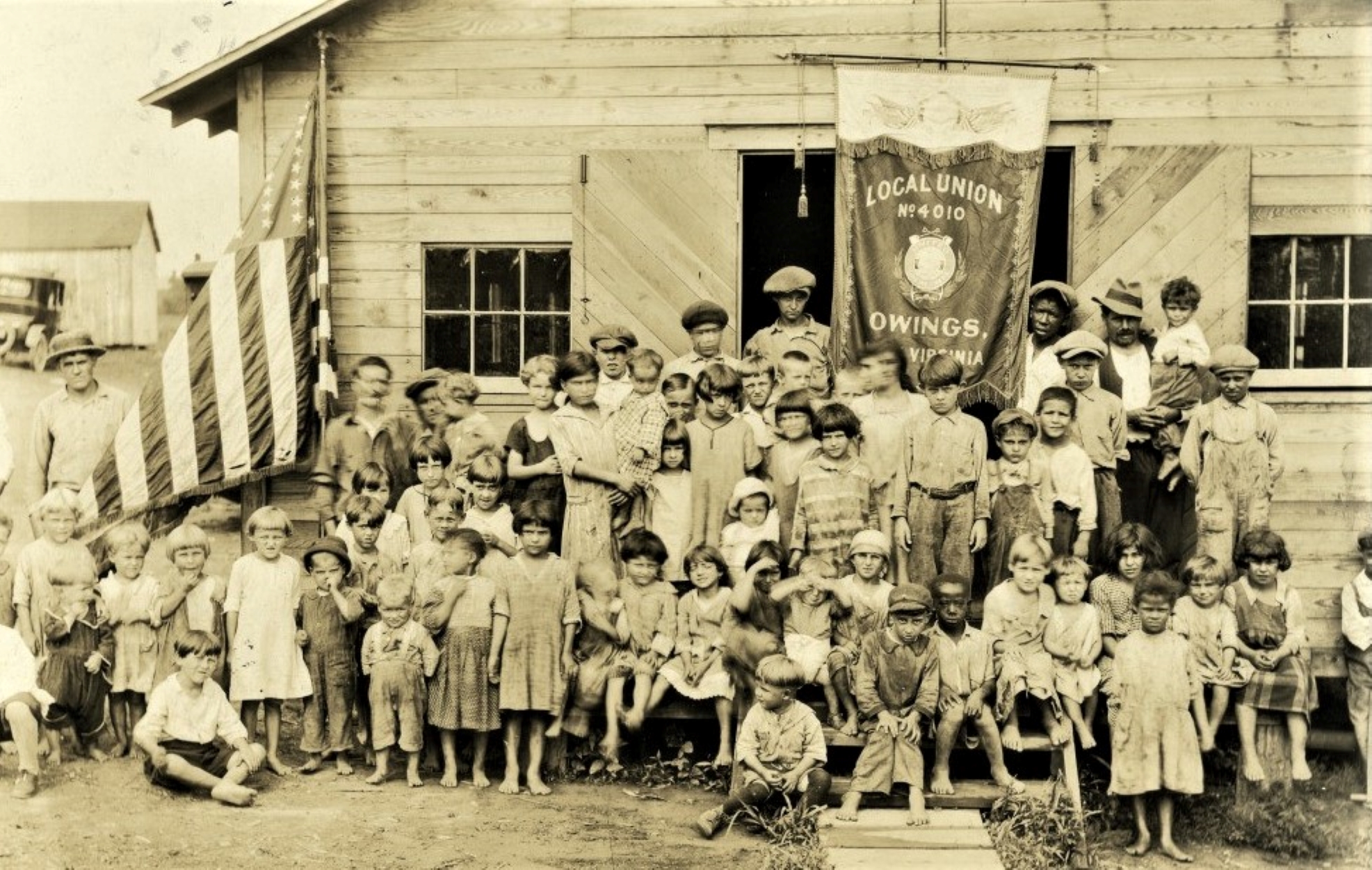
“This vast crowd,” said John McCleary, an international representative, the first speaker, “ought to convince Sam Brady that the United Mine Workers of America is not dead. Burning our union hall was a challenge which we have met.”
Appeal to Negroes
Appealing to the colored men among the strikebreakers below McCleary denounced operators’ propaganda, asserting that the Negro had no place in the United Mine Workers of America, and said that all miners were brothers, regardless of their color. Brady lost several colored workers the next day.
David Watkins, international representative from District 5, Van A. Bittner, International Representative in charge of the sub-district, with headquarters at Fairmont, were among the other speakers. Watkins told of the gallant fight Northern West Virginia fought in 1897, a fight lost by the employers’ injunction and the union’s lack of funds. Now, he said, the opportunity to win was here.
Brady miners are fighting an injunction now, nineteen awaiting trial on contempt charges for attempting to induce non-union men to break yellow dog contracts.
Like many other open-shop operators in West Virginia, Sam Brady has a private force of gunmen or “yellow dogs,” as the boys call them here. But, unlike ordinary capitalists employing gunmen, Brady sometimes takes personal command of his thugs when they are doing their stuff.
Brady personally directed a raid on the miners’ homes, in which doors were smashed down, women were dragged out, and the lives of three unborn children were destroyed. These eviction proceedings, carried out without regular process of law, were followed shortly by Brady’s next dramatic atrocity, the shooting-up and burning down of the miners’ union hall, all part of his campaign to crush the local union which was conducting the strike against the 1917 wage scale Brady posted up last May.
Brady was not fighting this group of miners along the upper Monongahela River for himself alone, but in the interest of a larger open-shop program. His firm, the Brady-Warner Coal Corporation, which has mines in other parts of the State, is linked up with the Warner sugar interests and has close relations with the Pennsylvania Railroad. When the company refused to sign the Jacksonville agreement last April the miners saw a fight coming. May 2, Brady posted a notice that tonnage rates were cut from 62 and 64 cents to 28 and 42 cents, with $3.75 for day labor instead of $7.28. The notice bluntly announced that any miner objecting to these terms could vacate his company house by May 9, seven days off.
Local Union No. 4041 met the challenge at a rousing meeting in their new hall, dedicated Labor Day a year ago–the hall which Brady’s thugs were so soon to burn down.
The miners declared emphatically that 1917 scales were out of date and that not a union miner would work for anything less than the 1924 scale. Heavy rains prevented Brady’s moving vans from getting in till the 19th. On that date the operator marched up the hollow at the head of a file of “yellow dogs” and a big truck. His equipment did not include warrants. Sheriff William McKinley Yost, a young Republican leader, who sanctioned the evictions, said Brady didn’t need any.
“Get ready to move!” shouted Brady at the door of Tom Morton, secretary of the local union. Morton is a young man, but he has a wife and six children. This little gray, four-roomed house was the only home he had or could get readily. Homes for families of eight are not easy to find. He told Brady he could not go.
“Well, I’ll move you, by God, whether you want to be moved or not,” shouted the boss, according to numerous witnesses.
Morton showed a written statement from Dr. Forest B. Combs, his family physician, certifying that his wife was in a delicate state of pregnancy and could not be hastily moved without risk.
“Nonsense!” bawled Brady, with an oath; “she looks all right.” Morton barred the door. It was crashed in, but the gunmen did not cross the threshold. Something in Morton’s hand stopped them. Sheriff Yost, faithful to the operators, saved the situation for Brady. The boss and his gang, with the sheriff’s backing, threw all the furniture into the van, roughly handling Mrs. Morton, and her children were ejected and the household belongings were dumped on the union lot up the hill. There the family camped till the union found a home for them near Fairmont.
Mrs. Morton took gravely sick; two months later she was delivered of a dead child, and the physician attending her said the stillborn infant’s death must have been due to the treatment she had received. Mrs. N. E. Coulter has a child murdered in similar fashion. The Brady thugs came to the door demanding the family get out. Coulter barred the door, put his wife and children in a rear room, and warned the thugs to stay away. Down came the door with a long battering ram behind it. Then the thugs leaped back. Coulter’s rabbit gun was ready and he told them what would happen if they crossed without a warrant. One gunman’s hand sneaked to his hip, but it jerked away as the steel rod in the miner’s hand snapped into line with his stomach. But Sheriff Yost again saved Brady’s game. Coulter was arrested, kept in jail for days, and is now out on $2,500 bail. Under Yost’s protection the thugs entered and rushed out the stuff, breaking some of the furniture and shocking Mrs. Coulter into a sick spell.
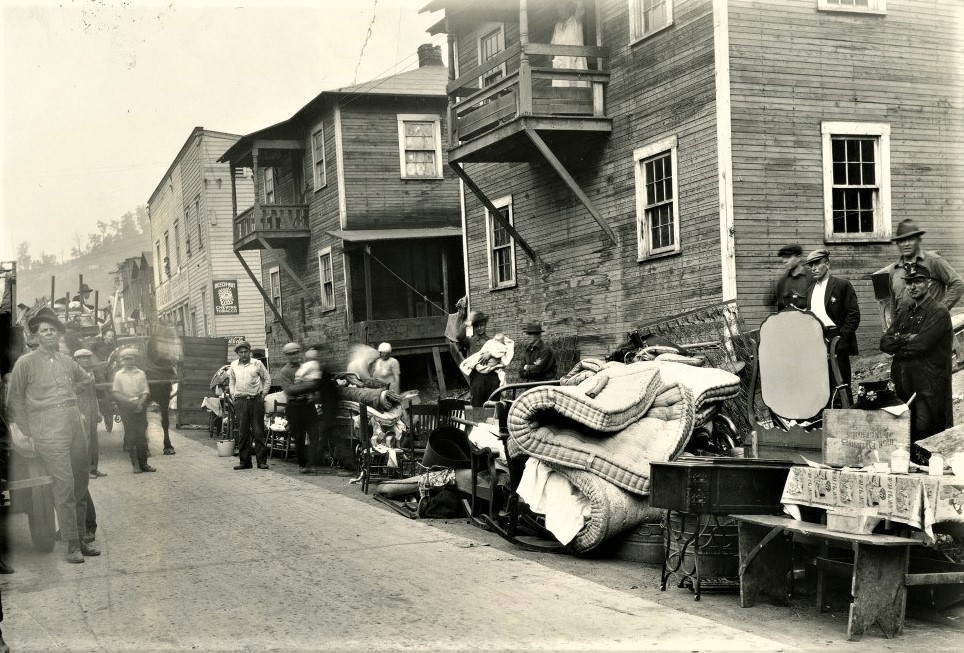
The coal digger’s wife was in an advanced stage of pregnancy. Shortly after she gave birth to twins, one dead.
Mrs. James Tony is the third woman whose unborn child perished as the result of the evictions. Fifteen families were evicted, with a total of sixty-four children. The resultant deaths of the babes the mothers were then bearing speaks volumes for the brutality of the eviction proceedings. The union miners speak of these three babes as murdered by Sam Brady’s company.
Sam Brady was a major in the Spanish-American War and served in the Philippines. Native life was cheap there, as far as the American army was concerned. His miners’ children’s lives are just as cheap to Brady now, say the workers of Brady. At best the homes they lost were miserable places, typical of the greed of their employer–little one-story homes, all painted a dull blue-gray and mounted on stilts, beneath which the winds whistled in winter. All are now living in houses obtained by the international union.
New Leader was the most important Socialist Party-aligned paper from much of the 1920s and 1930s. Begun in 1924 after the S.P. created the Conference for Progressive Political Action, it was edited by James Oneal. With Oneal, and William M. Feigenbaum as manager, the paper hosted such historic Party figures as Debs, Abraham Cahan, Lena Morrow Lewis, Isaac Hourwich, John Work, Algernon Lee, Morris Hillquit, and new-comers like Norman Thomas. Published weekly in New York City, the paper followed Oneal’s constructivist Marxism and political anti-Communism. The paper would move to the right in the mid 30s and become the voice of the ‘Old Guard’ of the S.P. After Oneal retired in 1940, the paper became a liberal anti-communist paper under editor Sol Levitas. However, in the 1920s and for much of the 1930s the paper contained a gold mine of information about the Party, its activities, and most importantly for labor historians, its insiders coverage of the union movement in a crucial period.
PDF of full issue: https://www.marxists.org/history/usa/pubs/new-leader/1924/v01n34-sep-06-1924-NL.pdf
 Revolution's Newsstand