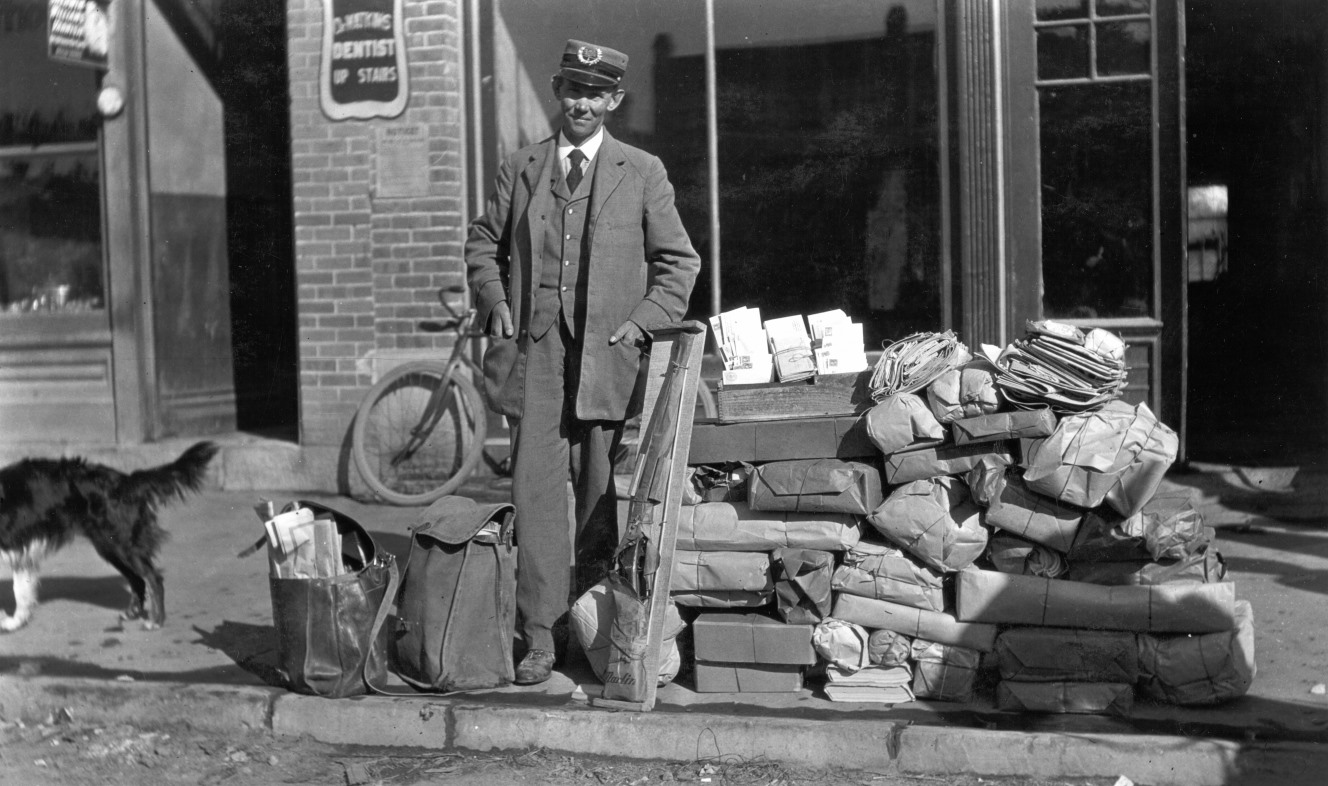
A ‘public’ job in which the violence of capitalist efficiency is as brutal as any field or factory. A postal worker tells the tale of Chicago’s mail rooms.
‘Slavery in Chicago Post Office’ by Obscurus from The Daily Worker. Vol. 3 No. 51. March 12, 1926.
THERE is probably nowhere in this happy hunting ground for capitalism known as the United States of America where workers are more systematically and scientifically exploited than in the gloomy bastile-like building at Dearborn and Adams streets in the city of Chicago. What is true in this office is, of course, true of the entire postal system, with here and there a minor concession.
In order to become a clerk here an incredible ordeal must be undergone. The sheep are separated from the goats in a long-drawn-out mental examination; a test that is ludicrously out of proportion to the mental requirements of a prospective clerkship.
If the applicant can show that he has participated in the recent European blood bath he is allowed five points. And if he can prove that he was sufficiently zealous in defense of his master’s foreign investments to have personally stopped a German shell directed thereat, he is allowed ten points.
In the physical examination the doctor determines whether or not the applicant’s anatomy is worth the 65 cents per hour that a clerk draws. At this point victims of physiological impairments incurred in the services of previous masters are dumped on the social scrap heap, and the cream is retained for the extraction of what exploitable elements it may yet contain.
Before a clerk has made his debut an initial expense of $12 is unavoidable. This consists of the price of his photograph that must be filed with his fingerprints, notary fee, and purchase of a thousand dollar bond. In addition to the foregoing there is an elaborate conglomeration of accessories in conjunction with the study in intricate postal routing. The latter not only constitutes a formidable personal expense, but will require upwards of two years’ study. References must be submitted which must not only be from businessmen but are accepted only on letterheads.
A year is required to get from the substitute into the regular class with its coveted seventeen hundred dollars per year. During this time a “sub” may get three hours work per twenty-four or he may get none, but he must report Sunday night whether he wants to or not He may have upwards of a dollar transportation on Sunday night and a return of one dollar thirty cents for a probable four hours, going and coming, plus work and time.
Going to work or lunch the clock is punched; returning involves the same procedure. In addition working numbers are checked going and coming from work. This does not include numerous check-ups at work to determine if anyone paying an arbitrary visit to the wash room. Fifteen minutes per four hours of work time is allowed for the latter purpose, same being checked in and out on the book and by the clock. If nature should make an intermediate demand the manner in which it would be satisfied may better be left to the imagination.
Unless a clerk is working on weight he dare not speak to his co-worker. Under this system, he is expected to handle certain weight of mail per hour or take his money and “get.” If the detail is switched to one on which it isn’t possible to keep a precise mathematical record of work done, the spy system is brought into play.
The “observer” watches a group from a hidden position and grades them according to the one who is going at the highest speed, and the paymaster is, in all probability, waiting to accommodate the ones who appear to be conserving their energies.
A supervisor is at liberty to walk up to a clerk and harass him or “write him up” for some trivial error, but to speak back to him by way of defense is economic suicide.
Although there are two, so-called, unions in the office, the great part of the force continues unorganized. The “Association of Chicago Postal Clerks” consists of the strawbosses, supervisors, stoolpigeons, and others who are perfectly sure that they will someday be president of the United States. The other (dis)organization, the “National Union of Postal Clerks,” is made up of those who are not so sure that they will yet occupy the White House but think their chances are good.
Strike! No indeed. We are a disciplined force. Furthermore, a clause in our by-laws specifies such un-American and sordid procedure as being the method of common overalled trash.
Going to the slimy politicians with their hats in their hands and tears in their eyes not only is their method, but accounts for the plight.
When it is realized that fully 50 per cent of appointees give up the struggle err the sixth year and the prospective forty-two dollars and fifty cents per week is won, it can be seen that only those of superior constitution can endure. The duty is nerve wrecking and physically devastating. Ventilation is antiquated and the lighting arrangement coupled with the strain very soon develops impaired vision.
The only humorous angle is the so-called pension arrangement. This is, of course, but deferred pay, pure and simple; although it is looked upon favorably by those who can’t detect the ruse. If at the age of sixty-five a clerk hasn’t entirely disintegrated from hard usage he is allowed a pension. This pittance–not more than fifty dollars per month–if judiciously handled might cover the rent on a hall room in Hogan’s alley–and it might not.
The travesty called a pension represents the accumulation of deductions from the employe’s pay at the rate of two and one-half cents from every dollar that accrued to him as wages over his entire life as a postal worker.
The Daily Worker began in 1924 and was published in New York City by the Communist Party US and its predecessor organizations. Among the most long-lasting and important left publications in US history, it had a circulation of 35,000 at its peak. The Daily Worker came from The Ohio Socialist, published by the Left Wing-dominated Socialist Party of Ohio in Cleveland from 1917 to November 1919, when it became became The Toiler, paper of the Communist Labor Party. In December 1921 the above-ground Workers Party of America merged the Toiler with the paper Workers Council to found The Worker, which became The Daily Worker beginning January 13, 1924.
PDF of full issue: https://www.marxists.org/history/usa/pubs/dailyworker/1926/1926-ny/v03-n051-NY-mar-12-1926-DW-LOC.pdf
 Revolution's Newsstand