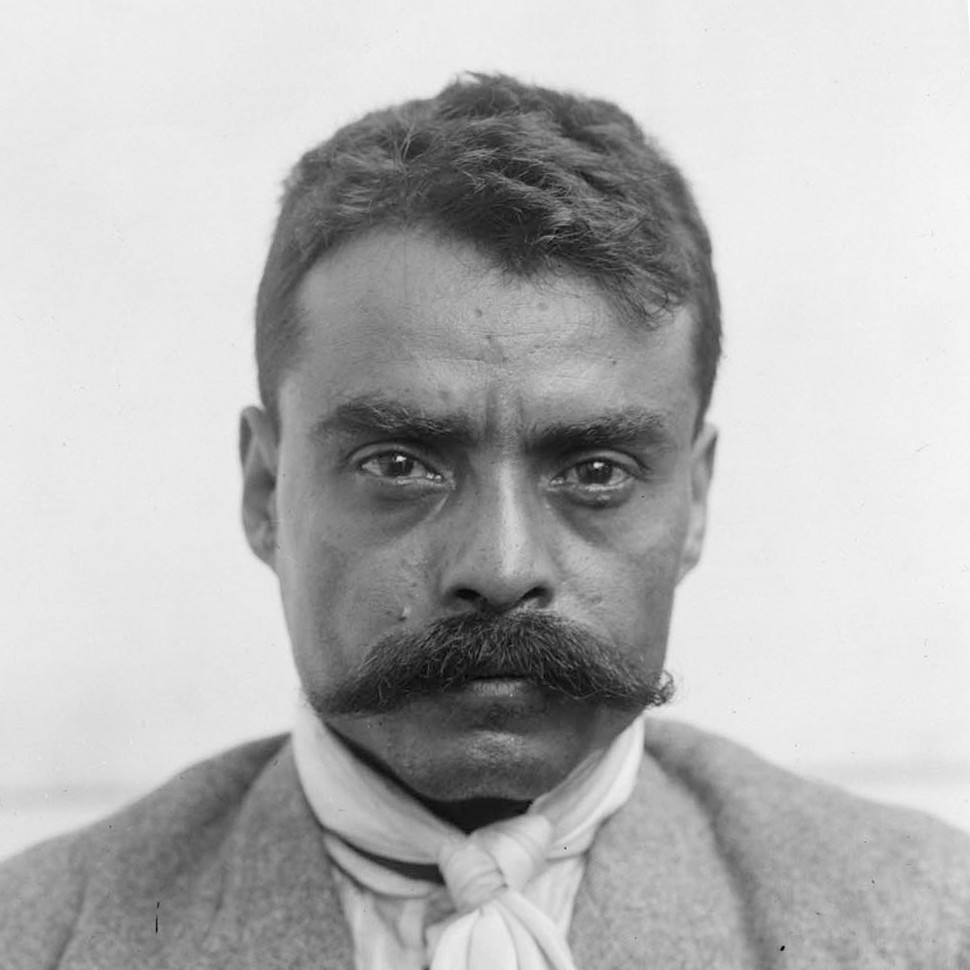
Nearly a decade after his assassination, John Dos Passos visits the Zapatista heartland of Morelos.
‘Zapata’s Ghost Walks’ by John Dos Passos from New Masses. Vol. 3 No. 5. September, 1927.
The State of Morelos (named after the revolutionary patriot, Jose Maria Morelos ) with a population of 160,500 and an area of 7,184 sq. kilom., is bounded on the North by the Federal District, on the West and Northwest and Southeast by the State of Mexico, on the East and Southeast by the State of Puebla and on the South and Southwest by Guerrero. Magnificent mountain chains cross the region, which is marked by tall peaks, deep valleys, gorges, waterfalls, luxuriant tropical vegetation, fine sugar-haciendas, Indian temples, towns and citadels…From Terry’s Mexico
The sun is hot and white on the dust of the market, on the small square awnings in the blue shade of which the Indian women, heavy as granite idols, squat behind minute piles of peppers or oranges or onions. There’s a heavy smell of fat from the pork crackling that seethes in a huge cauldron in front of the cantina. From inside, on the sour cool rankness comes an old man’s voice singing to a guitar. He is singing a corrido called The Ghost of Zapata. People stop talking when they hear the name of the song. Brown faces, yellow faces, are motionless under huge pushed back straw hats. This is Morelos where Zapata ruled.
Pero su alma persevere
en su ideal Libertador
y su horrenda calavera
anda en penas…oh terror…
You can hear the jingle of his spurs
his scaring voice once again
as teeth gritted in a curse he shouts
the orders to his men
and raising a limp hand in command
he leads a white and silent host
of dead men across the southern land
dead Zapata’s walking ghost.
This is Yautepec, blue, white, pink and lilac-splotched streets rambling among humped shiny mango trees. All the big houses have been burned or are falling to ruin. They keep sheep in the parlors of the old haciendados, chickens and turkeys go pecking between the tiles of abandoned courts, there are ducks setting in the counting houses where the overseers used to keep the accounts and figure out how much the peons owed the landlords. In a square where everyone walks round in the evening, you don’t see any foreign clothes, men wear white cotton suits like pyjamas, and broad petate hats, and girls dark shawls and full skirts.
One afternoon I climbed the hill. Two men were sitting at the foot of the cross. We stood smoking together and looked over the plain towards the huge barrier of reddish jagged hills that culminate to the northeast in the shadowy smoking peak of Popocatepetl. The fat man pointed out the churches and the abandoned sugar factories. “See, senor,” he said, “the green squares where there is cane planted, and the brown squares where there is none. In the old days it was all green. See those sheds, those are the mills where they crush the cane. There used to be eighteen in the district here and several refineries. Now they are all idle. There are no machinists to run them. The machines are all rusted. But then eleven men, Spaniards most of them at that, gachupines, maybe one or two were gringos, owned the whole state. “Well aren’t you better off without them?” “Quien sabe senor?” The man who was talking was a fat man in a threadbare khaki suit with bushy moustaches that had a melancholy droop to the tips. He addressed himself mostly to his friend, a little wiry coppercolored Indian with a few streaks of whisker at the corners of his mouth, who squatted on his heels and smiled and said nothing. The fat man was of a yellowish color and enjoyed talking.
“Hernan Cortes was a wise and great man, one of the ancients, the great conqueror,” he went on greasily. “When he came to Morelos he founded the first church and the first sugarmill side by side in Tlaltenango near Cuernavaca. Who knows, maybe he knew what he was doing.” The little Indian almost laid his hand on my knee, then he pointed with it to the town that shone in the dusk among the mango trees. “There was too much fighting here in the time of the Zapatistas, but now the priests have gone, the landowners have gone, the middlemen have gone, there are no bandits in the hills or in the cities, we are all united.” “United to starve,” said the fat man, “and the governor in Cuernavaca is a sinverguenza and the managers of the cooperatives were sinverguenzasy the next revolution will be against the sinverguenzas.” The little Indian looked up deferentially at his fat friend and smiled and said nothing.
That night I was sitting in the doorway of the hotel. There was an old brown man with a white beard with whom I had been dickering about the horse I was hiring in the morning. When we had settled about the horse he sat beside me and started talking. He jtalked so low into his beard I could not catch all he said. “‘Good Don Porfirio,’ they say, in the good old days…That is not true. Those days were very bad…good for the rich maybe, but there were very few rich men, in this town perhaps five or six and their families…For the poor…I had a wife and three children and suddenly they came and took me away. Nobody would say why, maybe it was all a mistake, because I have always been a quiet peaceful man. Maybe it was about a horse Don Abundio wanted to buy…I never knew. In the box car there were other poor people, old men and boys, some of them were criminals from the jail. We were shut up in the box car for days and days and then in the boat. I couldn’t eat or sleep thinking of my wife and the littlest child who was a little girl. I thought every day I was going to die. Then when we got to Yucatan we were marched many days across a trackless country with foul water to drink and those who got tired fell down and the wild Indians killed them, and every day I thought I was going to die…We stayed there for years building roads and every night they flogged someone. Then they told me to go home and I had to beg my way to Merida. My son who was already a grown man came and fetched me home. He found me sitting in the street in Merida. I didn’t know him because I had remembered him a little boy. You see they had sent me letters, but every time I tried to read the letters my eyes filled with tears so that I couldn’t read them.”
The state of Morelos is the great example for all the dollar-minded of the failure of the agrarian revolution. The sugar-landlords and their families have filled two continents with their lamentations over the ruin of its rich industries. They have formed an association and probably most of them live richly in Neuilly and on the Riviera; meanwhile their interests have fallen into the hands of three banks, the Banco de Londres y Mexico, the Banco Nacional de Mexico and the Banco Germanico de la America del Sur. These banks are constantly sponsoring projects to “put Morelos on its feet” and certainly their faces are not unknown in the various claims commissions that hover on the outskirts of Mexican politics always ready to back a revolution or hinder the operation of a useful reform. The government has tried to remedy the situation by promoting the culture of rice, as sugar is a crop that with the present market can only be grown under slave conditions. There are various “enlightened capitalist” projects in the air to reorganize the whole state on an industrial basis, of which the most favorably seen in Mexico City is that of the Honululu Ironworks Company to centralize irrigation and the refineries, at the same time leaving the land in the hands of the peasants. Naturally the land, without water or factories, won’t do the peasants much good, so they do not look with great enthusiasm at these foreign projects. Meanwhile, as in the bad times in the Bible, every man lives as best he can under his own vine and fig tree and is a law unto himself, and the state is bankrupt and the roads and ditches and towns are falling into weedy ruin, and the great hopes of Zapata and his men still stalk the land unappeased.
II. IN THE HILLS
It was sleeting in our faces as we crossed the last rocky gulch. Some cultivated land, a few trees, adobe cubes of houses, the top facade of a church hove in view on the soaring slope above us as we floundered through the slimy mud of the track. Broad-faced men standing in the lee of the low houses in the hardtrampled courtyards received us with shouts: “Viva los Agraristas, Viva Zapata” Antonio and his father and all his family came out and embraced us and made us sit in the house that was one long room with a broad bed of boards at one end and a sort of altar in front of the door. Outside the sleet had turned into a downpour and the young men were shooting off skyrockets into the rain.
A dozen people told us the story over bowls of warm pulque. The village from time immemorial had owned an ejido, a tract of surrounding land, part of it pasture, part of it worked in common by the families of the village that inherited its compactness from the Indian tribe that has some time settled it. In the days of the good Don Porfirio the owners of the neighboring ranch with the help of lawyers and gendarmes had gradually encroached on the village lands, first claiming the right to pasture and eventually forcing the villagers out entirely. They had to eat, so having no lands to work of their own they were forced to work for the ranch owners, who would so generously cede them the use of corn patches and advance them credit. So from free villagers they became in two generations peons. This until the “bandit” Zapata started riding through the south with the war cry of “Land, Water, Schools.” The Mexican owners of the ranch had long ago gambled it away to an absentee Spanish company. At the first ping of the bullets the overseers fled and the villagers quietly installed themselves in their birthright. Then divisions began within the village. The priest and a small group who had made a little money in towns or by dealing in cattle stood out against the rest of the village. They owned bits of communal land themselves and were quite content to let things ride as they were. The priest went off with documents stored in the church showing the ancient boundaries. The landless villagers sent delegations to the capital, received promises from one politico and the other, but as soon as the politicos were elected they were all for letting things ride. Meanwhile nothing was settled. Government engineers came and made surveys that somehow always came out in favor of the landowners who were working through a powerful lobby in Mexico City. Politicos came and went. Nobody had a clear title to the land so nobody dared work it. While the Indians stood guard with guns in their hands, the hard won fruits of the revolution were melting away behind their backs. There was little corn for the tortillas, beans were almost unknown; the young men were slipping away to the cities or taking up highway robbery. What were they to do? Now we had come, two men and a woman dressed in store clothes, speaking foreign languages, versed in the great movements all over the world, friendly with the Russians (in Morelos they called the Bolsheviks “the Zapatistas of the east”). Now we would help them; they were children lost in a lonely village in the mountains, far from roads and railroads and they wanted to feel they could work their land in safety, and they needed help.

The rain had stopped. They walked us up the hill through a scattering of houses to see a great cypress surrounded by a little fence that seemed to be the sacred tree of the village. Everyone spoke very respectfully of it as if it were a person; at Christmas they celebrated the nativity of Christ in the little wellswept enclosure round the trunk. They showed us from a distance the Church and the priests’ house and the houses of the enemies, as they called the small landowner faction. “I bet they’re looking out of the doors wondering what we’re doing with visitors from the capital,” said Antonio, and gave out a tremendous shout of “Viva los agraristas, viva los communistas.” As we were winding down the little lane again we had a scare. A party of men with guns came striding towards us out of the hilly pastureland. The boys didn’t set off any more rockets, everyone was quiet until they came within hail. Then the strangers shot their guns in the air and let out a great cry of “Viva Zapata”, they were gararistas from the next village. At the shout all tension vanished. The men of Amonalco were not alone any more. In hundreds of villages they had brothers who stirred to the same cry, men who dressed, starved and drank pulque the way they did. Their leader was dead, but his name had power to bind and to loose.
What they lacked, the old men said as they all crowded back together into the house, was a leader, a leader who thought and lived as a countryman. They were tired of trusting engineers and surveyors and lawyers, men in black suits and Stetson hats, from the capital. They were very disappointed next day when we started on our walk back into the Valley. They had hoped we would stay and help them with advice and counteract the wiles of the surveyor who was at that moment trying to whittle down the size of the ejido. The communist said he would send them back comrades to advise them. “Viva los communistas” they cried. We left them at the edge of the glen, a little group of men in white cotton suits, uneasy, hungry, leaderless, isolated, a fragment of a defeated nation, standing blinking, dazed in the light like a man just broken out of jail. When the Carranzistas killed Zapata they thought the agrarian movement was dead; his ghost walks uneasily and until it is laid Mexican politics will be perpetually unstable. Insofar as the Calles government has worked out this problem, it has a united country behind it. The redistribution of land cannot be finished in a month or a year, and until it is finished there is always danger that something will upset the hard won equilibrium.
But his soul still perseveres
in the will to liberate
and his skull goes out in tears
his dead bones walk…
The New Masses was the continuation of Workers Monthly which began publishing in 1924 as a merger of the ‘Liberator’, the Trade Union Educational League magazine ‘Labor Herald’, and Friends of Soviet Russia’s monthly ‘Soviet Russia Pictorial’ as an explicitly Communist Party publication, but drawing in a wide range of contributors and sympathizers. In 1927 Workers Monthly ceased and The New Masses began. A major left cultural magazine of the late 1920s to early 1940s, the early editors of The New Masses included Hugo Gellert, John F. Sloan, Max Eastman, Mike Gold, and Joseph Freeman. Writers included William Carlos Williams, Theodore Dreiser, John Dos Passos, Upton Sinclair, Richard Wright, Ralph Ellison, Dorothy Parker, Dorothy Day, John Breecher, Langston Hughes, Eugene O’Neill, Rex Stout and Ernest Hemingway, Artists included Hugo Gellert, Stuart Davis, Boardman Robinson, Wanda Gag, William Gropper and Otto Soglow. Over time, the New Masses became narrower politically and more journalistic in its tone.
PDF of full issue: https://www.marxists.org/history/usa/pubs/new-masses/1927/v03n05-sep-1927-New-Masses.pdf
 Revolution's Newsstand