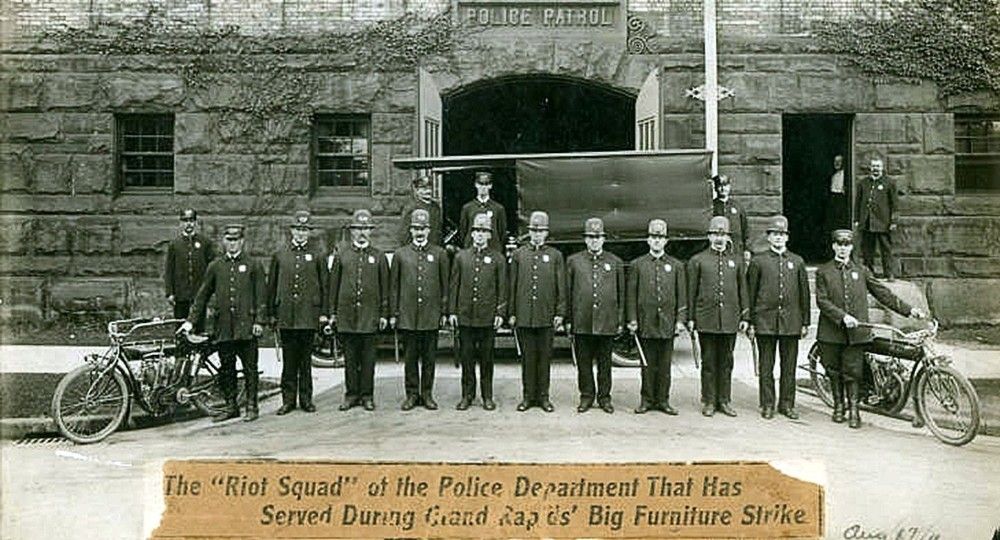
The limits of a craft union strike in the church-going, home-owning Dutch Calvinist community of Grand Rapids are reached when the bosses get their injunction.
‘”Riot” in Grand Rapids Furniture Strike’ by O.L. Wakeup from Solidarity. Vol. 2 No. 24. May 27, 1911.
Grand Rapids, Mich., May 17. The “injunction” stage in the furniture workers’ strike has been reached. On Wednesday, May 17, 34 manufacturers representing the furniture manufacturers’ association “prayed” for an injunction against the various unions directly engaged in the strike, the Trades and Labor Council and various individuals named and unnamed. Judge McDonald granted a temporary injunction restraining all the various unions and individuals from picketing for the purpose of “intimidating, coercing or persuading” persons who desire to and are anxious and willing to exercise their “right” of “freedom of contract” to go to work for whom and when and where they (the intimidated, coerced, or persuaded) “please.”
The “prayers” also relate that the pickets and others are a menace to their property, and cite 40 cases of overt acts done against property and person. The hearing to make the injunction permanent will come off next week and the craft unions will go through the regular craft tactics when “coping” with this capitalist instrument. They will endeavor, no doubt, to have the injunction so modified that picketing will not be entirely prohibited, but the pickets will not be allowed to place their hand or hands upon any person, nor persist in speaking to those who object to being spoken to. Possibly they will only be allowed to go within a certain distance of the factories, in short picketing may be permitted in a very much emasculated form. Anyway, the form of picketing practiced by craft unions doesn’t amount to much. Then again, the leaders in this strike set up the claims that picketing should not be prohibited entirely because the pickets are placed around factories, not for the purpose of intimidating workers who desire and are anxious to exercise their “freedom,” but almost solely for the purpose of protecting the bosses’ property and maintaining “law and order;” to see that the strikers and sympathizers obey and keep inviolate the laws of the state and city.
There is only one way to do with an injunction. If all the workers on strike and all other craft unionists who are not on strike would, by mass action, violate this injunction, what a hell of a time the city of G.R. would have on its hands. By the “city” of course I mean the masters of the bread who own the burg, and the petty traders who think they own it.
Oh my, how the cockroach taxpayers would weep and moan at the cost of taking care of from 5,000 to 12,000 workers who were willing to board at the expense of the patriots. Where would they put us? Let the authorities worry about that.
But they needn’t worry; I won’t have to record any such happening. The craft unions are running this strike; not the I.W.W. Let the crafters run it without interference; then they will not be able to use the I.W.W. for a hook to hang the inevitable craft defeat or setback on. The injunction proceedings were brought to a head by an infant “riot” which occurred Monday evening at the Widdicomb Furniture Company’s plant. It is alleged that a crowd of about 1,000 persons, the large majority of whom were the women and children of strikers and sympathizers, had assembled at the place. Many of the women carried babies in their arms, and the fighting that ensued was led by the women. The “rioters” were for the most part Polish and Lithuanian workers, who live in the vicinity immediately accent to the factories. Several men had been working in the plant; they have been going to and fro from the slave pen in the boss’ automobile. ‘Tis great to be a scab!
On Monday the large crowd gathered, as it has been doing since the inception of the strike, to watch the “heroes” as they came from the factory. It is claimed that as soon as the automobile containing the scabs appeared it was the signal for a volley of stones from the assembled spectators. A policeman then grabbed a man and started to rush the worker toward the factory office when, it is alleged, some stones were thrown at him. Then the brave minions of the law faced the women and children, many of whom, as stated above, held infants in their arms, and the few men, with drawn revolvers and fired, it is said, in the air. One woman is reported to have called on the crowd to take their fellow worker away from the cop and the bunch is said to have gone to it. Reinforcements arrived to assist the police and strike pickets in maintaining order. The police got hold of several men, but the crowd took them away. Then the police, when they got hold of men “rioters,” beat them into insensibility and, as the capitalist papers relate, “they were loaded into autos (employers) battered and bleeding and taken to police headquarters.”
The fire department sent a company to the scene and turned a stream of water on the crowd who dispersed for a time, but soon reassembled. Mayor Ellis appeared on the scene and addressed the crowd from the steps of an auto. He requested the crowd to disperse. He appealed to their “patriotism” and “civic pride.” The crowd cheered the mayor, but remained on the job.
As far as can be learned, four men were beaten up by the police; three policemen were put out of commission by being hit by stones, but up to date not one death has occurred a result of the “riot,” notwithstanding the lying statements of Hearst’s Chicago American scab “union” sheet. Of course the “riot” was played up big by the local capitalist sheets, but the interests of “our” city must not be jeopardized by distorting the “riot” too much; of course had it occurred in some other city the accounts printed here would not have been nearly so conservative.
Any person, especially a wage slave, who swallows whole what capitalist papers publish, particularly in regard to labor troubles, is one easy sucker. Say slave, build up your own press and let the capitalist class and its retainers support the capitalist press.
Several workers were placed under arrest charged with “assault with intent to do great bodily harm less than the crime of murder.” Their trials have been set for the latter part of the month and bail placed at $1,000. Whether the unions have come to the aid of these fellow workers I do not know. Another result of the “riot” is the swearing in of 120 extra policemen, and on the advice of the capitalist papers and the labor leaders, with a few exceptions these extra cops are strikers. These strikers will help “preserve order” and place under arrest any of their fellow workers who “violate the law.” They are under orders of the police department now and not the labor leaders. Some of the craft unions seem to think this is a master stroke in strategy. It might be under certain conditions. For instance, an I.W.W policeman would put the boss under arrest, but never a fellow worker.
This riot was the result of craft tactics. “Wait and starve!” The one idea of the crafter is to keep the plant tied-up. The leaders incessantly pound this into the strikers. “If we can keep the plant tied-up we will win”; that is heard on all sides. Well, these “rioters” saw men going to and from work, and they reasoned that that sort of business was not keeping the plant “tied up.” The pickets did not seem able to do the job. These women and children saw day after day pass and no headway seemed to be gained. They saw these men working and their husbands and fathers idle. So they proceeded, in their way, to put the great principle of the crafters into effect, that is, “Keep the plant tied up.”
The “riot” and its results are due to craft union “tactics,” notwithstanding the loud wailing by the “great” labor leaders whose high salaries are paid them, win or lose.
Two factories have made terms since my last letter. They are the Fritz Manufacturing Co., which grants the nine hour day and a ten per cent increase over present wages. The Nochtegall Manufacturing Co. “gives” the nine hour day with “ten hours” pay. In both cases signed agreements have been waived by the unions. The reason the sacred contract has not been entered into in these cases is not because the crafters are going back on the holy instrument; not because they are beginning to realize that if they have the power to compel the boss to sign a sacred contract, they do not need that holy of holies. Not at all. The reason why the crafters waived the agreement was because these two concerns positively declined to enter into other than a verbal agreement and they also made their own terms. Evidently the employers in this instance exercised the most power. It is also apparent that the leaders are willing to accept any old terms in order to get the strikers back on the job. In fact, MacFarlane is reported as saying, more than once, that “any reasonable concessions” would be accepted.
The Grand Rapids Show Case Co. placed an advertisement in all capitalist papers stating that there was work for 150 of their old employes, or any other competent workers, but they preferred the old hands. There was not work for all the old men, as the company had sublet all the contracts on hand to outside parties; had done this to great advantage in every way and been relieved of the responsibility in getting out the work. How many other concerns have done this is not known, but others may have protected themselves in like manner. And who knows but what these very contracts are being put out by good union men in other parts of the country who at the same time may be contributing financially and “morally” through their local unions toward winning this strike.
As some sentimental “sociologist” who composes slobbery slush on the “labor problem,” might say: “It is a complex situation.” Indeed, ’tis so. Craft tactics are “grate.”
O.L. WAKEUP.
The most widely read of I.W.W. newspapers, Solidarity was published by the Industrial Workers of the World from 1909 until 1917. First produced in New Castle, Pennsylvania, and born during the McKees Rocks strike, Solidarity later moved to Cleveland, Ohio until 1917 then spent its last months in Chicago. With a circulation of around 12,000 and a readership many times that, Solidarity was instrumental in defining the Wobbly world-view at the height of their influence in the working class. It was edited over its life by A.M. Stirton, H.A. Goff, Ben H. Williams, Ralph Chaplin who also provided much of the paper’s color, and others. Like nearly all the left press it fell victim to federal repression in 1917.
PDF of full issue: https://revolutionsnewsstand.com/2025/08/28/only-hunkies-by-louis-duchez-from-solidarity-vol-1-no-39-september-10-1910/
 Revolution's Newsstand