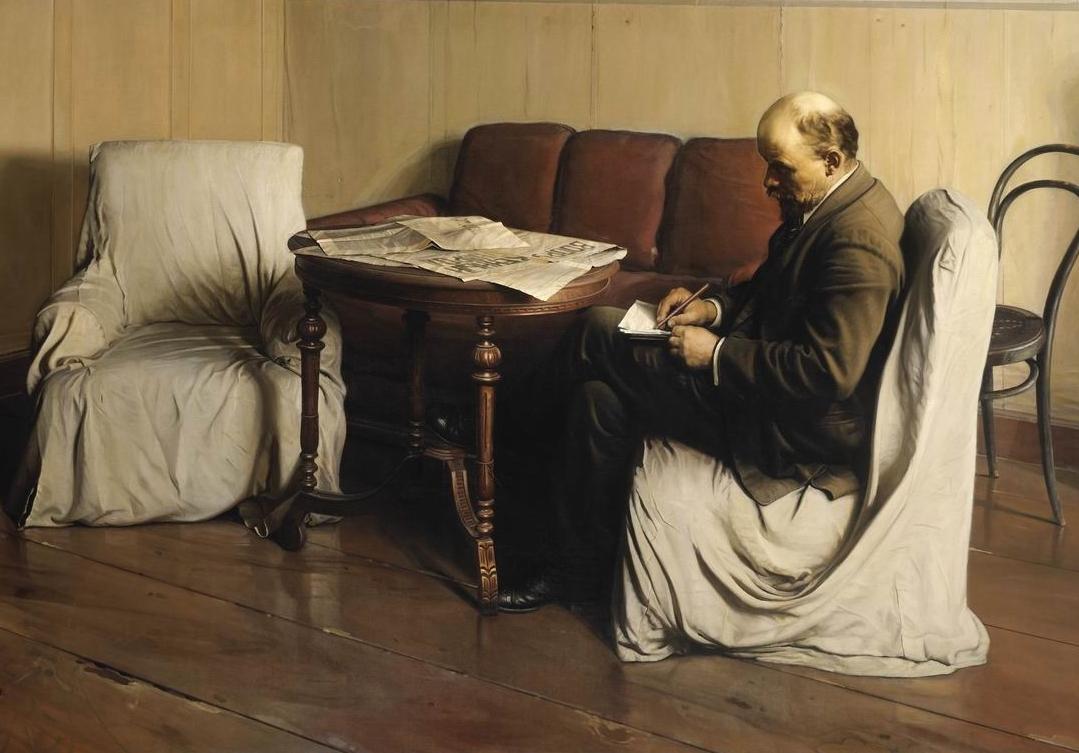
The original English translation of Lenin’s opening speech given to the Communist Party’s Tenth Congress in March, 1921 in which he speaks of the errors and mistakes made since the Revolution as well as the new period faced at the end of the Civil War. The gathering marked a turning point–coming after the defeat of the Red Army in front of Warsaw and after the contentious debate on trade unions, the congress introduced the New Economic Policy and placed a virtual ban on factions. As the congress was underway both Germany’s ‘March Action’ and the Kronstadt Rebellion broke out.
‘Address to the Communist Party‘ by V.I. Lenin from Soviet Russia (New York). Vol. 4 No. 19. May 7, 1921.
(The following salient portions of Lenin’s opening address to the Tenth Congress of the Russian Communist Party are taken from the March 15 issue of the “Russian Press Review.” After the speeches of the fraternal Delegates and the election of the Presidium at the first meeting of the Congress, Lenin made this report on the political activities of the Central Committee.)
Comrades, in my opinion the most important question of the day deserving our closest attention is that of the transition from war to peace. Probably all of you, or at least most of you, will remember that we have attempted this transition several times during the last three and a half years, but at no time did we complete it because the vital interests of international capitalism are bound up with our failure. I remember that in April 1918, three years ago, I had occasion to speak at the All-Russian Central Executive Committee on the tasks confronting us then as if the civil war had practically come to an end, when, as a matter of fact, it had only just begun. You will all remember that at the last Party Conference, we based all our calculations on this transition to peaceful construction, assuming that the enormous concessions that we made would secure peace. But in that very April the Polish bourgeoisie, in conjunction with imperialist and capitalist countries, interpreting our desire for peace as a sign of weakness, commenced their offensive; for which, however, they had to pay very dear, in that they had to accept a less advantageous peace than if they had accepted our earlier proposals. We, however, did not secure the possibility of turning to peaceful construction and we again had to concentrate our attention on the war with Poland and the subsequent liquidation of Wrangel. This is what our work for the past year consisted of. Again the whole of our work was devoted to the task of war.
The transition from war to peace began again when we had succeeded in clearing every single soldier of hostile armies from the territory of die Soviet Republic. This transition caused a shock the full effects of which we have not yet calculated.
The Difficulties of Demobilization
The demobilization of the army, which carried with it untold difficulties, has raised problems which are considerably underestimated. Here to a very large degree are the sources of the economic and social crises. At the end of last year, I already had occasion to point out that one of the greatest difficulties that would confront us in the spring would be in connection with demobilization. I must say that at that time we hardly realized the full extent of these difficulties. We did not yet see to what extent the misfortune which had already fallen upon the country during the previous imperialist war and later during the civil war, would tell during the demobilizaiton. The country for several years concentrated its efforts exclusively upon war and sacrificed everything for it, and only now, at the conclusion of the war, do we see the real extent of poverty and ruin which will compel us for a long period to devote our energies merely to the healing of our wounds.
The Central Committee undoubtedly erred in not correctly estimating the difficulties of demobilization, but it must be said that there was no basis for calculation, for the civil war was so difficult that the only rule was “all for victory on the civil war front” Only by the observation of the incredible concentration of effort which the Red Army displayed in the struggle with Kolchak, Yudenich and others, could we have achieved the victory over the invading imperialists.
Errors in Calculation
From this basic fact which determines a number of other errors in the growing crises, I would like to pass over to the fact that in the work of the Party there were revealed a number of other instances of inappropriate and incorrect calculations and plans. Let us summarize our experiences in such varying fields as the progress of our Polish war and questions of food and fuel.
There is no question that we erred in our too rapid advance on Warsaw. I shall not discuss at this moment whether this was a strategical or a political error. That would involve us in a too long discussion. In any case there was an error, which arose from our overestimating the superiority of our forces. To what extent tais superiority of forces depended on economic conditions, or on the fact that the Polish war aroused the patriotism of even the petty bourgeois elements who do not sympathize with communism and certainly do not support the dictatorship of the proletariat, is a question too complicated to be discussed now. The fact is that we committed errors in the Polish war.
If we take such a sphere of work as food, we will see here analogous errors. With regard to the com requisitions and the gathering of the com levies, last year was much more successful than the previous year. Last year the amount of com gathered reached 250 million poods. Up to February 1st it was calculated that we had gathered 235 million poods, when for the whole of the previous year we gathered 210 million poods, which means that for a much shorter period we exceeded the amount of com gathered for the whole of the previous year. It turned out, however, that of these 235 million poods, 155 million poods were used up in the first half of the year, that is, on an average of 25 million poods a month. Generally we have to confess that we were not able properly to distribute our resources even when they proved to be better than those of the previous year. We were unable to estimate correctly the extent of the approaching spring crisis and yielded naturally to the desire to increase the rations to the hungry workers.
It must be said, however, that even here we had no proper basis for calculation. In all capitalist states, in spite of the anarchy, in spite of the chaos peculiar to capitalism, there is a basis for calculation in the decades of experience by which the capitalist states, similar in their economic construction and varying only in details, can be guided. The investigation and comparison of experiences reveals an actual scientific law. We did not have and could not have such a basis for our calculations and naturally, as soon as we were able to give the hungry workers an increase of food, we were not able to establish the proper scale. It is clear that we should have only moderately increased the rations and should have stored up a reserve for the rainy day that would and did come in the spring. This was an error, the kind of error that is peculiar to all our work, an error which shows that the transition from war to peace would create difficult problems, for the overcoming of which we had neither the experience, nor material to go upon. As a result the crisis became more acute.
Something analogous took place with regard to fuel. This is the fundamental question of our economic policy. The transition from peace to war, that transition and economic construction about which we spoke at the previous conference of the party and which comprised the main part of our work during the preceding year, could only be based upon the supply and proper distribution of fuel. Without that there can be no talk of overcoming difficulties or of re-establishing industry. That conditions in this connection were better this year than last there is no doubt. Previously we had been cut off from the oil and coal regions. After the victory of the Red Army we secured oil and coal. At all events the extent of our fuel resources has increased. We know that the fuel resources at our disposal were greater this year than last. But on the basis of this increase we committed an error in consuming fuel to such an extent that we exhausted our fuel reserves.
From what we have experienced we should say that all these errors are connected with our rapid transition from war to peace. It turned out that this transition is a much slower process than we imagined. A much greater preparation was required and a much slower pace.
The crisis was undoubtedly rendered more acute by the failure of the harvest. I have pointed out that our work in the food department during last year gave us incomparably larger stocks than the previous year. But this in fact was one of the chief causes of the crisis, because, owing to the poor crops, and the shortage of fodder, which in its turn caused a great mortality among cattle and a deterioration of stock, the food requisition was concentrated in those places where the reserves of grain were not large. These reserves were largest in the various border republics, in Siberia and North Caucasus. But it is precisely in those places that the Soviet apparatus works less smoothly, since the Soviet power is there less stable and transport is very difficult. It follows therefore that we secured an increase of our food stocks from those districts which had suffered from bad harvests and this aggravated the agricultural crisis. Here again we see that we made no proper calculations. But, on the other hand, we were in such a difficult position that we had no choice. A country which had gone through such a destructive imperialist war and a prolonged civil war could not have acted otherwise than to take the food stocks from the peasantry, even without giving them compensation in any form. We said to the peasants “Of course you are lending your grain to the Workers’ and Peasants State, but you have no other way of saving your State from the landlords and capitalists.” We could not have acted otherwise under the conditions which the capitalists and imperialists imposed upon us by their war. But the prolongation of the war led to such a deterioration of our agriculture that the bad harvest was caused by the decreased area cultivated, the diminished means of production, lessened fertility, and reduction of labor power etc. The failure of the harvest was tremendous, but it was better than we expected. The gathering of the food, however, was accompanied by an acute crisis. We must carefully examine this circumstance in analyzing our experiences of the past year and the political tasks we should undertake in the new year.
The Prospects of International Revolution Help from the Western European countries is coming. It is not coming as fast as we should like, but it is undoubtedly coming. I have already said that one of the greatest factors of the preceding period was the Second Congress of the Communist International. In comparison with last year, the international revolution has made considerable progress. Certainly the Communist International which at the time of last year’s congress existed only in the form of proclamations has now begun to act as an independent body in every country, and as more than merely a vanguard party. Communism has become the central question of the whole labor movement. In Germany, France and Italy, the Communist International has become the centre not only of the labor movement, but of the whole political life of the country. It was impossible to pick up a German or French newspaper last autumn without seeing discussions on Moscow and the Bolsheviks, and how the twenty one conditions of entry into the Third International had become the central question of the political life of those countries. This is our gain of which no one can deprive us. The international revolution is growing with the increasing acuteness of the economic crisis in Europe. But if we were to suggest that in a short time help is coming from that quarter in the shape of a proletarian revolution, we should be mad, and I am sure that nobody in this hall would make such a suggestion. We have learned to understand during the last three years that basing ourselves on an international revolution does not mean calculating on a definite date, and that the increasing rapidity of development may bring a revolution in the spring, or it may not. For that reason we must base our activities with regard to class relations in our country and in other countries, so as to retain the dictatorship of the proletariat for a prolonged period and to extricate ourselves if only gradually from the misfortunes and crises which have come upon us. Only such an attitude can be sensible and correct.
Foreign Relations and Concessions
I will now deal with the question of foreign relations. Up to the Ninth Congress of the Party all our attention and all our efforts were directed towards securing a transition from a state of war with the capitalist countries to relations of peace and trade. For that purpose we took various diplomatic steps and proved victorious against undoubtedly great diplomats. When, for example, the representatives of America or of the League of Nations proposed that we should on certain conditions cease military operations against Denikin and Kolchak, they thought they would place us into a difficult situation. They were outwitted, however, and were compelled to withdraw their conditions, a fact which was later exposed in the diplomatic literature and the press of the whole world. But we could not be satisfied merely with diplomatic victories. We must have real trade relations. But only during last year did things approach a point where commercial relations were beginning to some extent to develop. The question of trade relations with England arose, but the war with Poland set us back considerably. England was prepared to sign a trade agreement. The British bourgeoisie desired this agreement, but English government circles were opposed to it and hampered it. The war with Poland postponed the agreement with the result that the question has not yet been settled.
In this connection there is the question of concessions. During the past year we devoted more attention to this question than previously. On November 23, a decree was published by the Council of People’s Commissaries dealing with the question of concessions in a form most acceptable to foreign capitalists. By this decree we advanced towards establishing concessionary relations. The majority of the Central Committee accepted the necessity of these concessions and we will ask you to strengthen it by your authority. This is necessary because we are unable by our own efforts to re-establish our ruined industry, without equipment and technical assistance from abroad. The mere importation of this equipment is not sufficient. We can give concessions on a much wider basis in order to secure for ourselves the installation of equipment according to the last word in technique. In this manner we may be able to catch up to some extent at least with the modern syndicates of other countries. No one who soberly examines our present position can doubt that without this we will find ourselves in a very difficult position, and without the application of all our resources, we cannot make headway. Negotiations with some of the largest trusts have already been commenced. Of course these trusts on their part are not merely rendering us a service. They are doing this only for the sake of colossal profits. Modern capitalism is not like the capitalism of the previous normal periods. It makes hundred per cent profits by taking advantage of its monopolist position in the world market. Of course we shall have to pay very dearly. But we must improve our technique.
On February 1, 1921, the Council of People’s Commissars decided to purchase abroad 18,500,000 poods of coal, and at that time our fuel crisis was already looming. We shall have to make even greater concessions for the purchase of articles used by the peasantry.
The Proletariat and the Peasantry
We must realize that in these critical conditions we cannot do otherwise than to appeal to the peasantry to help the cities and the villages. We must remember that the bourgeoisie is making efforts to arouse the peasantry against the workers. Here we are facing political difficulties requiring that the ruling Communist Party and the leading elements of the proletariat should take the proper course.
We must consider the economic questions involved. What is the meaning of the slogan of “free trade” advanced by the petty-bourgeois elements? It shows that there are some difficulties in the relations between the proletariat and the small farmer which we have not yet overcome. I refer to the attitude of the proletariat to the small property-holders in a country where the proletariat has been victorious and the proletarian revolution is developing but where the proletariat makes up the minority of the population and the majority is made up of petty-bourgeois elements. In such a country the proletariat must lead the transition of these petty property holders into collective and communist labor. This is theoretically beyond any dispute, and on this we based a number of our legislative acts. But we know that legislation is not sufficient, that only actual achievements count and that these achievements cannot be secured unless we have industry operating on a large scale and unless industry affords the small producer such advantages as would make him realize its advantages over small individual production.
This is the position which all Marxians and Socialists always occupied in dealing with the Social Revolution and the problems advanced by it. The feature which is peculiar to Russia in the highest degree is that we have here a proletariat making up the minority, and a considerable minority at that, of the population, while the overwhelming majority consists of the peasantry. Besides, the conditions under which we had to defend our revolution were of such a nature as to make the solution of our problems extremely difficult. We were not in a position to demonstrate the advantages of large industry, for that industry was ruined and dragging out a very precarious existence, and could not be reconstructed without imposing various sacrifices on these very farmers. We must increase production and so we need fuel, but for fuel we must resort to wood, and that means that we must count upon the peasant’s horse. In critical times when there is a shortage of fodder resulting in diminution of cattle, the peasant is compelled to render assistance to the Soviet Government for the sake of that large industry which as yet has given him nothing. This is the source of the economic difficulties we are in, and this is what compels us to give careful consideration to the transition from war to peace. During the war we had to say to the peasant: “You must lend your own grain to the Workers’ and Peasants’ Government in order to enable it to extricate itself from the difficult position.” Now in directing all our attention to work of reconstruction, we must bear in mind that we have to deal with the small farmer, the small property owner, the small producer, who is working for the market, and will continue to do so until large industry has been established and has achieved a complete victory. But this triumph of large industry is impossible on the old basis. This is a matter which will take a decade, and, considering our lack of economic cohesion, perhaps even more. Until that time we will have to do business with this small producer as such, and the slogan of free trade will inevitably come to the front. Prompted by these considerations the Central Committee decided to open a discussion on the question of replacing the grain requisitions by a definite tax, and to place the question before the Congress today for your approval.
Grain Tax or Requisition
The question of tax or requisition came up in our legislation as early as the end of 1918. The tax law of October 30th, 1918, imposed upon the peasants a tax in kind, which, however, was not carried out. The law was accompanied by a number of instructions but it was not applied. The conditions of war made it imperative that we take from the peasant all they could spare; but this measure is not at all suitable to peaceful conditions of agriculture. The peasant must have assurance that after having delivered a certain amount of grain to the State, he will have the rest left for his own household needs.
The whole of our industry was dominated by the conditions of war. We had to undertake the collection of a definite quantity of food without taking into consideration the effect it might have upon our industry as a whole. Now that we are going over from war to peace we begin to regard the tax in kind differently. We regard it now not only from the point of view of maintaining the State, but also from the point of view of the security of the small farmers. We must strive to do the utmost in this direction. This is the most important question for us. We must give the peasant the possibility of a certain freedom in local trade, replace requisitions by a tax, in order that the peasant may be better able to calculate his output in accordance with the tax. Of course, amidst the conditions which surround us, this is very difficult to realize, but we make the maximum of concessions to provide the small producer with the opportunity of exerting his energy. Up to now we adapted ourselves to conditions of war, now we have to adapt ourselves to conditions of peace. This question came up before the Central Committee, and is closely connected with that of concessions, it is the question of going over to a tax in kind under proletarian government. The proletarian government, by means of concessions, may secure for itself relations with the capitalist governments of the advanced countries. The improvement of our industry depends upon these relations, without which we will not be able to proceed along the path towards communism. On the other hand, in the transitional period, in a country with a predominance of peasantry we must be able to give the maximum of assistance to the peasantry. We must allow them the greatest possible freedom to carry on cultivation. Our revolution is surrounded by capitalist countries. As long as we are in that position we are compelled to devise extremely complicated forms of mutual relations. Crushed by the war, we could not concentrate our attention on establishing economic relations between the proletarian State, which has in its hands a large scale industry in this ruined condition, and the small farmers, who as long as they remain what they are, cannot exist without a certain amount of trade. I consider this one of the most important questions of economics and politics for the Soviet Government at the present moment. I consider that this question politically sums up our work from the time we concluded the war period and went over last year to a state of peace. This period is so full of difficulties; it shows up so clearly the petty-bourgeois element that we must examine it soberly. We regard all these events from the point of view of the class struggle. We are not mistaken with regard to the relations between the proletariat and the petty bourgeoisie–a most difficult question, which demands complicated measures in order to secure the victory of the proletariat, or to be more correct, a whole system of complicated transitional measures. The fact that at the end of 1918 we issued a decree on a tax in kind shows that this is a matter that engages the minds of Communists, but that owing to the war we were not able to carry it out. Under the condition of war we had to resort to war measures, but we would be committing a great error if we drew the conclusion that only such measures are possible. In the transition from war to peace amidst conditions of economic crisis, we must remember that it is easier to carry out the work of constructing a proletarian state in a country with a large production than in a country where small production prevails. We must recognize the necessity for concessions, for buying machinery and appliances for agriculture in order that, in exchanging them for grain, we may establish such relations between the proletariat and the peasantry as will secure their support in peace conditions.
Soviet Russia began in the summer of 1919, published by the Bureau of Information of Soviet Russia and replaced The Weekly Bulletin of the Bureau of Information of Soviet Russia. In lieu of an Embassy the Russian Soviet Government Bureau was the official voice of the Soviets in the US. Soviet Russia was published as the official organ of the RSGB until February 1922 when Soviet Russia became to the official organ of The Friends of Soviet Russia, becoming Soviet Russia Pictorial in 1923. There is no better US-published source for information on the Soviet state at this time, and includes official statements, articles by prominent Bolsheviks, data on the Soviet economy, weekly reports on the wars for survival the Soviets were engaged in, as well as efforts to in the US to lift the blockade and begin trade with the emerging Soviet Union.
PDF of full issue: https://www.marxists.org/history/usa/pubs/srp/v4-5-soviet-russia%20Jan-Dec%201921.pdf
 Revolution's Newsstand