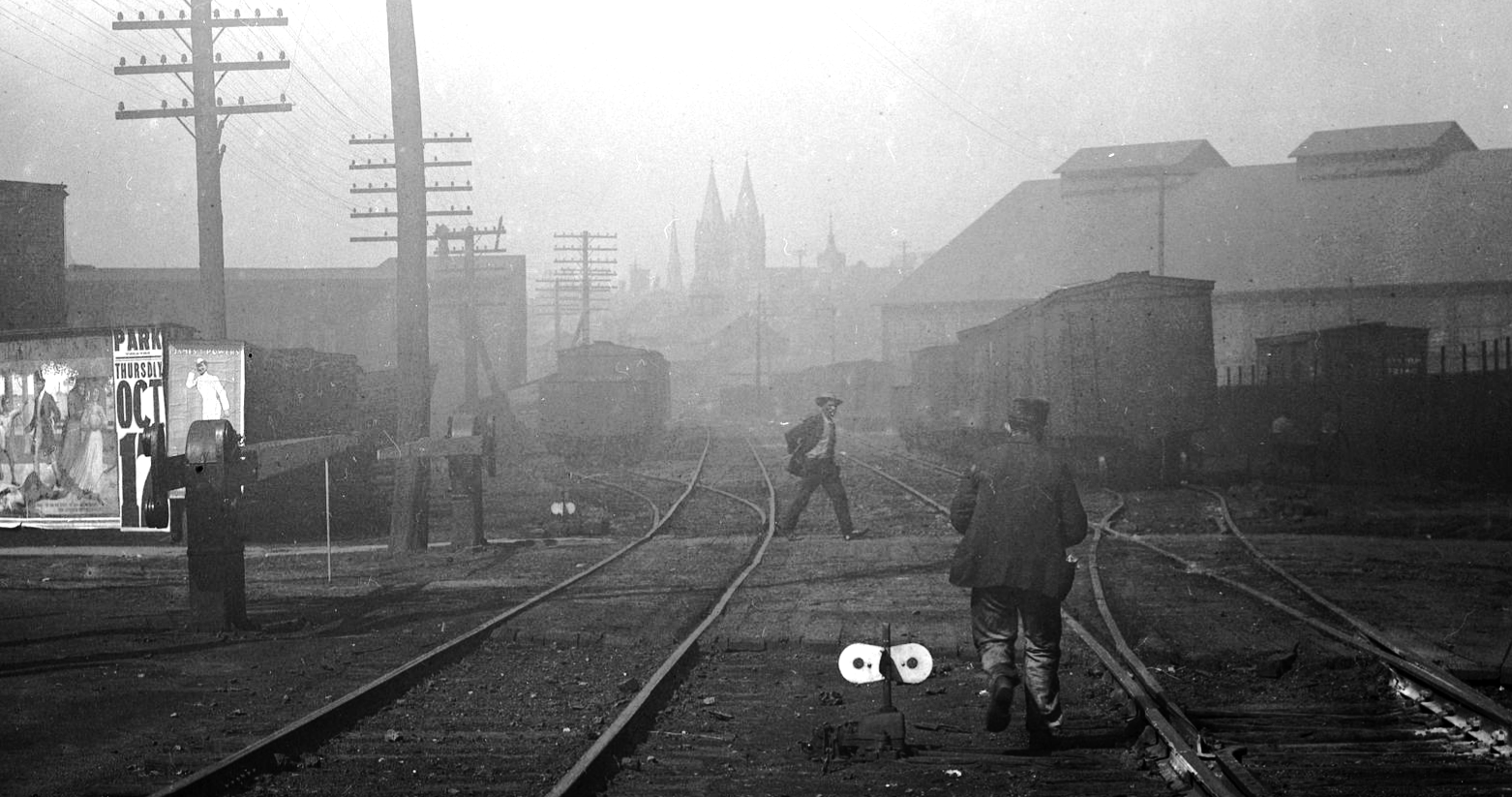
Justus Ebert brings the proletarian perspective to this fantastic social tour through Youngstown, Ohio–“a hell worse than Pittsburgh.”
‘Pittsburgh’s Industrial Rival—Youngstown Impressions’ by Justus Ebert from Solidarity. Vol. 7 No. 345. August 19, 1916.
“A worse hell than Pittsburgh”–in this short, crisp phrase a workingman at Youngstown, O., described the latter city. This description is sustained by some impressions of the place made in a fleeting visit to the vicinity.
Nature originally bestowed great beauty on the Mahoning Valley, of which Youngstown is the industrial centre. Wooded hills, stratified bluffs winding rivers and picturesque flatlands, were its original endowment, as is still apparent. Now, at East Youngstown, Youngstown and Girard, extensive iron and steel works crowd the area and mar the landscape. Rows of tall, tubular smoke stacks, blast furnaces and rolling mills rise up out of the lowlands. Railroad tracks, crowded with cars, flank them in deep rows or interline them with arteries of transportation. The sun shines through a murky atmosphere. Blue skies are obscured by heavy clouds of black smoke. The natural watershed is a foul sewer. Vegetation is blighted. And the song of birds has given way to a veritable din–a noise of banging cars, pounding hammers, swinging cranes, the thud of dropping iron, the clanking of metal, the whirring and droning of electricity, the wheezing, puffing, whistling, jetting and spurting of steam–a crunching, crashing, groaning, shrieking uproar. “A great iron and steel center,” as hard and as murderous as both of its products and pressing close on its foremost rival for renown as the leading industrial inferno.
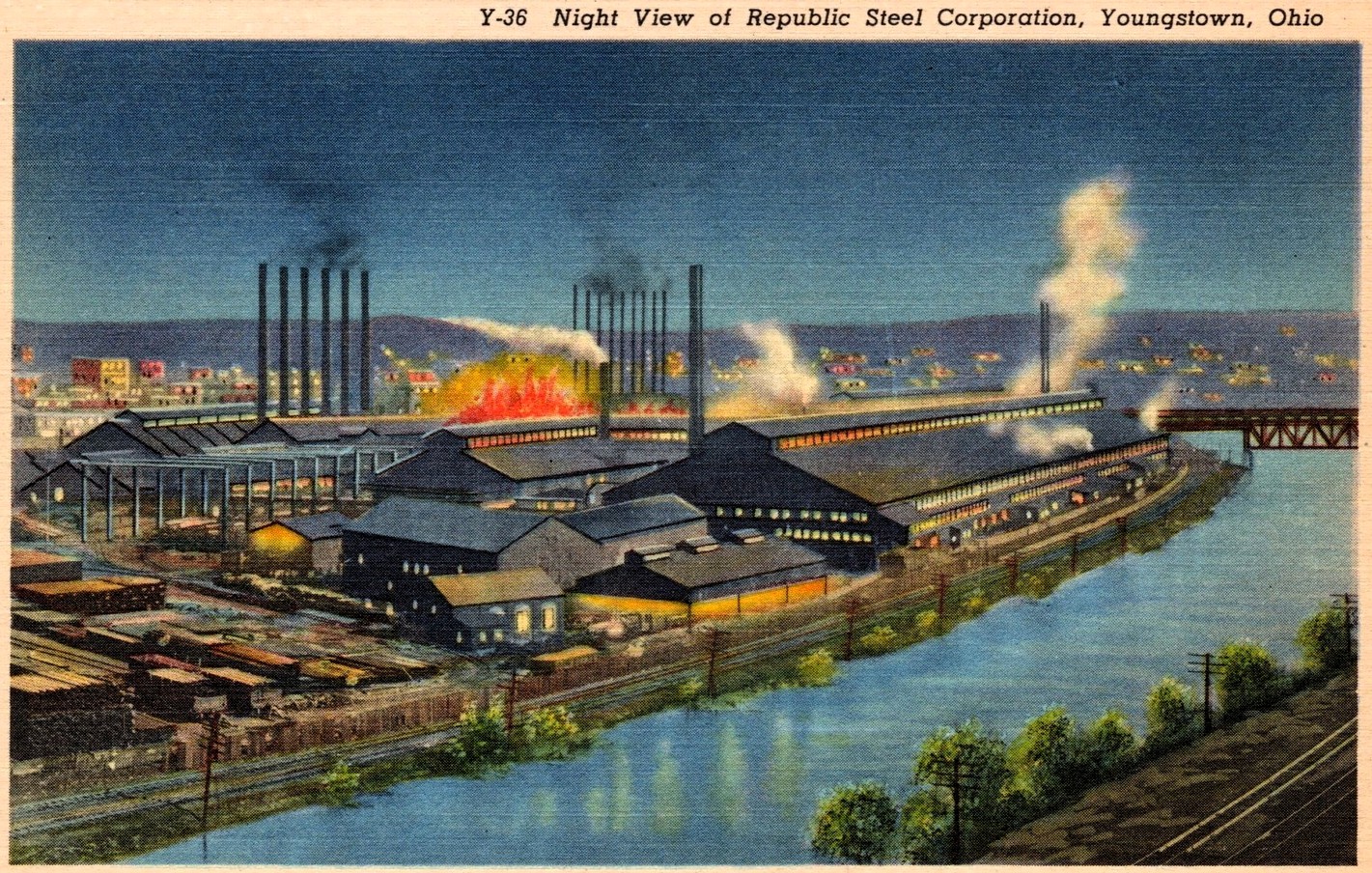
Cool breezes may sweep the valley, but the impression from a height is one of intense heat. Bessemer furnaces spit out volumes of flames, the blast furnaces turn loose streams of fiery metal, red hot ingots pass along rollers, or drop from link elevators onto flat cars, to be cooled with water that blisters and seethes into steam on contact. Pyrotechnic displays of huge sparks flying in all directions are frequent. Street bridges spanning the yards are warm and uncomfortable. Heat waves are wafted to them with stifling frequency; and over all hang heat clouds, shimmering in the atmosphere, dense near the structures and machinery where they originate and a thin haze far above the whole scene. The instinct that drives man to compare the place with the region presided over by his satanic majesty is a correct one–the place is as near an approach to an inferno as industry has yet evolved. As a workingman said, standing before the lawn about the office of the Republic Steel and Iron Co.: “It looks like paradise outside, but it is more like hell the further in you go.”
A KILLING PEACE
Just now the whole valley is sweating, straining, killing place. The war has contributed much to its activity. In the yards of the United Engineering Co., spanned by the Market St. viaduct, one can see shells for the allies carefully piled up. In the yards of the Republic Steel and Iron Co., overlooked by the South Ave. bridge, one can behold workers, with immense goggles carefully chipping bar steel intended for the same customers. So also has the war contributed much to the valley’s own killed and injured. The two wards reserved in the Youngstown City Hospital by “the Republic” and “the sheet and tube” (The Youngstown Sheet and Tube Co.) are full to overflowing. On the train to Cleveland we met worker going to friends to convalesce. His leg was broken. Speaking of the wards he said, “Men are coming in and going out, two and three at a time, everyday. It’s a regular slaughterhouse.”
Expansion is in evidence. The Carnegie Steel Company, which has an immense plant near Youngstown, is building a new $10,000,000 plant further up the Mahoning River, at a place to be called “McDonald.” The march of the steel and iron industry is ever northward. The “sheet and tube” is building immense coke ovens. So it goes. As a result there is a demand for labor, especially common labor. This demand the Carnegie Company is attempting to supply by the importation of negroes from the South. It is said to receive two or three car loads of them a day. Most of them do not last long. According to my well-informed workman-guide, “They only stay three or four days, until they get a piece of change. Then they quit.” However, Youngstown’s negro population is large enough to be evident.
Getting employment in the Mahoning Valley is like undergoing a third degree examination on a murder charge. The applicant presents himself at the employment office. There he is asked a series of questions. Then he is passed along to the company chief of police, whose questions are even more searching and brutal. Next the foreman of the department in which he desires employment, interrogates him, and looks him over. Then his papers are passed up to the company office. He must wait for notification of employment. But this is only an opportunity to investigate his record. Telephones are soon laden with inquiries. References are looked up; and the applicant may receive call only to find his papers marked: “Services are not wanted.” This third degree is given for the purpose of excluding “undesirables” the “agitators,” “impulsive,” “unstable” and “unreliable.” None but the most docile and submissive need apply. Corporation employment means corporation servility. Strict, organized surveillance is the price of corporation liberty from labor organization.
VIVID CONTRASTS
One night we encircled a part of “the Republic steel” works. Over the Market St. viaduct we went, along the South Side, across the “Elephant Bridge” and along Front St. It was a moving picture of corporation dominance and working class misery.
At the “Elephant Bridge” watched the tongues of flame blown from a Bessemer furnace. They made a beautiful, impressive sight, as they lit up both heaven, and earth, with a dazzling brilliancy. They silhouetted the surrounding buildings, giving them deep black shadows that contrasted vividly with their intense brightness. The tall smoke stacks seemed more tubular and slender; the cupolas to take on more width and bulk. The river reflected its surroundings photographically: the railroad tracks stood out like metal threads; and every detail of the laborers’ living quarters facing the livid glare,” was thrown into relief with microscopic exactness. It was only when the tongues of flame became red and black that everything appeared destructive and ominous. Then the brilliancy disappeared: the vivid contrasts vanished. The buildings, railroad tracks, river all mix up in the darkness, an unsightly and uncertain blur, suggestive of doubt and disaster. Everything seems to go out then, even life itself. No doubt the workers are safer in the white glare of the Bessemer, ” because there is then no lack of light to go by.
Along Front St., the rolling mills exclude the glare. We cross Tyler and Canal St. The way is narrow and caty-cornered irregular and electric-lighted. In the dark, dingy stores live families, some Slavonic, some Italian, some negro. In cottages, not of the newest nor of the cleanest, more families dwell. Squalor and poverty abound. There are many stunted women and children, many work weary men. On a porch, in the shadow of the electric light, two negro men and a woman sit playing cards at a small table, lighted by a kerosene lamp. They look uncouth, primitive, poor. Out of another cottage comes another negro, a giant in stature but, with a corrugated brow. Up the street we go, noting the groups seated outdoors, impressed with the congestion and the tall negro with a straw hat on carrying a bucket of foaming beer: the only refreshing bit in a very gray picture. These people know plenty hard work, few enjoyments, few aspirations and few riches. It is a life that has not yet begun to live. A life lived in a section once given over to prostitution and now considered fit for the poorest of producers–and they are many indeed.
Next morning we take the trolley car to East Youngstown. On board are many women with live roosters and chickens, some with wooden-ware baskets all have been marketing in Youngstown. After a spin over railroad tracks, along residential streets and a private right of way amid fields and unoccupied places, we get glimpse of the city made famous by its strike of last January. Soon we are walking its streets and are having its history reviewed for us. It is some history, suggestive and instructive to all.
E. YOUNGSTOWN’S SCARS
The scars left in East Youngstown by the January riots are fast disappearing. The section then blown and burned down is being rebuilt in quick order. It is alleged that the Youngstown Sheet and Tube Co., which was primarily responsible for its destruction, is now quietly financing its rebuilding. Up the crooked hillside streets we went, accompanied by our friends, a steel mill worker and a newspaper man. The standing ruins of many brick buildings were pointed out to us, red and buff brick walls, of varying heights, with blackened exteriors and charred interiors. In some places, only the masonry was visible; destruction had been complete. Also there were pointed out the many new buildings erected in places where similar ruins had once been. Eight city blocks, or squares, had suffered from dynamite and the torch in the mob’s wild progress.
Much is said of that mob that is interesting to the student of mob psychology and the methods by which capitalists defeat workers on strike.
On January 6, 200 workingmen in the Youngstown, Sheet and Tube Co. plant struck for more wages. By means of house-to-house visits they increased their numbers to 500 the next day. These assembled before the bridge leading over the main street and the railroad tracks to the company’s plant, consisting of blast furnaces, sheet, tube and wire mills, and coke ovens. They prevented entrance and so practically cut off the labor force, tying up the plant. The company appealed for militia.
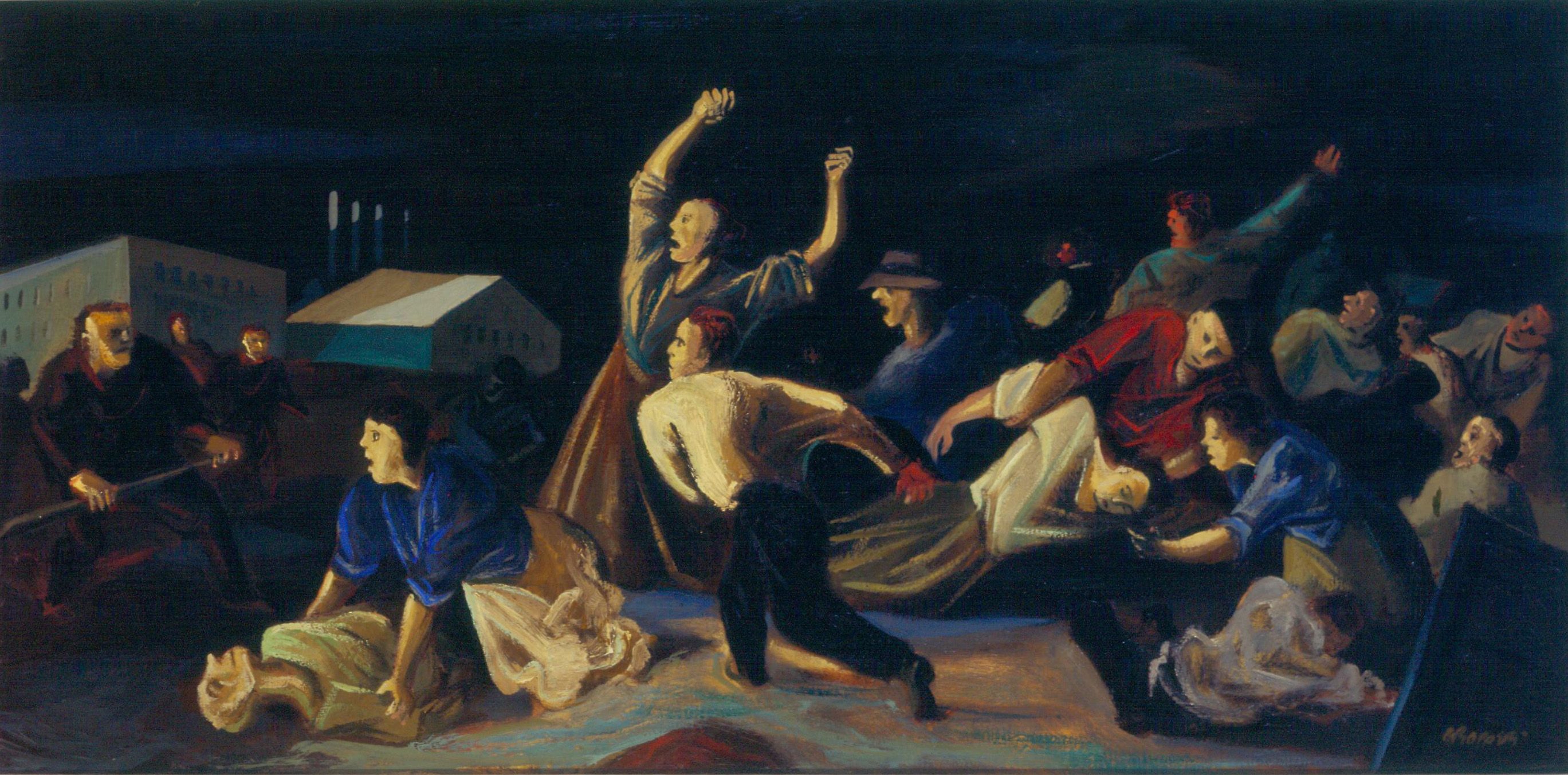
The sheriff refused, saying they were unnecessary, as he had the situation well in hand. Then an appeal was made to the governor. He sent a representative to investigate. He, too, declared against the appeal. Up to that time, the strikers, mostly Roumanians, had been peaceful. Nothing boisterous or riotous had occurred. They had been celebrating the European New Years, and felt jovial rather than harmful. But hardly had the governor’s representative left the scene, when pandemonium broke loose followed by a wild and uncontrollable orgy.
From the company bridge over the main street, company guards fired on the strikers below. These shots were returned and a stampede followed. Eight or ten men rose from among the crowd and led them in an attack, not on the company’s property, but upon the nearest saloons and buildings. The latter were wrecked, the whiskey seized and distributed, and the torch and explosives applied. This continued up the hill away from the company’s property, for a width of about two city blocks or squares, and depth of about four city blocks or squares. The mob destroyed the business section of East Youngstown–stores, banks, post-office even some of their own homes. The result was to turn “public sympathy” against them, enable the militia to be called and, after a day or two’s resistance, to break the strike completely. The newspaper men of Youngstown and the business men of E. Youngstown are said to incline to the belief that the mob’s violence was premeditated and provoked by outside factors acting in the interests of the corporation. It is said that the strikers had absolutely no motive in committing the wholesale destruction that took place; and that further they had shown no predisposition towards it. However, strikers’ motives and predispositions are no preventatives against capitalist strategy in the furtherance of capitalist interests. The latter demonstrates the necessity of organization and discipline able to cope with its frequent use in a similar manner. The strike was not altogether a failure. It caused all the Mahoning Valley corporations, “the sheet and tube,” the Republic, Carnegie, Brier Hill, the Struthers Furnace, etc.–to post an increase of wages from 19 to 22 cents an hour for common labor. Since then another raise to 25 cents an hour has been granted. The companies may have to give even more. Dissatisfaction is rife in “the sheet and tube.” Two weeks ago, an incipient strike was nipped in the bud by the discharge of the active spirits. A strike of non-union structural iron workers in the same plant resulted in an increase. Seven years ago, the union structural iron workers dynamited a bridge in “the sheet and tube” plant. The McNamaras are now suffering the results. The “tube and sheet” has a history that is typical of its kind. It is going to be repeated.
INDUSTRIAL PREPAREDNESS
It is said “the sheet and tube” has force of 100 men scattered about its plant. Three blasts of the whistle, followed by a fourth, will cause these men to converge at a given point. They are trained and armed with a gun that shoots buckshot at a distance of from 50 to 100 yards, and will hit anything before it within a radius of 30 feet. The Youngstown police are also said to be arming in a similar manner. Thus are coming events foreshadowed. Industrial preparedness means industrial war.
Youngstown is the scene of much A.F. of L activity. It is said that 27 A.F. of L. organizers have been there since January without any positive organization results. The eight hour fight begun on May 1st at the Tod Co, United Engineering Co., Concrete Steel, Automatic Sprinkler, and other plants is still on. Members complain that this fight lacks both aggressiveness and publicity. From information gathered the eight hour strikes appear to be partial strikes, including only machinists and their branches, but excluding other departments and the unorganized not entitled to benefits. They are not industrial union strikes, including all employed in the establishments taking part in turning out the machines made by them. They are dependent on skill and treasury; and already look lost to victory. The A.F. of L is unchanged by trust development.
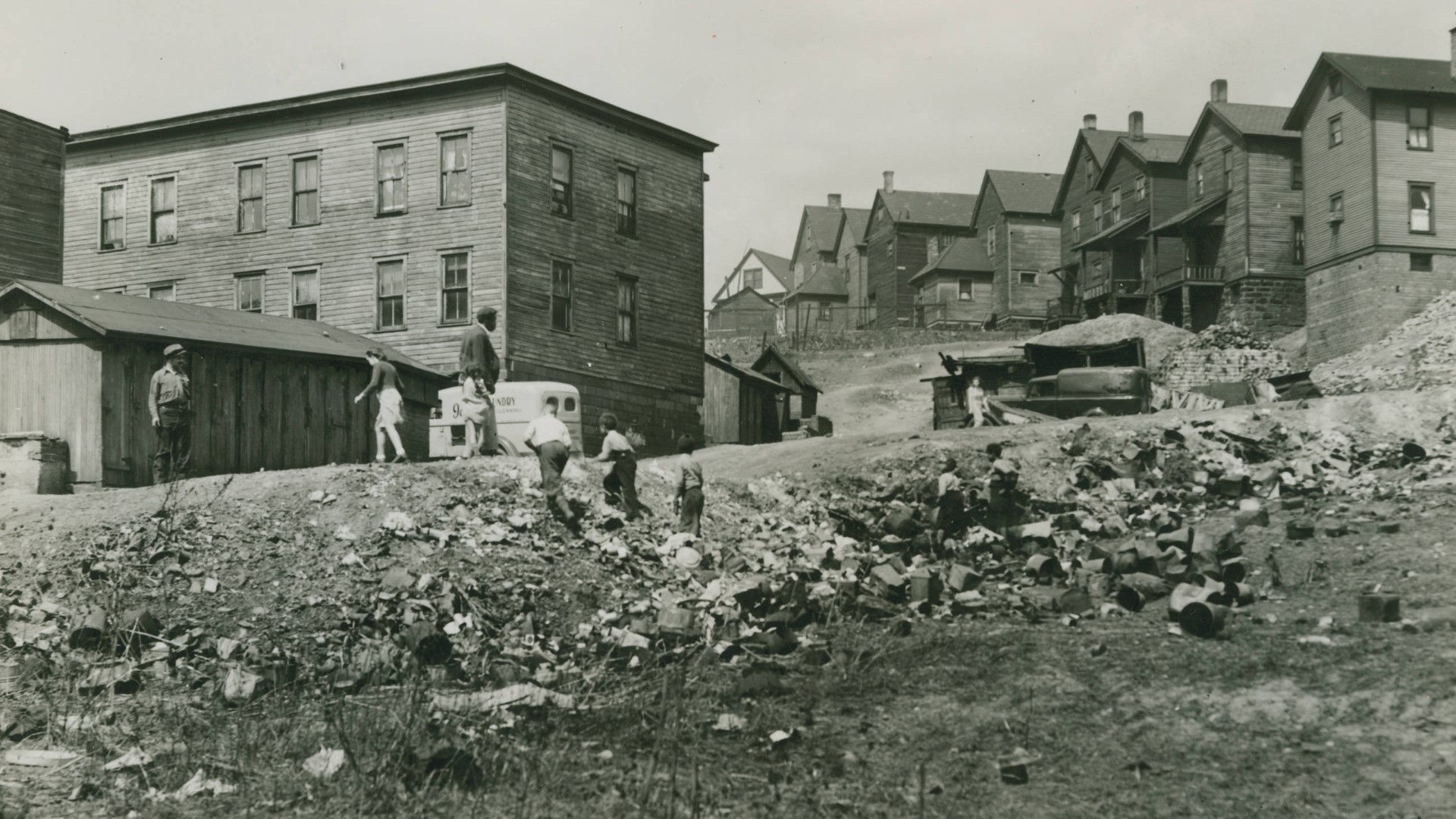
The future of Youngstown does not look roseate. It must have more labor, and what is more important, more wages. Prices and rents have gone up with wages. Rents are especially an interesting item. In fact, rent is disappearing in some sections. The workingman must buy. He must pay monthly installments, interest, taxes, etc. A student estimates that it will take 17 1⁄2 years to own a $3,000-$3,500 cottage on this basis. Some eke out the payments by furnished rooms. But if the boom doesn’t last longer than two or seven years at the most, as is variously predicted, what becomes of “the workingman’s home”? Who gets it? It looks as if Youngstown’s prosperity aftermath will be a prosperous one for real estate corporations. First, the worker is plucked in industry; and then he is fleeced some more in real estate. He will find the situation oppressive, and in seeking relief from it, will cause trouble. Capitalism is its own grave digger.
ABSENTEE CAPITALISM.
Youngstown is not a beautiful place on the whole. The millions resulting from its industries are not spent there. It has no amusement, intellectual and artistic institutions in keeping with its wealth-making facilities. Its capitalization is at once local and absentee. A walk up Wick Avenue, its aristocratic quarters, show a refinement, exclusiveness and hauteur, that tells where Youngstown’s exploiters reside, when at home. But they are rarely at home. They are mostly abroad, cutting a wide swath socially elsewhere; in city apartments for the elders and boarding schools and colleges for the young. Their district offers a striking contrast to the home district of the Slavs, the Italians and the Negroes. It is beautiful, where theirs is hideous. It can be varied, where theirs is deadly in its monotony. It is tree-lined, beautifully lawned and tastefully built. Theirs is grimy, because of its proximity to the plants, and destitute of all inspiration, thanks to the squalid adaptation made necessary by poverty.
Youngstown is truly a worse industrial inferno than Pittsburgh. Not all of the 150,000 population living in the Mahoning Valley are either satisfied or pleased with the honor implied in this will be found a ray of hope for the cause of progress.
The most widely read of I.W.W. newspapers, Solidarity was published by the Industrial Workers of the World from 1909 until 1917. First produced in New Castle, Pennsylvania, and born during the McKees Rocks strike, Solidarity later moved to Cleveland, Ohio until 1917 then spent its last months in Chicago. With a circulation of around 12,000 and a readership many times that, Solidarity was instrumental in defining the Wobbly world-view at the height of their influence in the working class. It was edited over its life by A.M. Stirton, H.A. Goff, Ben H. Williams, Ralph Chaplin who also provided much of the paper’s color, and others. Like nearly all the left press it fell victim to federal repression in 1917.
PDF of full issue: https://www.marxists.org/history/usa/pubs/solidarity-iww/1916/v7-w345-aug-19-1916-solidarity.pdf
 Revolution's Newsstand