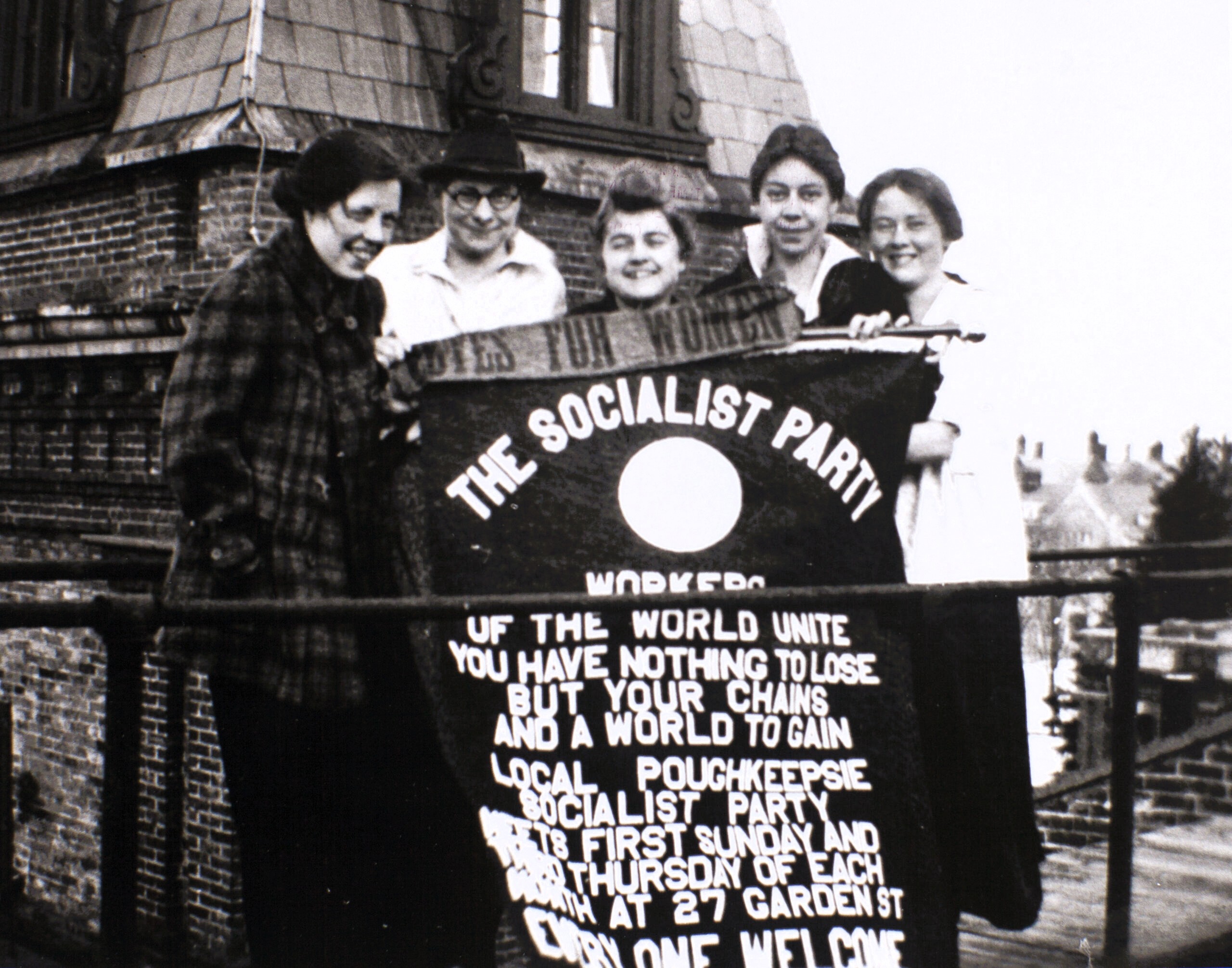
It is fair to say that male-domination of the Socialist Party faced many more public and private critiques from its women members for what we would now name sexism and misogyny than the equally male-dominated Communist Party ever did. Theresa Malkiel challenges the dismissal of women in practice by the ‘wise men’ of the Socialist International, and the failure of the Socialist Party in taking the organization of women seriously in this 1909 essay.
‘Where Do We Stand On the Woman Question?’ by Theresa Malkiel from International Socialist Review. Vol. 10 No. 2. August, 1909.
Theoretically we Socialists assert the equality of sex and race. We say, “All people are born equal,” and accordingly strain all our efforts towards the abolition of the existing social regime. But around the one uppermost problem, like numerous planets around the sun, revolve many smaller problems which, though they will be solved with the solution of the whole, are important enough to be taken up and fought for separately.
The Woman Question is attracting today world-wide attention. The evolution of society has brought woman to the point where she realizes at last her degrading position and vehemently claims redress.
As Socialists we recognize, of course, that the real freedom of woman cannot be achieved before the entire social problem is solved. But we realize at the same time that under a regime of political tyranny the first and most urgent ideal is necessarily the conquest of political liberty. And therefore, our women here, like our disfranchised male comrades abroad, are taking up the fight for universal suffrage.
But there are many Socialists who cry out in fear whenever that subject is viewed from a practical and not only a theoretical point of view. This element, in keeping with its views, demands that we drop the woman question altogether, that it is no concern of ours and that every active participation in the enfranchisement of woman is a crime against scientific socialism.
Another portion of our scientific socialists go a step further and in their great wisdom assert that it is all a mistake, that man and woman are not equal.
Says Enrico Ferri: “Utopian Socialism has bequeathed to us mental habit, a habit surviving even in the most intelligent disciples of Marxian Socialism, of asserting the existence of certain equalities—the equality of the two sexes, for example—assertions which cannot possibly be maintained.” He even censures Bebel for claiming that from the psycho-physical point of view woman is the equal of man.
Then, only as late as last month, comes another of our scientific men and says: “The impulse below intellect is intuition, which is developed further in many animals than in man. And because woman is nearer to the lower forms than man, intuition is more deeply seated in the female race.”
Is there greater wisdom in the assertion of a man who says: Woman is nearer to the animal than man, because she is endowed with an extraordinary amount of intuition; then in that of Mr. Roosevelt who says: “Every Socialist must be a free lover, because one or two of the Socialists had rather exciting marital experiences.”
Was woman ever given the chance to display fully the strength of her intellectual ability? How could anybody, in view of woman’s long subjection, judge her ability or the standard of her intellect? If our scientists would follow closely the history of woman and then note how today, though unprepared, she enters the different spheres of science, literature, music and art, where she holds fully her own with man, they might come to the conclusion that woman belongs rather to the higher plane of animal life.
True enough that there were but few great artists, musicians or scientists among the female of the race, but does not the writer himself state that a prolonged exercise of the brain cells goes to increase their quantity? If woman was able to achieve that much in the limited time of her brain development it goes to show that the quality of her brain cells is as good or even better than that belonging to the members of the opposite sex. In the face of the beastly acts so often characteristic of man, it is simply beyond human understanding how anybody could claim that woman is nearer to the animal, while man remains the supreme being.
With all due respect to our wise men, I think that even they would come to recognize our equality — if we only had the power to enforce it. It may be true that I am expressing myself with too much fervor, but if our male comrades were women they could understand easily how a statement like that goes to exasperate one. I have been always in the habit of speaking my mind freely and cannot see why this subject could not be discussed openly and thoroughly.
It is almost incomprehensible to me how our scientists came to such conclusion. And I, a plain ordinary mortal, challenge them in the name of my sex to set forth frankly and exhaustively the grounds on which they make these assertions.
My main object, however, in writing this article is to discuss our attitude on the Woman Question. For the workingwoman of today finds herself between two fires—on the one hand she faces the capitalist class, her bitterest enemy; it foresees a far-reaching danger in her emancipation and with all the ability of its money power tries to resist her gradual advent into the civilized world. In her anguish the workingwoman turns towards her brothers in the hope to find a strong support in their midst, but she is doomed to be disillusioned, for they discourage her activity and are utterly listless towards the outcome of her struggle.
In the heat of the battle for human freedom the proletarians seem to forget that the woman question is nothing more or less than a question of human rights. That the emancipation of woman means in reality the emancipation of the human being within her. They seem to overlook the fact that it is as much their duty to fight for the workingwoman’s political freedom, as it is to her advantage to make common cause with the men of her class in order to bring about the regeneration of society.
What revolution will yet have to take place in the conceptions of men! What change of education, before they will be able to attain the knowledge of a pure human relationship to woman! For every day experience teaches us that even the most progressive of our men are still considering woman as the being who, chained by a thousand fetters of dependency to man-made conditions, broken in spirit and in health by her long degradation and continual maternity, became a weak, thoughtless being that was neither man nor beast. They do not take into consideration that the woman of today has marched forward on the road of evolution.
What grandeur and beauty are contained in the meaning of this sentence in our platform: “There can be no emancipation of humanity without the social independence and equality of sex.”
But how bitter is our disappointment whenever we come to look upon matters as they really are—men who take enthusiastically the pledge to abide and follow the party principles and ideals follow their promise to the letter, as far as generalities are concerned, but stop short where the question comes to the practical point of sex equality, an act to which they had earnestly pledged themselves in accepting the Socialist platform.
The bulk of womanhood, that is linked some way or other to the Socialist movement, is kept ignorant of the necessity of its participation in same (as well as of the justice of its political rights), for man is a man for all that and fears that he might suffer by woman’s immediate freedom.
To those of us who had the courage and initiative to strike out for ourselves, the path is being covered with more thorns than roses. We are told very often to keep quiet about our rights and await the social millennium. Safe advice, rather, for the men.
The question before us is whether it is really possible that a host of men whose whole life is spent in the fight for human freedom should at the same time turn deliberately a deaf ear to the cry for liberty of one-half of the human race.
It is very humiliating for us Socialist women to be forced to admit this, but the question must be disposed of once for all, for we women cannot possibly build our expectations on the future freedom and at the same time submit calmly to the present oppression.
Among the 50,000 dues-paying members of our party there are only 2,000 women. Or, in other words, one woman member to every twenty-five men. Considering the fact that a number of our women members had entered the Socialist Party on their own accord, we may safely say that out of every thirty men within the party but one was ideal enough to bring in some female member of his family or a friend’s into the ranks of the party, while the other twenty-nine preach the ideals of Socialism and the necessity of party alliance everywhere except within the walls of their own homes.
We may bring amendments reducing the dues of the women in our party, we may elect National and Local committees for the purpose of increasing the membership, but we will not achieve any considerable progress until our men will change their views as to woman’s scope of activity in the movement. I know my sex and will admit freely that woman still looks to man as the guiding spirit of her life path and it is therefore for him to direct her steps into the party membership where she belongs—side by side with him.
The International Socialist Review (ISR) was published monthly in Chicago from 1900 until 1918 by Charles H. Kerr and critically loyal to the Socialist Party of America. It is one of the essential publications in U.S. left history. During the editorship of A.M. Simons it was largely theoretical and moderate. In 1908, Charles H. Kerr took over as editor with strong influence from Mary E Marcy. The magazine became the foremost proponent of the SP’s left wing growing to tens of thousands of subscribers. It remained revolutionary in outlook and anti-militarist during World War One. It liberally used photographs and images, with news, theory, arts and organizing in its pages. It articles, reports and essays are an invaluable record of the U.S. class struggle and the development of Marxism in the decades before the Soviet experience. It was closed down in government repression in 1918.
Theresa Malkiel (1874-1949) Theresa Serber was an American born in Ukraine into a large Jewish family. In 1891 the Serber family emigrated to New York City’s Lower East Side where a teenage Theresa found work, like so many Jewish women of her generation, in a garment factory. Still a teen, she joined the Russian Workingmen’s Club and in n 1892 she began her organizer’s life helping to found the Infant Cloakmaker’s Union of New York, becoming its first president. In 1893 she joined the Socialist Labor Party and representing her union in the Socialist Trade and Labor Alliance. In 1899, Theresa joined the ‘Kangaroos’ opposed to Daniel De Leon’s leadership and became a founding member of Socialist Party of America, and the first working class women to rise to leadership of the Party. In 1905, Malkiel organized the Women’s Progressive Society of Yonkers, a branch of the Socialist Women’s Society of New York. The ‘separatism’ of the Society was opposed by the male leadership. Malkiel was one of the best-known women Socialist writers of the ‘Debsian era’ with articles in many union, labor, feminist and socialist publications. Malkiel was elected to the Woman’s National Committee of the Socialist party in 1909 and led the establishment of Woman’s Day, starting on February 28, 1909, which would inspire International Women’s Day. That year also saw the epic New York City shirtwaist strike in which she would play a leading role with the Women’s Trade Union League. In 1910, Malkiel’s most lasting work, The Diary of a Shirtwaist Striker, a fictionalized account of the shirtwaist strike was published and widely read. Malkiel also helped to raise the question of race in the Party, challenging the Socialist’s internal segregation and racism and writing a scathing report on the life of the Party after a 1911 speaking tour through the South. A leading Socialist campaigner for the vote, in 1914, she headed the Socialist Suffrage Campaign of New York and was on its National Executive Committee to travel across the country campaigning for suffrage. Malkiel stayed with the Party during the disastrous 1919 splits, and ran for State office in 1920. Her partner was leading Socialist solicitor Leon A. Malkiel. Although Theresa was able to move from a life of factory work, she remained committed to workers organizing and education, leading immigrant and adult classes for workers in Yonkers for the remaining decades of her life.
PDF of full issue: https://www.marxists.org/history/usa/pubs/isr/v10n02-aug-1909-ISR-gog.pdf
 Revolution's Newsstand