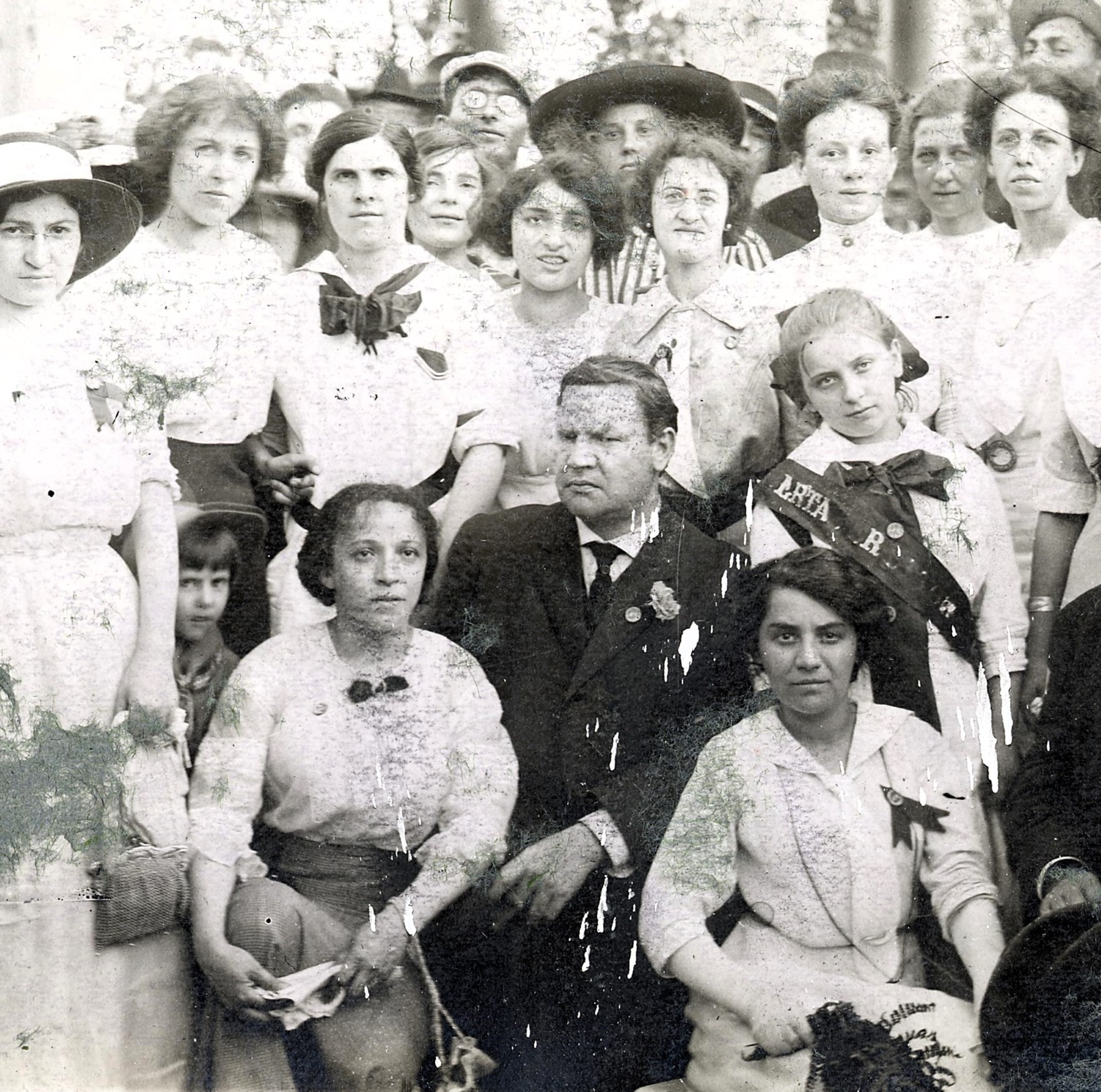
ISR editorial from Charles H. Kerr against the Haywood recall. Indicative of a growing left-wing, Haywood’s resounding 1911 election to the Socialist Party’s seven-person leading National Executive Committee seriously rattled the right-wing. Immediately they began a campaign against the left culminating in changing the S.P. constitution at the 1912 National Conference. “Article 2, Section 6” demanding the expulsion of any member who “advocates crime, sabotage or other methods of violence” was added. Charged with its violation by the State Committee of New York, Haywood, though not expelled, was removed from the N.E.C. in February, 1913.
‘The Motion to Recall Haywood’ by Charles H. Kerr from International Socialist Review. Vol. 13 No. 8. February, 1913.
The state committees of New York, New Jersey and the District of Columbia have suddenly sprung a referendum for the recall of Haywood from the National Executive Committee of the Socialist party. It is accompanied by a preamble falsely charging Haywood with saying things he never said. On another page of the REVIEW we publish extracts from Haywood’s public speeches and writings showing exactly how he stands on the question of political action. Haywood himself makes no reply, in view of the fact that the New York State Committee voted down a motion inviting him to make a statement before the motion for his recall should have been voted on. How the rank and file of the party who have listened to Haywood in the past feel about this motion is well illustrated by the following letter just received at this office from Comrade R.S. McAuley of Rock Springs, Wyoming:
“Comrades: I have a ballot given me by Sec. John Ramsay, Rock Springs, Wyo., to vote yes or no on the recall of Bill Haywood as member of the National Executive Committee. I have heard Comrade Haywood speak twice during the last year. Both times he made such a talk against the Republican and Democratic parties and capitalism in general as to make more class conscious Socialists than all those Sunday-school fellows that ever went over the pike. On the day that the membership of the party shall be so unwise, ungrateful and unjust as to turn down this man, I shall cease to be a dues-paying member. Have talked with several others who will take the same action. “A house divided against itself cannot stand.” Yours for the Co-operative Commonwealth. R.S. McAuley.”
We believe that the motion was proposed with the deliberate intention of driving industrial unionists out of the party, but we urge Comrade McAuley and all who think and feel as he does to think again and stay inside, no matter how the vote may result. If the motion carries, it will simply be because thousands of loyal party members have been deceived by the lying preamble and have voted under a misapprehension. We believe that more than ninety per cent of the membership care more for the working-class movement for the overthrow of capitalism than for votes and offices, and that when the issue comes clearly before them they will act accordingly. As for the politicians in the party, let us not worry about them.
Many of them sincerely believe that they are doing good, and part of them will be intelligent enough to see their mistake when the change of front of the capitalist politicians becomes fully apparent, and this will be soon. Meanwhile, let us all vote against the motion to recall Haywood, and go on fighting the biggest enemy, Capitalism.
The International Socialist Review (ISR) was published monthly in Chicago from 1900 until 1918 by Charles H. Kerr and critically loyal to the Socialist Party of America. It is one of the essential publications in U.S. left history. During the editorship of A.M. Simons it was largely theoretical and moderate. In 1908, Charles H. Kerr took over as editor with strong influence from Mary E Marcy. The magazine became the foremost proponent of the SP’s left wing growing to tens of thousands of subscribers. It remained revolutionary in outlook and anti-militarist during World War One. It liberally used photographs and images, with news, theory, arts and organizing in its pages. It articles, reports and essays are an invaluable record of the U.S. class struggle and the development of Marxism in the decades before the Soviet experience. It was closed down in government repression in 1918.
PDF of full issue: https://www.marxists.org/history/usa/pubs/isr/v13n08-feb-1913-ISR-gog-ocr.pdf
 Revolution's Newsstand