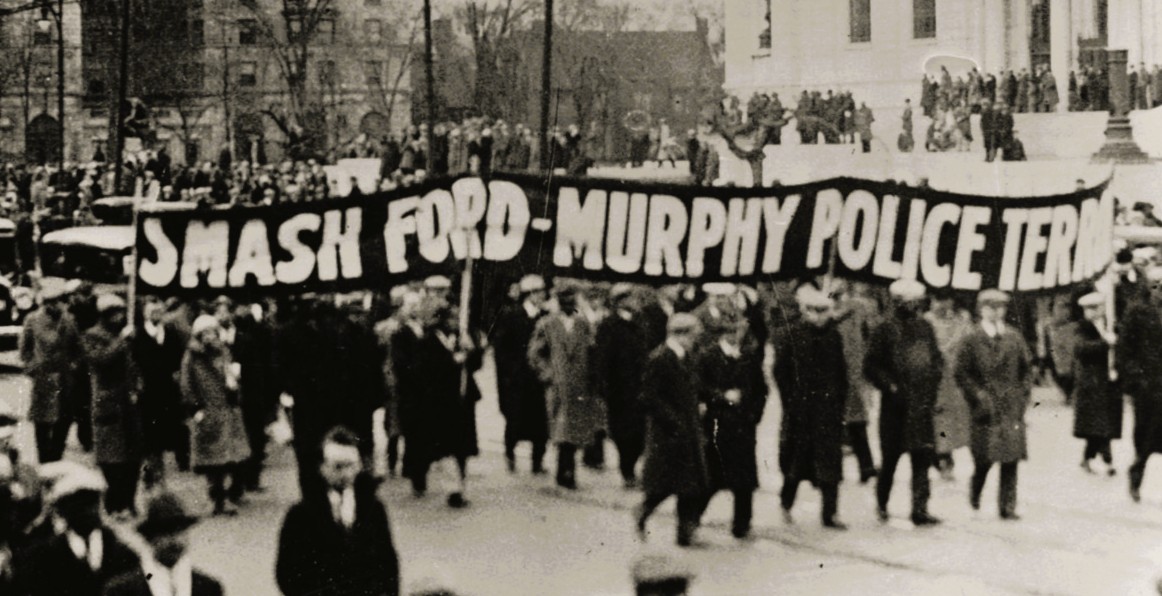
The Detroit District of the Communist Party sets itself the ambitious task of doubling its membership to around 1800 in just five months–over winter no less–and analyzed past failures in helping to map out strategy for the recruitment campaign. Full of valuable detail, the internal report on their findings below.
‘Party Recruiting in the Detroit District’ by Mary Himoff from Party Organizer. Vol. 8 No. 1. January, 1935.
THE EIGHTH Convention of our Party passed the decision of building our Party to one of 40,000 members by January 1. At the beginning of October, the Detroit District Committee reviewed the District’s recruiting work for the period since the Eighth Convention (April 1). On the basis of this review, and the results of the C.C. Recruiting Drive, which had just been initiated, the District set itself the quota of doubling the Party membership by March 1 (having a dues-paying membership of 1,800 by that time).
In our District especially, in view of the rising unemployed struggles now taking place, and the coming struggles in the auto industry, the question of building the Party amongst the masses, and especially in the shops, is of decisive importance.
If our District is to fulfill the task it has set itself, then we must carefully examine our recruiting work in the recent period, and see what are the main shortcomings, and what are some good experiences that can be used as examples for the whole membership.
We want to deal in this article with the following:
1. An analysis of the District’s recruiting from April 1 to October.
2. The C.C. October Recruiting Drive in our District. 3. The steps we must take to complete our quota by March 1.
Recruiting Since Party Convention to October
Recruiting totals of the District during this period: April—16; May—54; June—75; July—34; August—36; September—47. The figures for the important sections are:
Section—Concentration—April—May—June—July–Aug.–Sept.
1–(Negro sec.)—5—1—8—2—8—4
2–(factory sec.)—2—1—3—3—4—0
7–(Ford sec.)—1—0—8—2—4–3
Recruiting Work of the Membership
In the month of September, seeing the dangerous situation that existed on the question of recruiting, we carried through a dues and recruiting control of each Party member. The purpose of this control was to check on the dues standing of the member, and, most important, on his recruiting activity. By making every member do the latter, we tried to bring sharply to the attention of our comrades—what was one of the key reasons we were not speeding ahead to fulfill the Convention decision of building the Party to one of 40,000 by January 1. Through this control it was sharply brought to the attention of each member that the most important recruiting channel of the Party—the individual member—was not fulfilling his task.
Here are some of the glaring facts this recruiting control showed. Out of 315 members analyzed (we registered many more—this is just an example), only 38 did any recruiting, these 38 members winning 102 workers into the Party. In other words, over 90 per cent of our members did not recruit one member into the Party in a period of a half a year (the control covered the period from April 1 through Sept.).
In Section 2, out of 59 members controlled, only 7 did any recruiting, winning 14 new members (out of these 7, one comrade recruited 8 by himself). In Section 4, out of 47 registered, only 6 did any recruiting, winning 7; in Section 7 (Ford), out of 56 registered, 20 members recruited 30 new members; in Section 8, out of 56 registered, 7 recruited 11. These facts speak for themselves.
Recruiting of Shop Units
If we examine the recruiting activity of our shop units, the decisive units of our Party in relation to mass work, we find no better situation:
Out of 4 shop units registered, with a total of 35 members controlled, only 3 units reported any recruiting. Of the 385 members in these 4 shops, only 10 did any recruiting, winning 16, only 9 of which were workers from the shops in which the units exist. In the same half year, only 1 street unit in the Ford concentration section recruited workers from the Ford shop, gaining 2.
Composition
In the period from April 1 to September 15, we find our District recruited only 27 Negroes, only 21 women (among which there were no auto workers, and only 2 Negro women), only 12 A.F. of L. workers, and 4 workers from independent unions.
Why Such Slow Recruiting?
The conclusions we can draw from the above figures are:
If we take into consideration the dues totals and averages for the same period, compare them with the recruiting, we find that the main problem in our District in this period in the question of Party growth is stagnation, hardly any recruiting at all.
Even if we take into consideration the fact, that during this period, auto production was at its lowest, that the unemployed struggles were still very weak, we cannot explain the slow recruiting by these reasons.
The main reasons lie in the fact that, first of all, our shop units were never guided and orientated on the problem of recruiting, and shown the methods of winning new workers into the Party, were never taught how to make this a daily task of each individual member. The fact that most of comrades felt that their membership in a shop unit was only temporary (till they would be laid off, and they could resume ‘normal’ Party work in the street unit) also points to the fact that our comrades never really understand that the shop unit is the Party, and building the Party is linked up with the question of putting forward the Party through the shop unit work—this lack of understanding naturally was another great hindrance to recruiting in the shop through the struggles and other work of the unit and its members.
The second reason lies in the fact that there was a general lack of consciousness among the whole membership to recruit workers into the Party. Our comrades do not understand as yet, that recruiting must be done at all times—for this comes as a result of contact with workers, and conscious, patient convincing of the correctness of the Party program, and showing these workers the necessity for joining their Party.
Opportunism Stands in Way of Recruiting
During the control, and also today, we find that in personal discussions with our members, or when recruiting is discussed in the unit, a deep opportunism exists on the question of building the Party. It was sharply brought out by comrades when the C.C. Letter on recruiting was read that many of our comrades believe the “workers are not ready,” “this fellow is no good,” “this one won’t fight”, etc. At the same time, many comrades showed our sectarianism by the fact that they could not give even the name of one worker on whom they could work for the Party.
But examples show where there is consciousness in recruiting and confidence in the workers, and an understanding of their growing readiness for struggle, workers can be easily won for the Party. In this same period, one comrade alone recruited eight directly from his union—while in another local in which our comrades have done good work, and have good support not one was recruited. In another case, 7 comrades in one shop unit recruited 7 new members!
The October C.C. Recruiting Drive
During the month of October, we recruited 103 members, more than double the monthly average of the preceding months, and so far the total recruitment for the first 3 weeks in November is a little higher than that for the first 3 weeks in October. It is clear that these results are still low, but they show an improvement in the correct direction. It shows that the steps we took to better the recruiting activity of the Party were correct ones.
The first step—the recruiting control of each member, brought this question sharply to our membership. Secondly the beginning of combatting the opportunism that exists on this question by showing how some comrades do recruit, bringing out examples of no recruiting especially during times of struggles in various localities, and thirdly a constant weekly check-up on recruiting.
Pressing the question, constantly hammering at it, at least changes the situation of apathy that existed on recruiting. That this consciousness is beginning to bear fruit can be shown by the following examples: in one Section, in the preparation for a demonstration, one comrade went out leaflet distributing with a non-Party worker. In the course of the 2 hours, he got this worker to sign up and pay his initiation. In another instance, after a committee went to the welfare and had a scrap inside, they took some workers to the hall, and one comrade contacted a young American and recruited this worker. In one of our important shop groups, where the comrades now have a system of weekly visiting of contacts, and on the basis of some struggles we carried through inside, 2 new workers were recruited; one unit gave an Open Unit Party and recruited 5 shop workers; in another unit an open unit meeting was held and one foreign-born comrade brought down 2 Americans from his relief job that he is working on.
In one of our Sections (No. 8), the Section membership decided on the following: At that meeting, every comrade was given an application card, this card must be returned by each member with a new recruit by March 1 with the signature of the Party member. The Section Org. Dept. and each unit is checking on each of these cards, and the membership decided that those comrades who will not recruit one member by March 1 will not be in good standing.
Another experience that we find works well, is the method of dividing the drive into a series of shorter periods giving the comrades small quotas for each period. These quotas can easily be fulfilled, and thus we raise the enthusiasm and confidence of all our comrades.
Next Steps
If we examine the October recruiting, besides the fact that we are still moving too slowly, we still see that the quality of our recruits is still far from our goal.
Of the 103 recruited, only 21 were employed, of these only 10 were employed auto workers, the main industry of our District, and only 36 auto workers totally. Only 18 Negro workers, and only 18 women. The recruiting of A.F. of L. workers is the chief shortcoming—only 5 out of 103!
Therefore, the first step we must take, must be to help orientate our Party on the winning of shop workers and especially members of the A.F. of L. The fact that now we have assigned leading District comrades to work with every shop unit will help us to overcome this. But unless these leading comrades conscientiously take up the problem of recruiting from the shop, help the comrades in the shop units to solve their difficulties, we will remain where we were. In the next period the shop units must become the decisive recruiting weapons of the Party. That this can be done is shown by the example mentioned above—where in one week 2 members were recruited.
Our fractions in the A.F. of L. must overcome their present attitude towards recruiting. In certain auto locals, as well as in other trades, there are some splendid examples of the response of the members to programs and actions for struggle—and yet there is no recruiting.
In order to fulfill our quota by March 1, we are carrying through the drive in the following way:
1. The Drive has been divided into 3 periods:
a. November 1 to December 1. b. December 1 to January 21 (Lenin Memorial). c. January 21 to March 1.
2. Each Section has worked out quotas for itself, totals which will double their membership by March 1.
3. Use of socialist competition in drive:
a. The Sections decided to contribute to a fund for a prize that will be given to the best Section at end of the drive.
b. There will be two banners in the drive: a red banner for the Section completing its quota best, a black banner with a yellow turtle for the slowest Section. These banners will be given at the end of each period at open meetings, where the slowest Section will come up for open criticism—the best Section will keep the red banner at the end of the drive.
c. Some Sections are now working out the terms of socialist competition wagers among themselves, also units within Sections.
In Section 8, the Section Organizer was so determined not to get the turtle banner, that at his membership meeting, he himself brought in 2 recruits as an example to the members, and within one week his Section got 6 new members, whereas previously they never averaged more than 2.
4. The District is issuing a Special Recruiting Bulletin every 2 weeks, giving good examples, the standing of the Sections, with a Turtle list of all Sections averaging less than 2 recruits per week.
In this article, we do not deal with the question of Daily Worker and recruiting, use of literature, and also the question of new members, which it is evident are problems linked with the success of any recruiting work. We just wanted to give an analysis of the recruiting work of our District, and some of the measures we are taking to carry through the Convention decision of “doubling the recruiting activity of the Party”, thus overcoming the big lag that still exists in building a mass Party.
The Party Organizer was the internal bulletin of the Communist Party published by its Central Committee beginning in 1927. First published irregularly, than bi-monthly, and then monthly, the Organizer was primarily meant for the Party’s unit, district, and shop organizers. The Organizer offers a much different view of the CP than the Daily Worker, including a much higher proportion of women writers than almost any other CP publication. Its pages are often full of the mundane problems of Party organizing, complaints about resources, debates over policy and personalities, as well as official numbers and information on Party campaigns, locals, organizations, and periodicals making the Party Organizer an important resource for the study and understanding of the Party in its most important years.
PDF of issue: https://www.marxists.org/history/usa/pubs/party-organizer/v08n01-jan-1935-Party%20Organizer.pdf
 Revolution's Newsstand