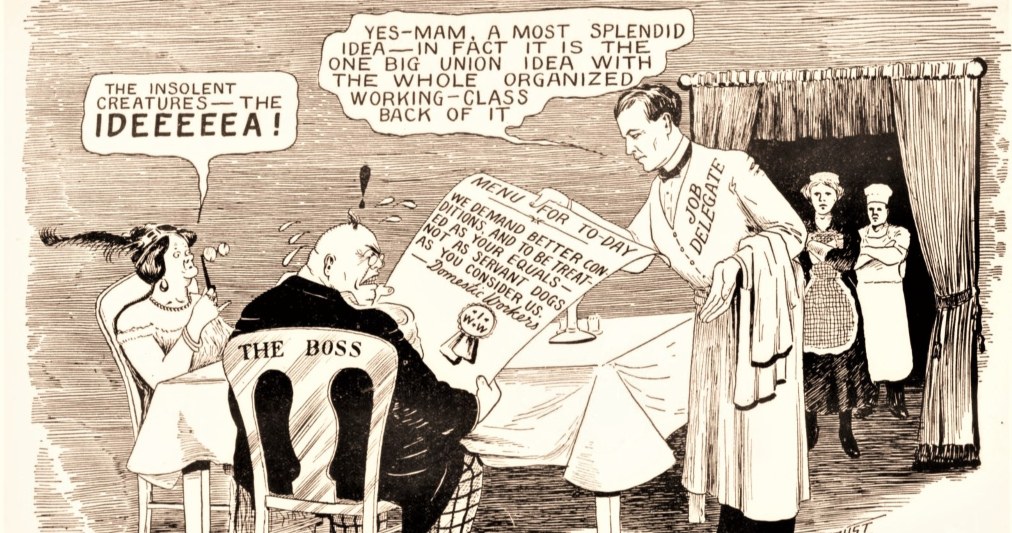
Mass strikes against Spokane’s restaurants started from a rank-and-file rebellion in the A.F.L.’s Waiters’ Union sees that city’s I.W.W. pitch in to help.
‘Cooks and Waiters on Strike in Spokane’ from The Industrial Worker. Vol. 2 No. 9. May 21, 1910.
For once we have a word of praise for a strike of the trades unions. The cooks, waiters and waitresses are out in Spokane and we must give them credit for the way they go about it.
It is a fine example of the true instinct of the worker when it goes into action so swiftly that the “leaders” are unable to hamper it.
At 11:55 a.m. on the day of the strike the restaurant and hotel employees presented a contract to the bosses in every eating place in the city and asked that it be signed at once. Many places gave up immediately, signed the contract and their business was resumed. But where the boss would not then and there agree to the demands of the strikers, the men and women walked out sharp on the noon hour, thus giving no notice and tying up the establishments at the busiest hour of the day. The demands are more money, a six-day week and a bettering of the horrible working conditions under which the workers have slaved.
Jimmie Durkin, who was already paying $1 more than the demands called for and whose employees already had a six-day week, signed the union contract at once, and was followed by about twenty-eight other restaurants at the time of the demand. Since then some nine other establishments have fallen in line and granted the conditions asked.
The trouble all started over the Restaurant Employers’ Association breaking the agreement with the trades unions by establishing a “free employment office” instead of procuring their help from the union, as per agreement. This, however, was only the last straw, for the endurance of the employees had been strained to the breaking point by the filthy working conditions, to be found specially in the larger and finer restaurants. (Wherever the masters are the most luxurious there are the workers the most miserable.)
In an interview with a prominent member of the waiters’ union the following came to light:
“There are about 1,000 men and women out, including cooks, waiters and waitresses. There was only one man that remained at work to scab. There were no women scabs and are none to date. Only two cooks went back to work after being out ten days.
“It Is just like this,” said the Interviewed man. “We were being gradually weeded out of existence by the Employers’ Association. You see, the association is supposed to exist for the purpose of regulating the restaurant prices and fighting the wholesale houses, but It failed in both these objects and the only function left it is the one it was really formed for to fight organized labor.”
“How it is that you did not go through the usual proceedings of the A.F. of L.?”
“The A.F. of L. had no time to say or do anything,” he replied, quickly. “The conditions were so bad that the spontaneous idea of the restaurant workers was to strike. We held a mass meeting and decided to strike the next day–and we did. There were 400 present at the mass meeting, but every worker with one exception walked out the next day at noon.”
“Then the strike was not called by the executive board?”
“Hardly,” he laughed. “We had no time for red tape or regular proceedings. You see, we realized that we have been too easy with the employers. They have promised to put clean dressing rooms in place of the stinking, filthy ovens which are in use now. They have promised many things, but have not lived up to their promises. Last year we went at it in the regular way and found ourselves up against it, with the bosses given several weeks’ notice of our intentions. So this time something had to be done and we did it. It had got to a point, where we had nothing to lose and a whole lot to gain.”
“Wouldn’t you call that ‘direct action’?”
“Well, it was certainly direct,” he grinned. “We were pushed too d—n hard and the worm turned.”
“Are the bakers on strike with you?”
“No.” grimly. “They are going through the red tape of the organization. I suppose that by the time the strike is won they will be ready to take some action–maybe.”
“Are they not equally interested with you in getting decent working conditions?”
“Sure they are, but they belong to another trade.”
“It their hair was of a different color would that have an effect on their action when struggle with the boss is on?”
“Well, I take what you mean, but the leaders won’t let them break the red tape.”
“Then why not throw out the leaders and organize industrially?”
“Lots easier said than done,” he replied. “The rank and file have the right instinct, but they are not good politicians and you know that politics plays a large part in the convention. But we are waking up.”
It was learned that the girls were showing a most remarkable rebel spirit and were even surpassing the men in their enthusiasm. No wonder, for they were not allowed to sit down, even if there was no one in the restaurant. They were even denied the privilege of eating the “come-backs,” the leavings from other people’s plates.
Davenport’s is the worst place in town for the kitchen help, but all association houses are far below the standard of decency, according to the story of the strikers. Four of the houses that have signed up are members of the association. The unions are offering and giving assistance to the members that need it and are amply able to care for all.
The I.W.W. is doing all in its power to assist the strikers, especially in the line of advertising the strike and keeping strikebreakers out of the city. This is appreciated by the strikers, and I.W.W. men have been addressing them in the waiters’ bail.
The following recently appeared in a daily paper under the caption, “Police Disperse I.W.W.’s”:
“Last night the police were called upon to disperse a gathering of I.W.W.’s that had surrounded James Kennedy, an alleged ‘scab’ who had taken the place of one of the striking dishwashers at the Jim and John restaurant on Front Avenue. The men were trying to dissuade him from further continuing on the job when the police approached and dispersed the crowd. The sympathies of the I.W.W.’s are with the strikers.”
It may be remarked that a defendant of Kennedy fell–accidentally, of course–through the large plate glass in the front of the restaurant.
An I.W.W. man who is also a member of the Waiters’ union, is leading a burro around the town. The donkey’s blanket bears on one side the placard, “I’m only a donkey, but I’ll not work but six days a week,” and on the other side, “I’m only a donkey, but I know enough not to scab.”
The one remarkable thing of this strike is that the strikers who are members of the trades unions are winning BECAUSE THEY HAVE FOR THE TIME THROWN AWAY THE TACTICS AND RED TAPE OF THEIR ORGANIZATION. They have refused to be hampered by the advice of leaders and officials, but have followed their instinct of DIRECT ACTION. If they only keep it up, and are not talked into a surrender by the good capitalistic leaders, they have fine chances of winning out. If they were organized Industrially, and had the support of ALL the workers that are concerned in the industry, such as the bakers, the teamsters who deliver union goods in a union wagon to the scab houses, etc., it would be a foregone conclusion that the bosses would crawl.
Yet the rank and file seem to be waking up and we see good reason to think that it is only a question of a short time before the workers are going to refuse to be divided along the lines of craft or complexion, or ordered to strike or cease striking at the command of a high salaried “leader.” They are beginning to see that they must take the management of their affairs into their own hands. They are also commencing to understand that their intelligence and judgment is higher and better than that of anyone else in relation to the interests of the working class. They are commencing to see that, organized into crafts, they are giving themselves a hopeless handicap at the very start. Let us hope that they will in the near future come to see that INDUSTRIAL UNIONISM is the ONLY form of unionism that will gain anything for the workers.
Later news comes that the Restaurant Owners’ Association is importing girls from the Coast cities and from the farms and small towns. Many of them, however, refuse to go to work and scab when they find that a strike is on. All I.W.W. members and Locals throughout the Coast country and elsewhere should take pains to spread the news of the hotel and restaurant workers’ strike in Spokane and warn any prospective scabs not to show up in this city.
The cooks and waiters are wise to the fact that they do not want a contract that expires at a different time than that of the bakers. Some time, it is to be hoped, they will understand that no contract for any time Is of any value to the worker. And their whole attitude Is that of progress and increasing understanding. Let us be grateful for small favors.
The Industrial Union Bulletin, and the Industrial Worker were newspapers published by the Industrial Workers of the World (IWW) from 1907 until 1913. First printed in Joliet, Illinois, IUB incorporated The Voice of Labor, the newspaper of the American Labor Union which had joined the IWW, and another IWW affiliate, International Metal Worker.The Trautmann-DeLeon faction issued its weekly from March 1907. Soon after, De Leon would be expelled and Trautmann would continue IUB until March 1909. It was edited by A. S. Edwards. 1909, production moved to Spokane, Washington and became The Industrial Worker, “the voice of revolutionary industrial unionism.”
PDF of full issue: https://www.marxists.org/history/usa/pubs/industrialworker/iw/v2n09-w61-may-21-1910-IW.pdf
 Revolution's Newsstand