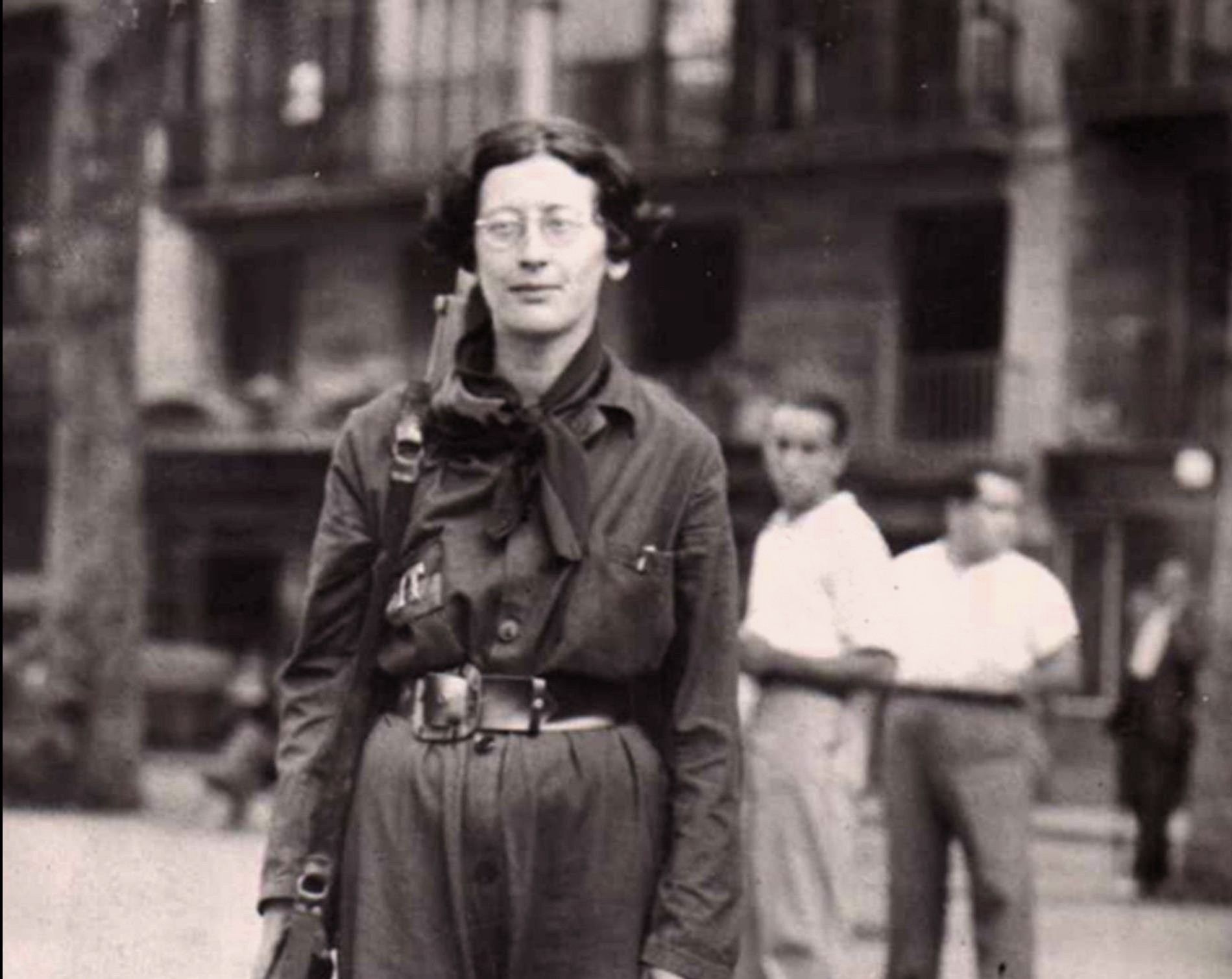
Brilliant and idiosyncratic, Simone Weil’s famous essay warning that the militarism of revolutionary wars risked deforming their own revolutions was written in 1933 at just 24-years-old. Reprinted here as the Spanish Civil War loomed, on the outbreak of which Weil, a pacifist-combatant, would travel to Spain and join the Durutti Column, despite her extreme nearsightedness, to fight fascism.
‘War and Revolution’ (1933) by Simone Weil from International Review. Vol. 1 No. 5. June, 1936.
From “Critique Sociale”, Paris
THE PROBLEM OF WAR is on the order of the day. We are living in the perpetual expectation of war. The prevalent reaction to the situation can be positively described as that of panic. Not so much the panic of courage before the menace of massacre, as the panic of the mind before the problems posed by the menace. Nowhere is this rout more noticeable than in the labor movement.
We must make a serious effort to analyze the situation facing us. Otherwise the first day of the war will find us impotent not the first thing we must do is to draw up the balance sheet of the traditions which have guided our behavior in similar situations hereto.
Up to the period following the last war, the revolutionary movement, in its various forms, had nothing in common with pacifism. The revolutionary stand on war and peace has always found its inspiration in the memories of the years 1792-3-4, the cradle of the revolutionary trends of the 19th century. In absolute contradiction with historic reality, the war of 1793 appeared as a victorious outburst that, by ranging the French people against all foreign tyrants, was going to break with the same blow the domination of the Court and the upper bourgeoisie and hand over the power to the representatives of the laboring masses. From this legendary belief, perpetuated by the song Marseillaise, flows the conception that a revolutionary war, defensive or offensive, is not only a legitimate form but one of the most glorious forms of the struggle of the toiling masses against their oppressors. This was the idea common to all Marxists and almost all revolutionaries up to about fifteen years ago. In fact, however, the socialist tradition has given us more than one conception of war. It has given us several contradictory ones, which have never been clearly compared and evaluated.
IN THE FIRST HALF OF THE 19TH century, war seems to have had a certain prestige in the eyes of the revolutionaries, In France, for example, they vigorously rebuked Louis-Phillipe for his peace policy. Proudhon wrote an eloquent eulogy of war. The revolutionaries of the period dreamed not only of insurrections but of wars waged in order to liberate oppressed peoples. The war of 1870 forced the proletarian organizations—that is to say, the International—to take, for the first time, a definite stand on the question of war. The International, through Marx’s pen, invited the workers of the two combatant countries to show opposition against any attempt at conquest, but it also advised them to participate resolutely in the defence of their country in opposition to any attacking foreign adversary.
It was in behalf of another idea that Engels, in 1892, evoked the memories of the war of exactly one hundred years before when he called on the German social-democrats to fight with all their might in the case of a war of Germany against allied France and Russia. According to him, the matter was no longer one of defence or attack. It was now a question of preserving, either through an offensive or defence, that country where the working class movement was most powerful. It was a question of crushing that country which was most reactionary. According to this outlook, which was also that of Plekhanov, Mehring and others, the stand to be taken in a war could be determined by calculating what result would be most favorable to the international proletariat. Sides were to be taken accordingly.
This position is opposed by that of Lenin (the Lenin of 1914-1918, ed.), according to whom all but national or revolutionary wars were to be sabotaged by the proletariat in each country. It is also opposed by that of Rosa Luxemburg, according to whom the proletariat ought to try to sabotage all wars, excepting revolutionary wars. The last two conceptions, founded on the notion that all wars (save the mentioned exceptions) are imperialist in character and are to be compared to quarrels of bandits over the division of their booty, also have their difficulties. For they seem to break the unity of action of the international proletariat by engaging the workers of each country to work for the defeat of their own country, and favor at the same time the victory of the imperialist enemy, which, on the other hand, the workers in the Opponent country must endeavor to prevent.
LIEBKNECHT’S FAMOUS FORMULA: “Our enemy is in our country” clearly brings out the chief difficulty when it assigns to the various national fractions of the world proletariat a different enemy and thus, at least in appearance, opposes one section of the proletariat against the other.
It is obvious that on the question of war the Marxist tradition presents neither unity nor clarity. One point was common to all the Marxist trends: the explicit refusal to condemn war as such. Marxists—notably Kautsky and Lenin—willingly paraphrased Klausewitz’s formula, according to which war only served to continue the politics of peace times. War was to be judged not by the violence of its methods but by the objectives pursued through these methods.
THE PERIOD FOLLOWING THE WAR did not introduce a new conception of war into the labor movement. One can hardly accuse the labor organizations of our time of having definite ideas on the subject. But the post-war years did introduce a new moral atmosphere. As early as 1918, the bolshevik party which then desired a revolutionary war, had to resign itself to peace under the direct pressure from the Russian soldiers, whom the example of 1793 no more inspired with the desire of emulation than was evoked by Kerenski. In the same way, in other countries, the masses bruised by the war compelled the parties that leaned on the proletariat to adopt a language that was purely pacifist; a language which, moreover, did not prevent some from toasting the Red Army and others from voting war credits for their own country.
Let it be understood, that language was never justified theoretically. Nobody ever stopped to remark that there was something new about such an attitude. But the fact was that instead of attacking war because it was imperialist, people began to attack imperialism because it made wars. So that the so-called Amsterdam movement, which theoretically was directed against imperialist wars, was obliged, in order to be heard, to present itself as being against war in general. In its propaganda, the pacific inclinations of the U.S.S.R. were emphasized rather than the proletarian character—or that called such—of contemporary Russia. But the formulae of the great theoreticians of socialism on the impossibility of condemning war as such were completely forgotten.
THE TRIUMPH OF HITLER in Germany brought to the surface, so to speak, the entire inextricable tangle of the old conception. Peace appeared less precious now since it permitted the unspeakable horrors under which thousands of workers were groaning in the German concentration camps. The idea expressed by Engels in his 1892 article reappeared. Is not German fascism the principal enemy of the international proletariat just as Tsarist Russia was in those days? This fascism, spreading like a blotch of oil, can only be erased by force. And since the German proletariat is disarmed, it seems that only the might of the remaining democratic countries can clear away the stain.
Moreover, people said, it is not important to stop to decide whether we are dealing here with a war of defense or of a “preventive war.” Did not Marx and Engels at one time try to force England to attack Russia? The coming war can no longer be thought of as a struggle between two imperialist combatants but as a struggle between two political regimes. And just as it was suggested by old Engels in 1892 when he recalled what happened one hundred years before, so it is suggested now that a war will oblige the State to make serious concessions to the proletariat. Especially since the impending war will necessarily bring a conflict between the State and the capitalist class and, without question, also advanced measures of socialization. Who knows but the war may automatically carry to power the representatives of the proletariat?
All these considerations are beginning to create in the political circles that seek support among the proletariat a current of opinion that is more or less explicitly in favor of an active participation of the proletariat in a war against Germany. This current is still relatively weak, but it will without doubt swell. Others stick to the distinction between aggression and national defence. Still others hold on to Lenin’s conception. Others, as yet quite numerous, remain pacifists, for the most part from the force of habit. The confusion is great.
THE EXISTENCE OF SO MUCH uncertainty and obscurity may be found surprising and almost shameful considering the fact that we are dealing here with the most characteristic phenomenon of our time. It would be surprising, however, if we arrived at anything better in view of the persisting influence of the absolutely legendary and illusory tradition of 1793 and in view of the very defective common method of evaluating each war by its supposed ends rather than by the character of the methods employed. Nor would it be preferable to put the blame on the usage of violence in general, as does the pure pacifist. In each epoch war constitutes a clearly determined species of violence, the mechanism of which we must study before we can form any opinion. The materialist method consists above all in the act of examining all social acts in accordance with a procedure that seeks to discover the consequences necessarily implied in the working out of the methods employed instead of taking the avowed ends of the human facts in question at their face value. One cannot solve nor even state a problem relating to war without first taking into account the mechanism of the military struggle, that is, without first analyzing the social relationships implied by war under the given technical, economic and social conditions.
WE CAN SPEAK OF WAR in general only abstractly. Modern war differs absolutely from anything designated by that name under previous regimes. On one hand, war is only a projection of that other war which bears the name of competition and which has made of production a simple form of struggle for domination. On the other hand, all economic life now moves toward an impending war. In this inextricable mixture of the military and economic, where arms are put at the service of competition and production is put at the service of war, war merely reproduces the social relationships constituting the very structure of the existing order but to a more acute degree.
Marx has shown forcefully that the modern method of production consists essentially of the subordination of the workers to the instruments of labor, which are disposed of by those who do not work. He has shown how competition, knowing no other weapon than the exploitation of the workers, is transformed into a struggle of each employer against his own workmen and, in the last analysis, of the entire class of employers against their employees.
In the same way, war in our days is distinguished by the subordination of the combatants to the instruments of combat. And the armaments, the true heroes of modern warfare, as well as the men dedicated to their service, are directed by those who do not fight. And since this directing apparatus has no other means of fighting the enemy than by sending its own soldiers, under compulsion, to their death, the war of one State against another State resolves itself into a war of the State and the military apparatus against its own army.
War in the last analysis appears as a struggle led by all the State apparatuses and their general staffs against all men old enough and able to bear arms. But while the machine used in production takes from the worker only his labor power and while employers have no other weapon of constraint than dismissal—a weapon that is somewhat blunted by the existence of the possibility for the worker to choose among different employers—each soldier is forced to sacrifice his very life to the needs of the total military machine. He is forced to do so under the menace of execution without the benefit of a trial, which the State power holds over his head. In view of this, it makes little difference whether the war is offensive or defensive, imperialist or nationalist. Every State is obliged to employ this method since the enemy also employs it.
THE GREAT ERROR OF NEARLY ALL studies of war, an error into which all socialists have fallen, has been to consider war as an episode in foreign politics when it is especially an act of interior politics, and the most atrocious of all.
We are not concerned here with sentimental considerations or with a superstitious respect for human lfie. We are concerned with a very simple fact, the fact that massacre is the most radical form of oppression and that soldiers do not merely expose themselves to death but are sent to death. And since every apparatus of oppression, once constituted, remains such till it is broken, every war that places the weight of a military apparatus over the masses, forced to serve it in its maneuvres, must be considered a factor of reaction even though it is led and directed by revolutionists. As for the exterior compass of such a war, that is determined by the political relationships established in the interior. Arms wielded by the apparatus of a sovereign State cannot bring liberty to anybody.
THAT IS WHAT ROBESPIERRE came to understand and that is what was verified so brilliantly by the war of 1792, the war that gave birth to the notion of revolutionary wars.
At that time, military technique was far from reaching the degree of centralization of our days. Yet, after Frederick II, the subordination of the soldiers, charged with executing the war operations, to the high command, charged with coordinating these operations, was quite strict. At the time of the French Revolution, war was to transform France, as Barrére put it, into a vast cam and as a result give to the State apparatus the power without appeal that is usually held by military authority. And such was the very calculation made by the Court and the Girondins in 1792. For this war—which a legend so easily accepted by socialists has made appear as a spontaneous outburst of the mass aroused against its oppressors and at the same time against the foreign tyrants menacing the mass—was in fact a provocation on the part of the Court and the upper bourgeoisie united in a plot against the liberties of the people.
In appearance the Court and the Girondins had made a mistake. For instead of bringing the Holy Alliance for which they hoped, the war exasperated all the conflicts and sent the king and then the Girondins to the guillotine and put dictatorial power into the hands of the Montagne. But this does not negate the fact that on the 20th of April, 1792, the day of the declaration of war, all hope for democracy foundered. The second of June was followed but too soon by the 9th of Thermidor, which, in turn, served to usher in the 18th of Brumaire. Of what good to Robespierre and his friends was the power they exercised before the 9th of Thermidor? Their aim was not merely to seize power. Their aim was to establish an effective democracy, at the same time social and democratic. By the bloody irony of history, the war forced them to leave on paper the Constitution of 1793. It forced them to exercise a bloody reign of terror, which they could not even turn against the rich. It forced them to destroy all liberty. It forced them, in short, to prepare the way for the bourgeois, bureaucratic and military despotism of Napoleon.
The revolutionaries of 1792 at least remained clear-headed. On the eve of his death, Saint-Just wrote this profound formula: “Only those who are in battles win them, and only those who are powerful profit from them.”
As for Robespierre, as soon as he faced the question, he understood that war, powerless to free any foreign people (“one does not bring liberty at the point of the bayonet”), would hand over the French people to the chains of State power, a power that one could not attempt to weaken at the time when it was imperative to struggle against the foreign enemy. “War is good for military officers, for the ambitious, for money-jobbers…for the executive power…The condition of war settles for the State all other cares; one is quits with the people as soon as war is given to it”. He foresaw very soon the military despotism that was coming. He never ceased to point this out in spite of the apparent successes of the Revolution. He again predicted it in his death speech. He left this prediction after him as a testament to which those who have since made use of his name have unfortunately paid no attention.
THE HISTORY OF THE RUSSIAN REVOLUTION furnishes exactly the same data, and with a striking analogy. The Soviet Constitution met the same fate as the Constitution of 1793. Like Robespierre, Lenin abandoned his democratic doctrines of the time of the revolution in order to establish the despotism of the apparatus of a centralized State. He was the precursor of Stalin just as Robespierre was the precursor of Bonaparte. There is a difference. Lenin had prepared this domination of the State apparatus by forging a strongly centralized party. He deformed his own doctrines in order to adapt them to the needs of the hour. Moreover, he was not guillotined, but became the idol of a new state religion.
The history of the Russian Revolution is the more striking because war constitutes its central problem. The revolution was made as a movement against war by soldiers who, feeling the government and military apparatus go to pieces over them, hastened to shake off an intolerable yoke. Kerensky, invoking with an involuntary sincerity due to his ignorance the memory of 1792, appealed to them to continue the war for exactly the same reasons as the Girondins before. Trotzky has admirably shown how the bourgeoisie, counting on war to adjourn the problems of interior politics and to lead back the people under the yoke of State power, wanted to transform “the war till the exhaustion of the enemy into a war for the exhaustion of the Revolution”.
The Bolsheviks then called for a struggle against imperialism. But it was war itself and not imperialism that was in question. They saw this well when, once in power, they were obliged to sign the peace of Brest-Litovsk. The old army was then broken up. Lenin repeated with Marx that the dictatorship of the proletariat could tolerate neither a permanent army, police or bureaucracy. But the white armies and the fear of foreign intervention soon put the whole of Russia into a state of siege. The army was then reconstituted, the election of officers suppressed, thirty thousand officers of the old regime reinstated in the cadres, the death penalty, the usual discipline and centralization reestablished. Parallel with this, came the reconstitution of the police and bureaucracy. It is well known what this military, bureaucratic and police apparatus consequently did to the Russian people.
REVOLUTIONARY WAR IS THE GRAVE of revolution. And it will be that as long as the soldiers themselves, or rather the armed citizenry, are not given the means of waging war without a directing apparatus, without police pressure, without exceptional jurisdiction, without punishment for deserters. Once in modern history was a war carried on that way—under the Commune. Everybody knows with what results. It seems that revolution engaged in war has only the choice of either succumbing under the murderous blows of counter-revolution or transforming itself into counter-revolution through the very mechanism of the military struggle.
The perspectives of a revolution seem therefore quite restricted. For can a revolution avoid war? It is, however, on this feeble chance that we must stake everything or abandon all hope. An advanced country will not encounter, in case of revolution, the difficulties which in backward Russia served as a base for the barbarous regime of Stalin. But a war of any range will give rise to difficulties that are at least as formidable.
For the strongest reasons a war undertaken by a bourgeois State cannot but transform power into despotism and subjection into assassination. If war sometimes appears as a revolutionary factor, it is only in the sense that it constitutes an incomparable test for the functioning of the State. In contact with war, a badly organized apparatus collapses. But if the war does not end soon or if it starts up again, or if the decomposition of the State has not gone far enough, the situation results in revolutions, which, according to Marx’s formula, perfect the State apparatus instead of shattering it. That is what has always happened up-to now.
In our time the difficulty developed by war to a high degree is especially that resulting from the ever growing opposition between the State apparatus and the capitalist system. The Briey affair during the last war provides us with a striking example. The last war brought to several State apparatuses a certain authority over economic matters. (This gave rise to the quite erroneous term of “War Socialism”.) In consequence, the capitalist system reverted to an almost normal functioning in spite of the customs barriers, quotas and national changes. There is no doubt that in the next war things will go a little farther, and we know that quantity can transform itself into quality. In this sense, war can constitute in our time a revolutionary factor, but only if one wants to give the term “revolution” the meaning given to it by the Nazis.
Like the crisis, war will provoke a lively hostility against the capitalists. This hostility, manipulated by the Holy Alliance, will benefit the State apparatus and not the workers. Furthermore, in order to recognize the kinship tying the phenomenon of war to that of fascism, it suffices to turn to the fascist texts, which evoke tirelessly the “warrior spirit” and the “socialism of the front”. In both cases, we are dealing with the total effacement of the individual before the State bureaucracy through the instrumentality of an exasperated fanaticism. If the capitalist system finds itself more or less damaged in the affair, it will be only at the expense and not at the profit of human values and the proletariat, if demagogy goes as far as it can in certain cases.
THE ABSURDITY OF AN ANTI-FASCIST struggle which chooses war as its means of action thus appears quite clear. Not only would this mean to fight barbarous oppression by crushing peoples under the weight of even more barbarous massacre. It would actually mean spreading under another form the very regime that we want to suppress. It is childish to suppose that a State apparatus rendered powerful by a victorious war would lighten the oppression exercised over its own people by the enemy State apparatus. It is even more childish to suppose that the victorious State apparatus would permit a proletarian revolution to break out in the defeated country without drowning it immediately in blood. As for bourgeois democracy being annihilated by fascism, a war would not do away with this threat but would reinforce and extend the causes that now render it impossible.
It seems that, generally speaking, history obliges every political action to choose between aggravating the oppression exercised by the various State apparatuses and carrying on a merciless struggle against these apparatuses in order to shatter them. Indeed, the almost insoluble difficulties presenting themselves nowadays almost justify the pure and simple abandonment of the struggle. But if we are not to renounce all action, we must understand that we can struggle against the State apparatus only inside the country. And notably in case of war, we must choose between hindering the functioning of the military machine of which we are ourselves so many cogs or blindly aiding that machine to continue to crush out human lives.
Thus Liebknecht’s famous words: “The principal enemy is in our own country” take on their full significance and are revealed to be applicable to all wars in which soldiers are reduced to the condition of passive matter in the hands of a bureaucratic and military apparatus. Which means to say that as long as the present war technique continues, these words apply to any war, absolutely speaking. And in our time we can not foresee the advent of another technique. In production as in war, the increasingly collective manner with which forces are operated has not modified the essentially individual functions of decision and management. It has only placed more and more of the hands and lives of the mass at the disposal of the commanding apparatuses.
AS LONG AS WE DO NOT perceive that it is possible to avoid in the very act of production or of fighting, the domination of an apparatus over the mass, so long every revolutionary tentative will have in it something of the hopeless. For if we do know what system of production and combat we aspire with all our heart to destroy, we do not know what acceptable system could replace it. Furthermore, every attempt at reform appears puerile in face of the blind necessities implied in the operation of the monstrous social machine. For present society resembles an immense machine that ceaselessly snaps at human beings and which no one knows how to master. And they who sacrifice themselves for social progress resemble persons who try to catch hold of the wheels and transmission belts in order to stop the machine and are destroyed in their attempts.
But the helplessness in which we find ourselves at present, an helplessness which must never be regarded as unchanging, cannot exempt us from keeping faith with ourselves. It cannot excuse capitulation to the enemy, no matter what mask he assumes. No matter what is the name by which the enemy adorns himself—fascism, democracy or “dictatorship of the proletariat”—the main enemy still remains the administrative, police and military apparatus. Not the apparatus that is in front of us—that is only as much our enemy as it is the enemy of our brothers—but the apparatus, over and in back of us, that says it is our defender and makes of us its slaves. No matter under what circumstances, the worst possible treason consists in accepting subordination to this apparatus and trampling, in order to serve it, all human values in ourselves and others.
Translated by Jane Sherman
International Review was a short-lived, independent Marxist journal edited by Herman Gerson, pen name Integer, which hosted writers of the anti-Stalinist left, best known for its translation and publication of Rosa Luxemburg’s ‘Reform or Revolution’.
PDF of full issue: https://archive.org/download/international-review-1936_1936-06_1_5/international-review-1936_1936-06_1_5.pdf
 Revolution's Newsstand