New York City’s Transport Workers Union was a dynamic force in the early CIO. Begun modestly in 1934, by 1937 it had organized most of the city’s transit workers and had tens of thousands of members. Part of its work was in creating recreation programs for its members, including sports teams. Those teams soon became powerhouses in their fields.
‘Labor Sports with The Transport Workers Union’ by Fred Kitty from Champion of Youth. Vol. 3 No. 8. July, 1938.
IT IS a number of years, now, since labor unions, among other progressive organizations, came to recognize the important role played by sports on the American scene and the important role they could and should play in the activities of the labor unions.
However, it was with the coming of the CIO and the great mass industrial unions that labor sports really made a start. For with the CIO’s organizational surge came, too, the realization to labor leaders that a broad union sports program would go a long way in drawing their newly won recruits closer to the unions.
Especially in the large mass unions, auto, steel, rubber, mining, and transport have firm foundations been laid down for a great sports program. Softball and basketball have served as the backbone of labor sports in the midwestern steel and auto unions. In the East, in New York City, the Transport Workers Union has shown the way in the organization of baseball as a mass sport.
In their building of a sports movement, the labor unions had to cope with many obstacles—the greatest of these, of course, the problem of finances. These pioneers were trying to build a large scale sports movement, requiring ordinarily thousands of dollars, on a shoestring. Then, too, there was the problem of drawing their membership away from their sheeplike support of the highly publicized billion-dollar sports industry—major league baseball—in huge plants such as New York’s Yankee Stadium which seats about 90,000 spectators, the ballyhooed boxing game, the faked-up wrestling racket, et al. That the unions were able to meet with and overcome these obstacles is a tribute to their remarkable determination to build Workers’ Sports.
Until recent years, numerous attempts to organize the New York transport industry had been quite uniform in one respect—their failure to gain more than a handful of the thousands of workers in the industry for the union. With the appearance of the TWU on the scene, however, the transport industry got a much-needed shock. This dynamic young union (the overwhelming majority of the TWU’s membership has joined within the last 20 months, and most of its closed shop contracts have been signed within the last 12) now totals 52,000 members in New York City and 65,000 nationally.
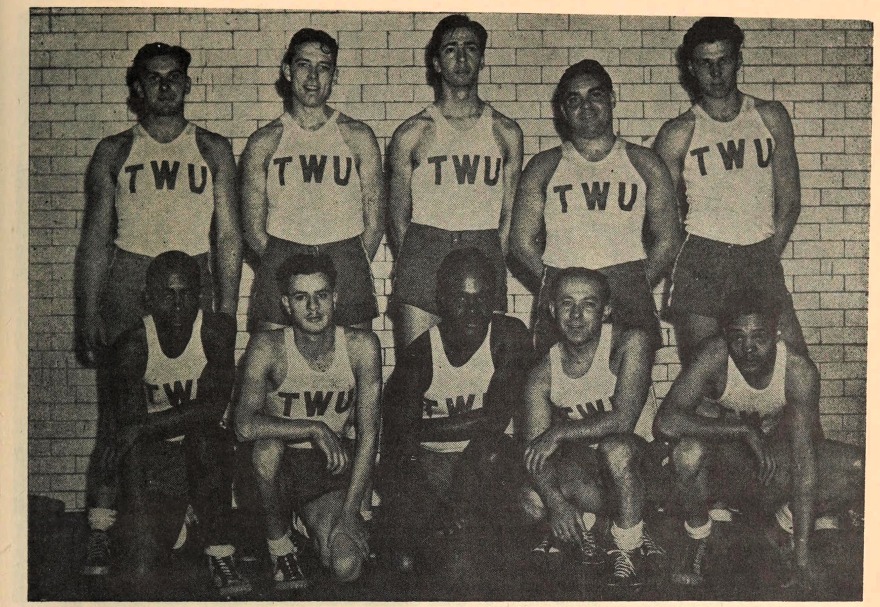
IN THE sports field, the TWU again registered an amazing growth, though their beginnings were quite modest. The fall of 1937 saw two TWU teams take the field—one basketball, the other soccer. The soccer team, playing in the Manhattan Soccer League, was one of the outstanding teams in the League, even though they didn’t nab the championship cup. While the TWU hoopsters competed in the Trade Union A.A. league, and, while they weren’t quite a ball of fire, they played pretty fair basketball for a new team.
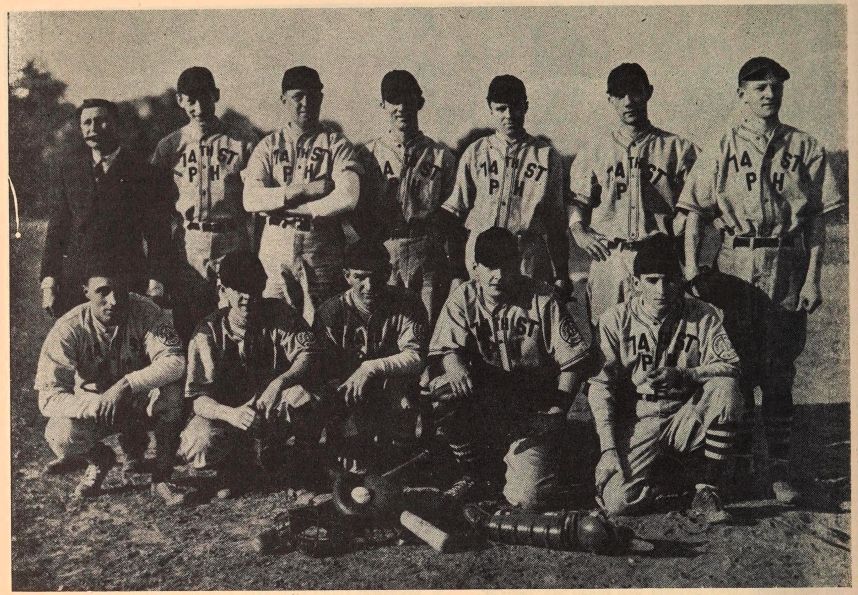
With the Spring of 1938, the Transport Workers, their newly acquired athletic director, Jack Roth, at the helm, launched a sports program which exceeded the expectations of the most hopeful unionists.
The TWU organized no less than 34 teams into 4 leagues; 510 players are playing in the competition and hundreds of union men come down to root for their representatives. This is a mighty landmark on the road to a mass workers’ sports program!
Not stopping with this feat, the Transport Workers are going ahead in their construction of a recreational program and they don’t intend to stop until their entire membership is engaged in some sort of athletic activity. The TWU has already made a start or is just about to start in the following sports: Handball, Boxing, Track and Swimming—with the possibilities of Softball, Bowling, Fencing, Ping-Pong, Gymnastics, Wrestling and Tennis still in the offing.
Recently, a questionnaire including a list of 12 different sports was issued to the membership, asking them to indicate the sports they prefer to engage in.
The thirty-four TWU teams are divided into four leagues—two of ten teams each, A, B, C, and D. The winners of the four TWU leagues will automatically enter the quarterfinals of the Trade Union A.A. tournament, with a possibility of emerging as the Trade Union A.A. baseball rulers.
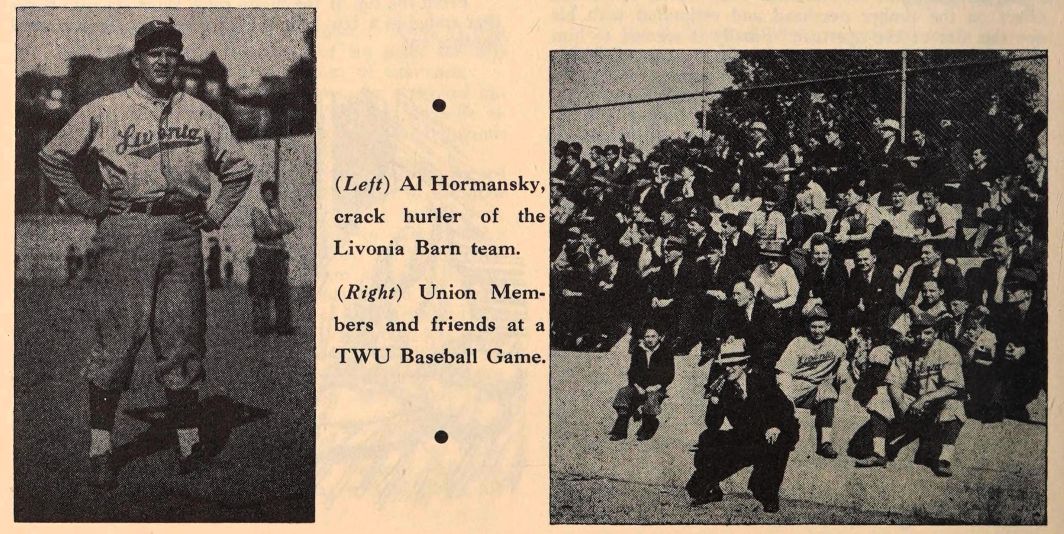
It’s a bit too early in the season to try to pick the TWU winners, but not too early to indicate the outstanding teams thus far in the competition. In the “A” league the IRT Lighting and Maintenance outfit is out in front with four wins in as many starts with the Livonia Barn and Bell Taxi Maintenance nines right at their heels with five won and one lost. In the “B” league the East New York Depot and the Crosstown Depot lead the pack with undefeated records in three and two contests respectively. The Flatbush Depot nine is in third place with two wins in three starts. The Independent Subway 207th Street Shop “A” team, the IRT Structural Department, and the 59th Street Powerhouse teams occupy the first three notches in the “C” league, with records of 3-0, 2-0, and 2-1 respectively. Only one game has been played in the “D” league with the 180th Street Division Surface Transport Drivers emerging victorious over the Kingsbridge Operators.
HANDBALL in the Transport Union is due to get under way as this article goes to press. Swimming has been brought closer to the TWU’s membership by getting reduced rates for members at the Parc Vendome Hotel Pool. Members of the TWU merely have to show their union books at the door to get the reduced rates.
Track and Field hopefuls, who heretofore had confined their track work to the steel of New York City’s multifarious subway and trolley lines, will get an opportunity to do work on a track of a different sort—a cinder track. The TWU is entering a team in the Trade Union A.A. Track and Field Carnival which will be held this August in New York City.
Boxing recently took first place in TWU sports when on the night of April 22 the Transport Workers sponsored a Boxing Carnival at the Bay Ridge Boys Club. The boxing matches. with Transport men in the feature bouts, were attended by a capacity crowd.
The good work of the TWU was not accomplished without its share of difficulties. The managers of all the teams could tell a woeful tale of lack of funds and of searches for suitable fields.
Take the case of Johnny Raia, sports director of the 74th Street Powerhouse. The story leaked out of how Johnny, in making a collection, found that he had collected only $20 towards equipping the team. So Johnny laid out $78.75 of his own money and when asked how the collection was going, he said, “It’s going fine.” Fortunately, Johnny finally collected enough money to repay him for what he had contributed. In Johnny Raia’s local no less than 215 men out of a possible 275 gave money to outfit their team.
The TWU, thus far, has done a good job but is by no means finished. In the words of Jack Roth, “the Transport Workers are going to go ahead with their sports activity until we have involved the great majority of our membership in a broad mass recreational program.”
Champion of Youth and Champion Labor Monthly were the Popular Front-era publications of the Young Communist League published from 1936-1939 and as such included many writers from Socialist, liberal, and radical traditions as well as the Y.C.L.
PDF of full issue: https://archive.org/download/champion-labor-monthly_1938-07_3_8/champion-labor-monthly_1938-07_3_8.pdf
 Revolution's Newsstand