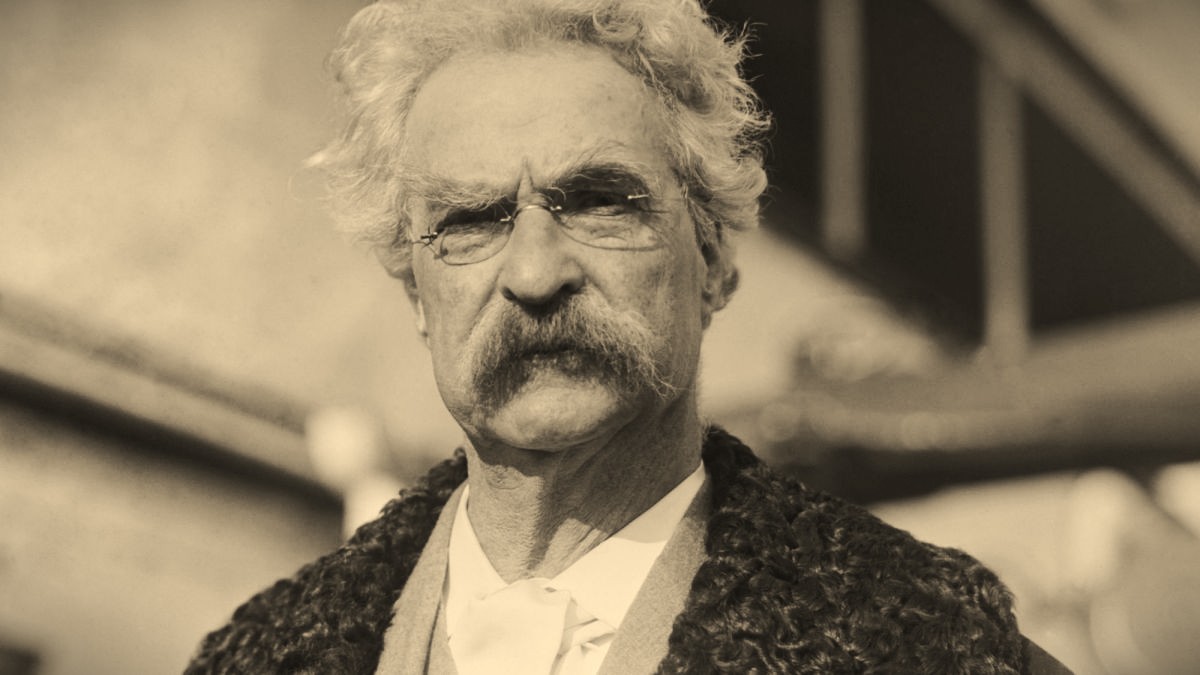
Mark Twain was, and remains, a giant of U.S. literature and social criticism. For Twain, humor had many devices, not least was to safely deliver some of the most profound observations on human behavior ever made, while novels such as Puddin’head Wilson stand as a social challenge even today. However, as late as 1935 much of Twain’s most biting satires and critiques of American life remained unpublished or fragmentary. Below a ‘Soviet View of an American Classic.’
‘The Satire and Humor of Mark Twain’ by Sergei Dinamov from International Literature. No. 5. 1935.
A Soviet View of an American Classic
For decades the world knew Mark Twain as a writer whose works bubbled over with humor. And for decades the world remained profoundly ignorant concerning the real Mark Twain; for his sparkling, flashing, rumbling humor hid the frightful grimace of a man who in private confessed: “I degrade myself—I force myself to play the part of an official jester. This is terrible. I cannot bear it any longer.” The irrepressible laughter is interrupted by sudden spasms; the smile of the humorist fades away; the ridiculous is transformed into the terrible. Yes, the world did not know and does not yet know the “fun-maker,” Mark Twain. Twain’s biographers love to cite from his letter, written after the death of his daughter: “My temperament has never allowed me to remain in poor spirits for a long time.” It is possible that personal misfortunes actually affected him but slightly, but we are not interested in narrowly biographical episodes. The point is that Mark Twain’s life and work afford a most striking example of the manner in which bourgeois reality breaks the genuine artist; degrades him, forces him to submit to that which should be destroyed, assent to that which should be denied, keep silent concerning that which should be cried “aloud in the face of all mankind; disavow that for which he should struggle. The life of the “fun-maker” Twain was a tragic one.
“In the evening,” wrote his daughter in 1886, “daddy and I went to the library, where he told me that he wanted to write only one book—write it or die. And he wrote even) more than he intended, and shut it up in a safe and has not had it published.” Twain wanted to publish it, but he could not, for in this “secret” work he assumed the role of a satirist, of a wrecker of bourgeois foundations and) consequently of his own diverting works and his fame, for bourgeois America never forgives anyone the crime of being a genuine satirist.
For forty years Mark Twain kept hidden the manuscript of his Captain Stormfield’s Visit to Heaven—from this same fear of bourgeois public opinion. In one of his stories he drew a realistic picture of the priesthood. This story he handed over for approval to his permanent literary advisers—his wife and the famous critic and novelist, the first president of the American Academy of Arts and Sciences, William Dean Howells. This “council” would of course not permit the publication of the story. Twain translated it into German, but it was of no avail: the story never saw the light. That is what lay behind the bitter remark: “He who writes for the press fears the public; but he fears himself even more; for he cannot believe himself.” His biographer, Paine, cites a short note written by Twain, in which he remarks that it is best not to write for others: “In one’s letters one can write with complete honesty and freedom—if one does not show them to anyone else.” Only through random scraps of letters, notes and reminiscences can we restore the portrait of this melancholy humorist, for only the future will know the autobiography of Mark Twain.
In Twain’s book, The Mysterious Stranger, published only after his death, Satan declares to the hero: “You suffer from lack of courage.” Mark Twain spoke of this shortcoming more than once. But the problem was not merely one of the personal qualities of the writer, but rather of the position of his class—the petty bourgeoisie.
II
Mark Twain’s first book, The Celebrated Leaping Frog of Calaveras County, appeared in 1867. The sixties and seventies of the last century were the years of the rapid rise of American capitalism. This rise was accelerated by the fact that the Civil War of the early sixties had on the one hand retarded this rise, and on the other determined it; inasmuch as it destroyed the economic system of the South, which was founded on slavery and had constituted an impediment to “normal” capitalist development. The country came under the control of one central government, which was in essence the “Execution Committee” of Capitalism.
New banks sprang up; grandiose speculations were executed; new railroad lines were built. Around these arose an “orderly” system of fraud and swindling (misappropriation of immense areas of government land, the granting of huge subsidies without the slightest basis, the issue of worthless stock, etc.). New branches of industry arose; trade rapidly developed. Mark Twain neatly dubbed this period “The Gilded Age.” And in reality it was just that—“gilded” and not golden. The precipitous advance of capitalism resulted in intellectual stagnation, narrow mindedness, cultural constriction; for it signified the suppression of all that was socially vital, of all that breathed the spirit of revolt—for capitalism no longer found it necessary to fight with feudalism, in comparison with which it constitutes a historically progressive form.
In his book, Plain Americans, the critic Canby takes a leaf from the Calvinist ethic of life, calling it “the backbone of Puritan civilization.” There we read: “In all the situations of life the Christian should hourly endeavor to show that he is a godly, righteous man, able to save himself from the fires of Hell only through his god-given sense of the divine.” This pompous and cloudy statement meant, in essence, that religious doctrine played a dominant role in the American scheme of things; that no backslidings from that which was generally accepted could be tolerated; that public opinion should cut off any dissenting free-thinker; that no protest against the bourgeois scheme of things would be supported by a single hundred percent American. Horace Fletcher, who formulated a theory of the optimistic attitude towards reality, rephrased this religious thesis in practical language: “Optimism can be prescribed like medicine…The business man can make practical use of it, apply it in his affairs and profits thereby. Optimism means ease, pleasantness, utility and profit.” For the gilded age” optimism became a philosophy of life which dominated men’s dispositions. Don’t look at the dark side of things; see nothing unpleasant; don’t protest; be submissive: regard life with a smile—such was the device of “the gilded age.” William Dean Howells, that, in the words of Twain, “critical court of the last instance, from whose rulings there is no appeal in our country,” made this “philosophy” the basis of all art, propounding the thesis that “the most optimistic views on life are the most American.” This thesis became the basis of the so-called school of “tender realism”—realism without real contradictions; realism without satire; realism without protest.
Bernard Shaw once remarked that America had created only two real men on genius: Edgar Allan Poe and Mark Twain. Let us leave to Shaw’s conscience the soundness of this statement (for we cannot forget Walt Whitman, a more significant artist than either Poe or Twain), and let us consider that which Poe and Twain have in common—their retreat from the contemporary scene. This may sound rather strange, for there exists a tradition that Twain was preeminently an artist of his day. Paine, for example, affirms that Twain “more than anyone else lived in the present.” This is both true and untrue: every artist lives in the present, although there should not be the slightest indication of it in his work; for this very turning to the past is caused by his inability either to come to terms with his environment or to denounce it.
“The tacit, colossal lie of ‘nation’ is the foundation and ally of tyranny, shame, inequality and dishonesty, which grieve the peoples, and it should be assailed with word and stone. But let us be discreet and leave it to someone else to begin,” once remarked Mark Twain—that Twain who wrote in a letter in 1887 that whereas in 1871 he had considered himself a Girondist, he now regarded himself a sans-culotte.
This “not a colorless, characterless sans-culotte, but a Marat,” this “Marat” Twain nevertheless left it to others “to begin” while he himself multiplied this “lie of nation” with his amusing stories, his professional optimism. The contemporary scene weighed heavily upon him, and to the very end he could not reconcile himself to it. But no more could he attack it, for he was organically bound to the conservative layers of the petty bourgeoisie. Such was the genesis of a number of works in which he escaped from his environment, departing into distant ages and localities. Life on the Mississippi—America’s past, so romantic, full of stormy episodes and strong men–A Connecticut Yankee at King Arthur’s Court—medieval England, The Prince and the Pauper—15th century England, Joan of Arc—14th century France, The Mysterious Stranger—16th century Austria.
Here Mark Twain raises himself to the dignity of a satirist; he is merciless in his description of the barbarism, coarseness and cruelty of feudalism; he comes to the defence of peasants and servants, and we can understand his condemnatory pathos; because capitalism attacked feudalism professedly for the welfare of all mankind; because the bourgeoisie, fighting for its class interests, proclaimed itself the emancipator of man and citizen, although immediately after the fall of feudalism it showed that by “man and citizen” it meant—the bourgeois, Twain’s class affiliations permitted him to assume here the role of a satirist. But to become a satirist of the contemporary scene would have necessitated a shift to other class positions. Letters, leaves from Twain’s note book and other documents indicate that Twain recognized the necessity of turning the sharp fire of satire upon his environment. Moreover, the conservatism of the petty bourgeoisie was already being put to a test, for the crisis of 1893 shattered “the gilded age,” while even earlier, in 1886, a number of working class actions had taken place. The development of class contradictions inevitably brought American writers into conflict with bourgeois society.
Such, for instance, were: Stephen Crane, who provoked the loud outcry of the conservative press by his realistic portrayals of the Civil War (The Red Badge of Courage) and the plight of women (Maggie, A girl of the Streets), Frank Norris, author of the novels, The Octopus and The Pit, and Hamlin Garland, who, like Norris, described the misery of the farming population. Mark Twain was not a member of this pleiad of petty bourgeois radicals. But his story The Man Who Corrupted Hadleyburg appeared at just this time—1899. This story indicates what Mark Twain might have been had he dared to be himself; had he dared to cut himself free from his class as did Theodore Dreiser.
Likewise satirical in character is the story Captain Stormfield’s Visit to Heaven, the manuscript of which he kept hidden for forty years. In this story Twain ridicules the ordinary conceptions of heaven. He brings thither inequality and servility; i.e. he denies that which the church affirms. Lastly, in the novel Puddin’head Wilson appear a number of satirical portraits, in which the stagnation of the American provinces, their narrowmindedness and intolerance to all social innovations are depicted. Through his mouthpiece, Puddin’head Wilson, he makes several extremely passionate comments on the bourgeois scheme of things.
But Twain himself dulls the edge of his weapons; he neutralized the effect of his satire. Thus, in his most radical novel, Puddin’head Wilson, he begins with all manner of fortuitous incidents, chiefly of a detective story character, and in conclusion all contractions are made to take on an accidental and unessential character. By revealing the attitude of the small town philistines towards Wilson, who frightens them by his unconventionality, Twain exposes their dullness and narrow-mindedness. But there is the inevitable happy ending. Wilson receives recognition; the unjust treatment which was accorded to him is shown to have been based on error—and satire degenerates into humor. This is not accidental. The petty bourgeoisie, as such, has never been able to undertake an independent, active struggle against capitalism. Only when fighting shoulder to shoulder with the proletariat does it become strong. And in America such a union has only been effected now, around the Communist Party.
III
Van Wyck Brooks, author of the interesting biography, The Ordeal of Mark Twain, considers Twain’s most “honest” books to be those extraordinary twins, Captain Stormfield’s Visit to Heaven, Puddin’head Wilson, and lastly, The American Pretender. This last is to a certain degree a continuation of the novel The Gilded Age, which treats of an earlier period, immediately following the Civil War.
In The American Pretender Twain develops the struggle between two systems: the aristocratic, in the person of the family of Earl Rossmore, and the bourgeois-democratic, in the person of the former’s American relations and a large number of other characters. At first Twain is silent concerning his hostility to certain aspects of bourgeois democracy; the young Earl Rossmore and other characters speak in the most flattering terms of the equality of all before the law; Twain turns Rossmore into a typical ideological representative of bourgeois democracy, and refrains from introducing his own “corrections.”
America is described to the young earl as a democratic paradise; where all are equal; where each is free; where genuine freedom of speech exists. But, journeying there, he becomes convinced that American equality is merely a surface form of inequality; that by freedom, in America, is meant freedom for the rich; that the dollar is the driving force of “democracy.” The free press, he finds, is a fiction; for the press is bought and sold like a commodity. And Rossmore discards his ideals and returns to his castle.
Mark Twain likewise exposes the lie of democracy in the person of the Sellers Family. We see them fawning before the aristocracy, dreaming of titles and distinctions, ready to exchange all the blessings of bourgeois democracy for aristocratic advantages. Similar treatment is extended to a number of other characters, notably in the exposure of the bourgeois interior of the “class conscious” worker Barrow.
But Mark Twain could not help neutralizing the effect of these radical utterances of opinion. Having depicted these or other negative traits of aristocratic and bourgeois society, he then cancels, so to speak, one defect with another; for, in the last analysis, he finds in both these social groups certain universal human attributes: kindness, idealism, tenderness, ability, manhood, perseverance. He crosses these two lines—the aristocratic and the bourgeois, and unites them, ending the novel with the inevitable marriage and the happy pair.
Thus in this novel also, Twain remained true to himself and did not pass beyond the orbits of his class…
“Everyone, like the moon, has his dark side, which he reveals to no one,” once said Mark Twain. We shall remember that side of Twain which was destroyed by bourgeois society, in creating the humorist and annihilating the satirist. At the price of his artistic downfall Twain purchased a place on the heights of fame. At the price of creative sterility he purchased the title of a “famous writer.” For us his “dark” side is more valuable than the “lighted” one; for us that which died in him is dearer than the “living.” It is possible to forget his laughter, but it is impossible to forget the blows of his satire.
Translated from the Russian by B. Keen
 Revolution's Newsstand