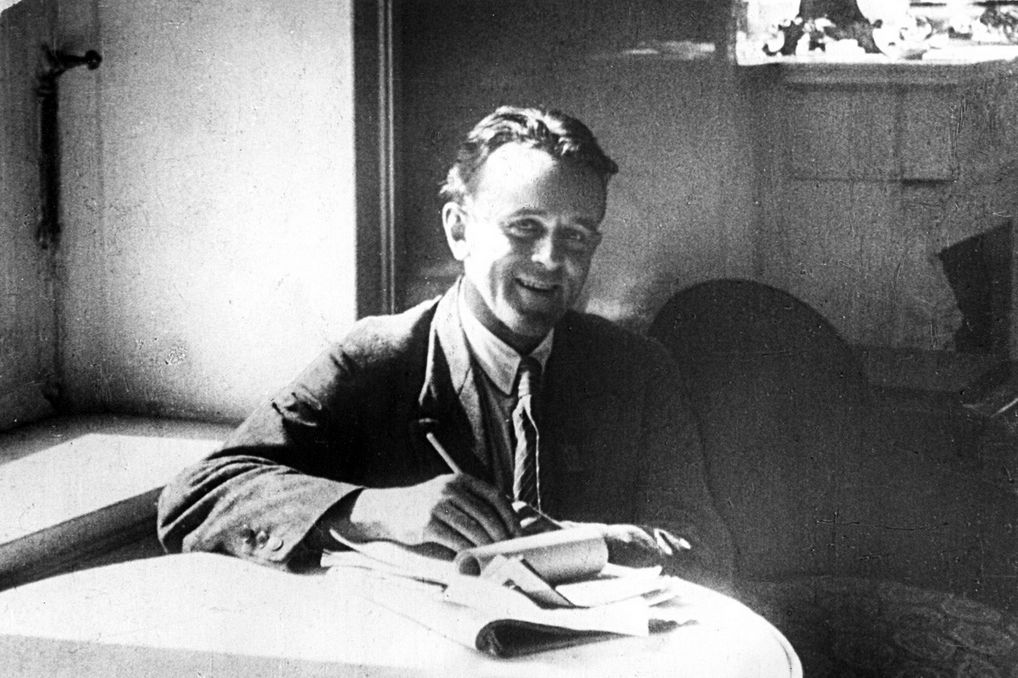
Seeing and reporting on the European war up-close was, of course, a milestone experience in John Reed’s deepening politicization. That process is well seen in the story below, and it is surely a story-and surely informed by real people, as Reed visits the Serbian Army on the front lines and interviews a pre-war Socialist about the lost world of before the war.
‘The World Well Gone’ by John Reed from The Masses. Vol. 8 No. 4. February, 1916.
THE Serbian town of Obrenovatz is a cluster of red tile roofs and white bulbous towers, hidden in green trees on a belt of land, around which sweeps the river Sava in a wide curve. Behind rise the green hills of Serbia, toppling up to blue ranges of mountains upon whose summit heaps of dead bodies lie still unburied, among the stumps of trees riddled down by machine-gun fire; and half-starved dogs battle there ghoulishly with vultures. Half a mile away on the bank of the yellow river, the peasant soldiers stand knee-deep in inundated trenches, firing at the Austrians three hundred yards away on the other side. Between, the rich hills of Bosnia sweep westward forever like sea-swells, hiding the big guns that cover Obrenovatz with a menace of destruction. The town itself is built on a little rise of ground, surrounded by flooded marshes when the river is high, where the sacred storks stalk seriously among the rushes, contemptuous of battles. All the hills are bursting with vivid new leaves and plum tree blossoms like smoke. The earth rustles with a million tiny thrills, the pushing of pale green shoots and the bursting of buds; the world steams with spring. And regular as clockwork, the crack of desultory shots rises unnoticed into the lazy air. For nine months it has been so, and the sounds of war have become a part of the great chorus of nature.
We had dinner with the officers of the Staff,–goodnatured giants, who were peasants and sons of peasants. The orderly who fell upon his knees to brush our shoes and stood so stiffly pouring water over our hands while we washed, and the private soldiers who waited on us at dinner with such smart civility, came in and sat down when coffee was served, and were introduced all round. They were intimate friends of the Colonel.
After dinner somebody produced a bottle of cognac and a box of real Havana cigars, which Iovanovitch laughingly said had been captured from the Austrians two weeks before, and we strolled out to visit the Serbian batteries.
Westward over the Bosnian hills a pale spring sun hung low in a shallow sky of turquoise green. Line after line of little clouds burned red-golden, scarlet, vermilion, pale pink and gray, all up the tremendous arch of sky. Drowsy birds twittered, and a soft fresh wind came up out of the west.
Iovanovitch turned to me:
“You wanted to talk to a Serbian Socialist,” he said. “Well, you’ll have the chance. The captain in command of the battery we are going to see is a leader of the Serbian Socialist parties, or at least he was in the days of peace. No, I don’t know what his doctrines are; I am a Young Radical myself,” he laughed. “We believe in a great Serbian Empire.”
“If all the Socialists were like Takits,” said the Colonel, puffing comfortably at his cigar, “I wouldn’t have a thing to say against Socialism. He is a good soldier.”
In a deep trench, curved in half-moon shape across the corner of a field, four six-inch guns crouched be- hind a screen of young willows. There was a roof over them almost on the level with the field, and on this roof sods had been laid and grass and bushes were growing, to hide them from aeroplanes. At the sentry’s staccato challenge the Colonel answered, and hailed “Takits!” Out of the gun-pits came a man, muddy to the knees and without a hat. He was tall and broad; his faded uniform hung upon him as if once he had been stout; a thick, unkempt beard covered his face to the cheekbones, and his eyes were quiet and direct.
They said something to him in Serbian, and he laughed.
“So,” he said, turning to me with a twinkle in his eye, and speaking French that halted and hesitated like a thing long unused. “So. You are interested in Socialism?”
I said I was. “They tell me you were a Socialist leader in this country.”
“I was,” he said, emphasizing the past tense. “And now—”
“Now,” interrupted the Colonel, “he is a patriot and a good soldier.”
“Just say ‘a good soldier,'” said Takits, and I thought there was a shade of bitterness in his voice. “Forgive me if I speak bad French. It is long since I have talked to foreigners, though I once made speeches in French–“
“And Socialism?” I asked.
“Well, I will tell you,” he began slowly. “Walk with me a little.” He put his arm under mine and scowled at the earth. Suddenly he turned swiftly, preoccupied, and shouted to some one invisible in the pit: “Peter! Oil breechblock number one gun!”
The others strolled on ahead, laughing and throwing remarks over their shoulders the way men do who have dined and are content. Night rushed up the west and quenched those shining clouds, drawing her train of stars like a robe to cover all heaven. Somewhere in the distant trenches voices sang a quavering Macedonian song about the glories of the Empire of the Tsar Stefan Dooshan, and an accompanying violin scratched and squeaked under the hand of a gypsy “gooslar.” On the dim slope of a hill far across the river in the enemy’s country a spark of flame quivered red. “You see, in our country it is different than in yours,” began Takits. “Here we have no rich men and no industrial population, so we are not ready, I think, for the immense combining of the workers to oppose the concentration of capital in the hands of the few.” He stopped a minute, and then chuckled, “You have no idea how strange it feels to be talking like this again!
“Our party was formed then to combat the regular Socialists, to apply the principles of Socialism to the conditions of this country,–a country of peasants who all own their land. We are naturally communists, we Serbians. In every village you will see the houses of the rich zadrugas, many generations of the same family, with all their connections by marriage, who have We pooled their property and hold it in common. It didn’t want to waste time with the International. would hinder us,–block our program, which was, to get into the hands of the people who produced everything and owned all the means of production, the means of distribution too. The political program was simpler; we aimed at a real democracy by means of the widest possible suffrage, initiative, referendum and recall. You see, in the Balkans, a great gulf separates the ambitious politicians in power and the mass of the people who elect them. Politics is getting to be a separate profession, closed to all but scheming lawyers. This class we wanted to destroy. We did not believe in the General Strike, and the great oppressed industrial populations of the world could do nothing with us, except use us for the furtherance of their economic programs, which had nothing to do with conditions in Serbia.” “You opposed war?”
He nodded. “We were against war–” he began, then stopped short and burst out laughing. “Do you know, I had forgotten all that. It seems so silly now! We thought that the peasants, the people of Serbia, could stop war any time if they wanted to, by simply refusing to fight. God! There were only a few of us–not a great solid working-class as in Germany and France–but we thought it could be done. Why on God’s earth did no one in Europe realize what a conscript army means? We thought war was brutal, bloody, useless, horrible. Imagine anyone who could not see how much better war is than peace and the slavery of industry! Think of the thousands of people killed, maimed and made unfit every year by the terrible conditions in which they must live to support the rich, even in prosperous times. No. In war, a man dies with a sense of ideal sacrifice,–and his wife and mother and family miss him less, because he fell on the field of honor! Besides, in peace-time they were left to starve when the machines got him, and now there is a pension. They are taken care of.” He spoke vehemently.
“And now,–after the war?”
Takits turned slowly to me, and his eyes were tragic and bitter. “I don’t know. I don’t know. It was myself before the war who spoke to you just now. What a shock it was to me to hear my voice saying those old, outworn things! They are so meaningless now! I have come to think that it has all to be done over again,–the upbuilding of civilization. Again we must learn to till the soil, to live together under a common government, to make friends across frontiers among other races who have become once more only dark, evil faces and speakers of tongues not our own. This world has become a place of chaos, as it was in the Dark Ages; and yet we live, have our work to do, feel happiness on a clear day and sadness when it rains. These are more important than anything just now. Afterward will come the long pull up from barbarism to a time when men think and reason and consciously organize their lives again…But that will not be in our time. I shall die without seeing it,–the world we loved and lost.”
He turned to me with extraordinary emotion, eyes blazing and dark, and gripped my arm tensely. “Here is the point,–the tragic point. Once I was a lawyer. The other day the Colonel asked me about some common legal point, and I had forgotten it. When I talked with you about my party, I discovered again that all was vague,–nebulous. You noticed how obscure and general it was, didn’t you? Well, I have forgotten my arguments, and I have lost my faith!
“For four years now I have been fighting in the Serbian army. At first I hated it, wanted to stop, was oppressed by the unreasonableness of it all. Now it is my job, my life. I spend all day thinking of the position of those guns,–I lie awake at night worrying about the men of the battery, whether So-and-So will stand his watch without carelessness, whether I shall need fresh horses in place of the lame ones in the gun-teams, what can be done to correct the slight recoiling-fault of number three. These things and my food, my bed, the weather,–that is life to me. When I go home on leave to visit my wife and children, their existence seems so tame, so removed from the realities. I get bored very soon, and am relieved when the time comes to return to my friends here, my work,–my guns…That is the horrible thing.”
He ceased, and we walked along in silence. A stork on great pinions came flapping down upon the roof of the cottage where he had his nest. From far down the river a sudden ripple of rifle-shots broke out inexplicably, and ended with sharp silence.
The Masses was among the most important, and best, radical journals of 20th century America. It was started in 1911 as an illustrated socialist monthly by Dutch immigrant Piet Vlag, who shortly left the magazine. It was then edited by Max Eastman who wrote in his first editorial: “A Free Magazine — This magazine is owned and published cooperatively by its editors. It has no dividends to pay, and nobody is trying to make money out of it. A revolutionary and not a reform magazine; a magazine with a sense of humour and no respect for the respectable; frank; arrogant; impertinent; searching for true causes; a magazine directed against rigidity and dogma wherever it is found; printing what is too naked or true for a money-making press; a magazine whose final policy is to do as it pleases and conciliate nobody, not even its readers — There is a field for this publication in America. Help us to find it.” The Masses successfully combined arts and politics and was the voice of urban, cosmopolitan, liberatory socialism. It became the leading anti-war voice in the run-up to World War One and helped to popularize industrial unions and support of workers strikes. It was sexually and culturally emancipatory, which placed it both politically and socially and odds the leadership of the Socialist Party, which also found support in its pages. The art, art criticism, and literature it featured was all imbued with its, increasing, radicalism. Floyd Dell was it literature editor and saw to the publication of important works and writers. Its radicalism and anti-war stance brought Federal charges against its editors for attempting to disrupt conscription during World War One which closed the paper in 1917. The editors returned in early 1918 with the adopted the name of William Lloyd Garrison’s The Liberator, which continued the interest in culture and the arts as well as the aesthetic of The Masses/ Contributors to this essential publication of the US left included: Sherwood Anderson, Cornelia Barns, George Bellows, Louise Bryant, Arthur B. Davies, Dorothy Day, Floyd Dell, Max Eastman, Wanda Gag, Jack London, Amy Lowell, Mabel Dodge Luhan, Inez Milholland, Robert Minor, John Reed, Boardman Robinson, Carl Sandburg, John French Sloan, Upton Sinclair, Louis Untermeyer, Mary Heaton Vorse, and Art Young.
PDF of full issue: https://www.marxists.org/history/usa/pubs/masses/issues/tamiment/t58-v08n04-m56-feb-1916.pdf
 Revolution's Newsstand