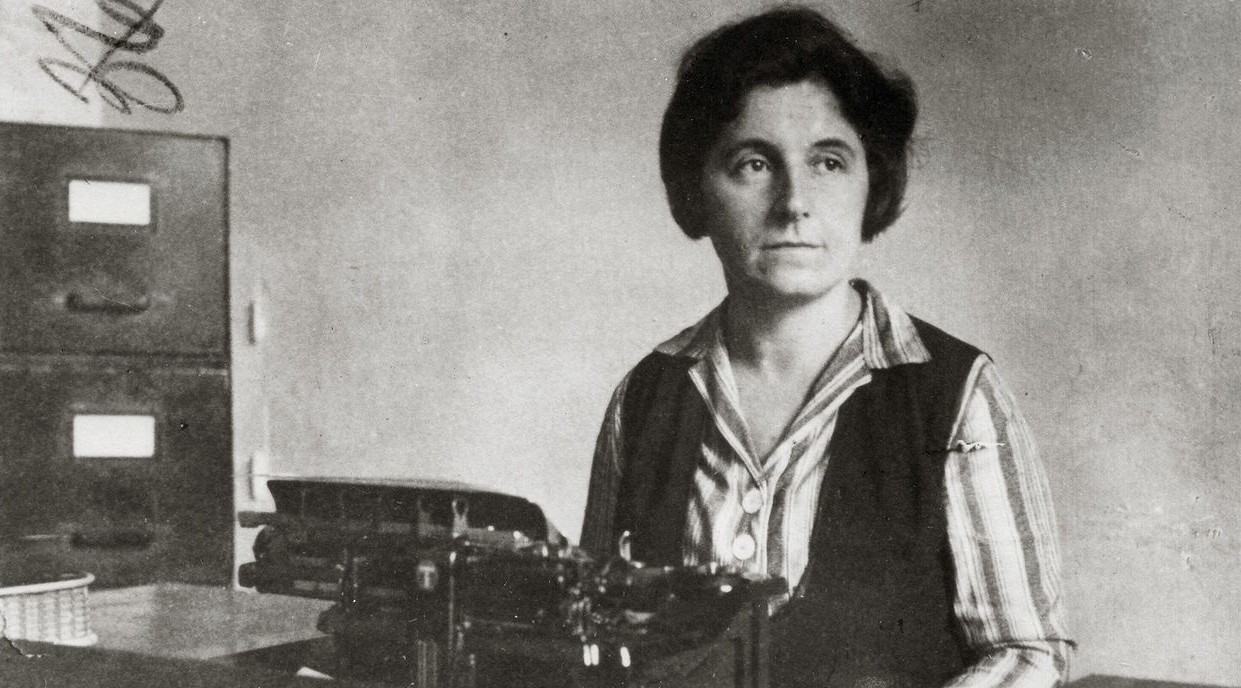
Grace Hutchins on the heroic resistance in the face of a fascist takeover waged by the working class women of Vienna in February, 1934.
‘Women of the Barricades’ by Grace Hutchins from Working Woman. Vol. 5 No. 2. February, 1934.
“WOMEN WERE ACTIVE IN AUSTRIAN WARFARE. HAVE FOUGHT SIDE BY SIDE WITH SOCIALIST MEN, REFUSING TO TAKE CHANCES TO FLEE.”
“WOMEN ARE SELF-POSSESSED. HOUSES TESTIFY TO TRAGEDY.”
“SOCIALIST WOMEN FIGHT BESIDE MEN. HELP CARRY THE MUNITIONS AND RELOAD RIFLES IN ALL-NIGHT STRUGGLE IN FLORIDSDORF. SCORES ARE CASUALTIES.”
“VIENNA WOMEN FIGHT. SCORES DIE.”
Such were some of the headlines. in the general, capitalist press through the days of fighting in Vienna, February 14 to 18, when Chancellor Dollfuss decided to murder women and children and establish fascism in Austria. Now we see more clearly what fascism means. It means the killing of babies and the mothers who carry them; the turning of big guns on workers’ homes in working class districts; the wiping out of labor unions and the hanging of workers and their leaders; the destruction of all the organizations and workers’ schools and books that might bring life and freedom to the working class.
To women, fascism means the return to the kitchen and the church and the children: “Kinde, Kirche and Küche,” as the German fascists say. Bear as many children as possible and stay imprisoned between the narrow walls of your own kitchen; learn nothing except what the pastors and masters teach; be slaves and forget your dreams of freedom.
No wonder the Austrian women were ready to defend themselves and their homes against the fascist state forces bombarding them with howitzers. No wonder they fought side by side with the men from the windows of their tenements and answered the appeal:
“Fight with all weapons. Your freedom, your children and your future are at stake. We will not be slaves.”
On the streets, strewn with dead bodies, the workers built barricades of large iron garbage cans and defended themselves with machine guns until forced to retreat to their homes in the face of heavy shelling by government troops. Shells screamed and smashed the doors and windows and walls of their homes, but the women fought on beside the men, loading and firing and reloading as rapidly as possible.
When the great Karl Marx apartment house was wrecked, a 5-year old girl and a boy of 14 died in the fighting around the building.
At one Vienna hospital, of 87 dead after the fighting, 27 were women.
For every 20 men killed in the workers’ suburb of Floridsdorf, at least one woman or child was killed, according to the estimate of an Associated Press writer.
In Simmering, a woman slipped through the lines of soldiers who were constantly shooting at the house where she lived, bought medical supplies at a pharmacy and returned again through the lines in the midst of heavy firing.
The Indiaverhof apartment house, home of many workers, was destroyed by artillery fire, as were so many other houses. When the workers at this house were finally forced to surrender, it was found that most of them were women, many of them wounded. Many of the men had already been killed, while others had gone to help defend other houses. The women prisoners of the fascist state were marched out of the buildings in lines, grim and determined, herded into police wagons and taken away. Some of them carried children in their arms.
“If it had not been for the encouragement of the women,” the men stated, “we could not have held our positions so long. The women harangued the men, urging them to fight to the last.”
FIGH TO THE LAST. It is a slogan that encourages not only the heroic Austrian workers, but workers all over the world. In Berlin, Germany, it arouses new hope among those who are now suppressed but who are courageously fighting the daily battle against fascist control of their lives.
In New York City, on the corner of 42nd St. and Fifth Ave., the busiest corner of the world, the words “Fight to the Last” are taken up by Communist and Socialist workers, demonstrating in solidarity with the Austrian workers. Their heads are broken by police clubs, women are trodden under policemen’s feet the photographs show, but the workers march on.
“FIGHT TO THE LAST.” The words will ring out in every strike in every capitalist country. And like the Austrian women of Vienna, women workers will stand shoulder to shoulder with the men in the front lines of every strike, of every demonstration, of every revolt.
The Working Woman, ‘A Paper for Working Women, Farm Women, and Working-Class Housewives,’ was first published monthly by the Communist Party USA Central Committee Women’s Department from 1929 to 1935, continuing until 1937. It was the first official English-language paper of a Socialist or Communist Party specifically for women (there had been many independent such papers). At first a newspaper and very much an exponent of ‘Third Period’ politics, it played particular attention to Black women, long invisible in the left press. In addition, the magazine covered home-life, women’s health and women’s history, trade union and unemployment struggles, Party activities, as well poems and short stories. The newspaper became a magazine in 1933, and in late 1935 it was folded into The Woman Today which sought to compete with bourgeois women’s magazines in the Popular Front era. The Woman today published until 1937. During its run editors included Isobel Walker Soule, Elinor Curtis, and Margaret Cowl among others.
PDF of full issue: https://www.marxists.org/history/usa/pubs/wt/v5n02-feb-1934-Working-Women-R7524-R2.pdf
 Revolution's Newsstand