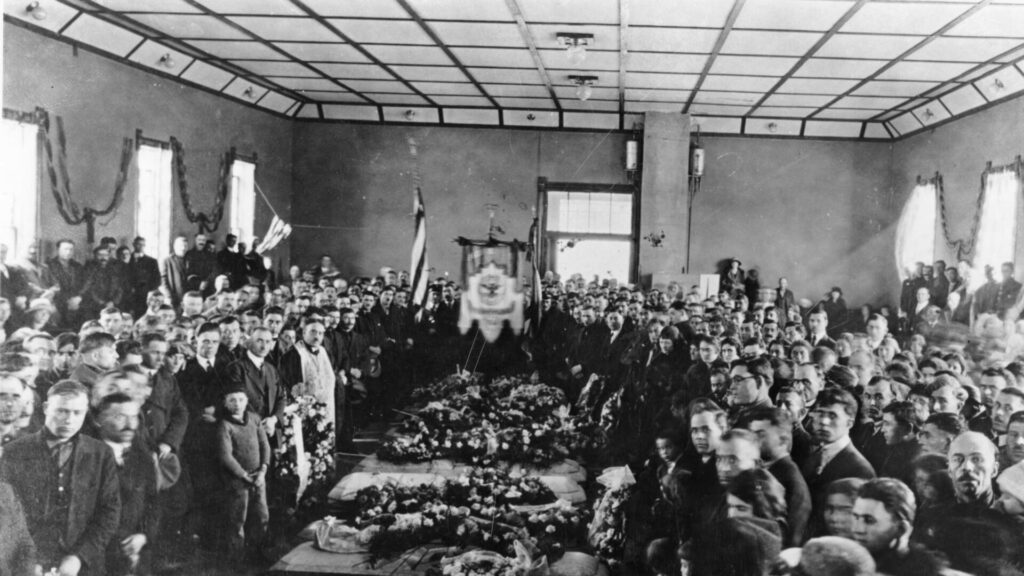
Greed and dehumanizing neglect murder 173 coal miners–Austrian, Greek, Italian, Scottish, Korean, Japanese, English, Belgian, and U.S.-born-–making profits for the violently anti-union Utah Fuel Company at its Mine No. 2 in Castle Gate, Utah in a series of coal dust explosions on March 8, 1924. Below is a collection of notices and articles, including names of most of the dead, on the ‘disaster’ from the Daily Worker as it unfolded.
‘Horror Rules at Utah Mine; Majority of Victims Foreign-Born’ from The Daily Worker. March, 1924.
BIG DISASTER HITS MINERS IN UTAH PIT. Mach 10, 1924.
No Hope Held Out For 183 Coal Diggers.
(Special to The Daily Worker) SALT LAKE CITY, Utah, March 9.-One hundred and eighty-three men are believed to be trapped in the Utah Fuel Mine No. 2 at Castle Gate, Utah, as the result of an explosion that occurred in the mine here.
The reports state that 183 men entered the mine Saturday. No word has yet been received as to whether any of the supposed entombed men have been able to make then way to safety.
One of the rescuers sent down was killed and bursts of deadly gas hamper the work, as black damp fills the mine. All hope for the escape. of the men is lost.
Another battalion of the army of labor has fallen. The greed of the capitalists knows no limits and only a catastrophe like this brings to the attention of the workers of the United States the dangerous conditions under which the miners toil to roll up millions for their masters.
Most of the miners were married and have families. The scenes around the mine are indescribable. Frantic women, attempting to burst their way to the pit are held back by guards.
The first explosion occurred between 8:15 and 8:30. It was violent. Two more blasts followed in quick succession.
The rescuers are working frantically.
HORROR RULES AT UTAH COAL MINE TRAGEDY. March 11, 1924.
No Hope For Coal Barons’ Victims in West
(Special to The Daily Worker) CASTLE GATE, Utah, Mar. 10. Headless and charred bodies of the victims who were caught in the terrible disaster at Utah Fuel Company’s Mine No. Two, last Saturday are today being taken to the surface.
Thirty-one bodies, eighteen of them identified, have so far been removed from the galleries. Mine experts say there is positively no chance that any- body could be alive in the stifling, gas-filled chamber.
The single street of the little mining town is crowded daily with the relatives and friends, widows and orphans of the entombed miners.
Pathetic Scenes.
Pathetic scenes were witnessed as frantic women driven insane by sorrow attempted to go down into the deadly pit to join their husbands in death.
One young woman with a baby in her arms roamed about all day crying “I want to go to him.” Her husband had laid down his life as a sacrifice to the capitalist greed for gold.
Considerable coal baron propaganda is being broadcasted telling of the precautionary measures taken to preserve the lives of the miners. There is an investigation on, but the miners fear it will whitewash the coal barons.
Twenty other bodies were sighted in a tunnel still inaccessible as workers bored into the mass of debris choking the passageways.
Fire and deadly gases hampered the relief efforts yesterday, but the flames finally were extinguished last night and rescue squads equipped with gas helmets made their way into the tunnels.
It was believed that the levels where the main body of the entombed men were at work might be reached today.
Gas Fumes Deadly.
One rescue worker died from in- haling deadly gas fumes last night. As soon as the blaze is extinguished, officials believe they will be able to reach the position where the miners were working at the time they were trapped by a series of blasts. Of the seven bodies recovered near the entrance to the mine, five have been identified. All were married men with families. Two other bodies were so badly mutilated that they could not be identified.
Crowds packing the canyon roads leading to the mine, are orderly. Deputies held the spectators and members of families of men caught in the death trap, a mile from the mine entrance.
The Disaster in Utah. Editorial. March 11, 1924.
The coal mining industry affords the most harrowing proof of the destructive character of capitalism. Coal mining, like all other industries today, is run on the principle that dollars come first and lives come last.

Unless the unexpected happens 175 miners working eleven thousand feet below the surface shall have lost their lives digging coal and dividends for their bosses. As the charred bodies of the Utah miners are taken out of the ghastly pits, the families and friends of the entombed coal-diggers are giving way to despair and giving up all hope for the rescue w of their beloved.
The miners are continually exposed to gas and dust explosions, to the falling of slate and coal, drowning and electrocution, mine damp and fire. Coal mining is an especially hazardous industry and extra steps must be taken all the time to prevent the loss of life and limb amongst the miners. But to take these safety measures would entail an expense of dollars. It might mean a reduction of profits. Consequently the coal capitalists, like all other capitalists, do their best not to spend any money for the protection of the lives of the workers. Last year more than two thousand miners were killed while at work for their bosses.
The horrible conditions arising out of capitalist control in the mining industry is characteristic of the criminal state of affairs in a every other capitalist-controlled industry today. In the year following the war no less than 28,000 workers were killed and three million wounded in the “peaceful industries” of America. This horrible toll is a gruesome monument to the efficiency of the profit-hungry employing class running our industries. Ten per cent of all railroad men were either killed or injured while at work in 1922. Close to thirty thousand metal miners were injured or killed at work in the same year. In New York State one out of every three thousand workers o is killed or crippled in industry.
The Utah mine disaster, the moans and cries arising out of the hell holes at the Castle Gate mine, the broken hearts and the shattered lives of the families of the murdered workers in the coal pits are the sordid picture of life as the workers live it under the tyranny of their capitalist exploiters.
Not until the working class takes matters in its own hands and assumes full political power in and reorganizes the management and control of our productive system along social lines so as to eliminate the private profits of the individual capitalists, will this huge toll of life taken every year from the working masses be saved. Not until the mines are owned and controlled by the coal diggers, the railway workers who haul the coal, and workers and in farmers who use the coal, will we be spared of the calamities and disasters, the wholesale murder of workingmen as have occurred in this Utah mine disaster, at Spangler, Pennsylvania, Pekin, Illinois, and many other places where the workers sweat blood to enrich their capitalist masters.
UTAH MINE PIT CONTINUES TO GIVE UP DEAD. March 12, 1924.
Twenty Crews Search For Bodies
CASTLE GATE, Utah, March 11. Little hope is now held that any one caught in Utah Mine No. 2 at the time of the fatal explosion has escaped with his life. It was believed that by tomorrow the fate of all the unfortunate wage slaves will be determined.
Governor Charles R. Mabey, of Utah, who reached here yesterday, is planning to issue a nation-wide call for relief funds for the dependents of the coal company victims.
It is estimated that on an average the widow of each dead miner has five children.
Picked rescue crews, working in groups of twenty, continue to remove the dead.
Smouldering Fire Halts Removal of Bodies From Mine. March 13, 1924.
CASTLE GATE, Utah, March 12. In the lower workings of No. 2 mine of the Utah Fuel Company here, brought a halt to rescue work today.
Fifteen bodies have been located in a portion of the mine that has become flooded.
One hundred and twenty-seven bodies have been recovered.
The little town is the scene of one of the greatest tragedies in the history of mining in the United States. Hope has no completely given way to grief.
Heartbroken widows sob their hearts out as body after body is brought to the surface. Halls formerly used for recreation purposes are now filled with dead.
Many of the victims were World War veterans. They braved the dangers of the German shells for the American capitalists only to meet their doom in peace, toiling to produce profits for the same masters.
COAL COMPANY BLAMED FOR BIG DISASTER. March 14, 1924.
Coal Dust Accumulation Caused Blast
(Special to The Daily Worker) CASTLE GATE, Utah, March 13. The second greatest disaster in the mining industry of Utah was caused thru an explosion resulting from an accumulation of dust, in the opinion of miners with years of experience in coal digging.
The Utah Fuel Company is trying to offset the strong suspicion created in the public mind that its criminal negligence is responsible for the death of 175 miners, practically every one of them leaving a family to depend on public charity for a living.
Send Out Inspired Statements.
Inspired statements are sent out over the press association wires to the effect that this mine was one of the show mines of Utah. The fact is that the Utah Fuel Company is one of the most notorious anti-labor combinations in the United States and has defied all efforts on the part of the United Mine Workers of America to organize it.
So bad are the conditions under which its employes work that even the strikebreakers it took on after an unsuccessful attempt on the part of its coal diggers to organize went on strike.
While the coal company claims that its sprinkling system was in good working condition there is no other theory of the explosion other than thru one caused by an accumulation of dust.
The Utah mines are required to frequently sprinkle their mines in order to take out of the air any coal dust that might otherwise accumulate. It is evident that the company fell down here and did not properly consider the safety of its employes.
Single Men Fired.
The company’s No. 1 mine was closed down last week and all the single men were dismissed. The married men were given employment at mine No. 2.
The owners of the Utah Fuel Company mine were not in any danger from the explosion. One of the officials was at the general offices of the company in Boston, Mass., and another was in San Francisco.

128 bodies have already been removed from the fatal mine. Small fires hamper the rescue crews. No church services will be held for the victims because of the large number of funerals.
Castle Gate is indeed a sorrowing city. It has paid its tribute to greed.
MAJORITY OF MINE VICTIMS FOREIGN BORN by Yosio Nishimura. March 30, 1924.
Hundreds of Children Left Fatherless
CASTLE GATE, Utah, March 30. The latest report from Carbon County, Utah, shows there were 97 foreign born among the 173 victims of the Castle Gate explosion, the fact eventually tells what one of the basic industries of America–most perilous, yet most essential of all industries–owes to those foreign-born peace time soldiers.
Austrian…6
Belgian…1
English…7
Greek…49
Italian…24
Japanese…5
Korean…3
Scottish…2
Sub-Total…97
Negro…2
Total: 99
American…74
Total…173
The Utah Fuel Company, notorious with its tactics of force and violence against the miners passive resistance, produced ghastly crops of human corpses and human misery:
Orphan, 1 to 5 years old…117
Orphan, 6 to 10 years old…72
Orphan, 11 to 18 years old…59
Widows…151
Old mothers…25
Total Dependents…424
Since there are 117 children under 5 years, practically all of the dead miners were in the prime of life–about 30 years old. Just imagine 424 e dependents with many more crying in the far away lands while the Utah Fuel Company is groaning about the estimated loss of $750,000 as the result of the mine being obliged to remain idle for one month, probably. Several miles away from Castle Gate, there lies a beautiful plateau, situated 8,500 feet above the sea. In the midst of the blooming columbine and the sego lilies there stand 200 tombs, the last resting place of the victims of the Scofield mine disaster of 23 years ago.
Castle Gate or any other mine in Utah is not a gas mine and if proper precautions were taken with abundant air current and keeping the mine free from coal dust. etc., the mine would be safe. Numbers of times the miners attempted to organize a union and protested against the existing unbearable conditions and each time they were forced with guns pointed in their faces to disband the organization. Not very long ago the miners of Castle Gate took to the hills, right across the creek and held the fort for a week under the cross fire of the gunmen and the state militia.
“Gas is fast accumulating in the mine. Unless the Kemmerrer Coal Company does something, there will be a catastrophe. Best we can do is to beat it.” This remark was uttered by a miner, Kozaki, just one day before the horrible explosion of Frontier mine, Kemmerrer, Wyoming last fall. On account of his wife and children, he had to work one day more to cover their traveling expense, that one day cost him life.
It is a dangerous practice to leave the safety of the miners’ life to an inspector who was picked up from incompetent captains of coal companies. He is holding his office because he prefers to stay in the pump house or the repair shop of the mine he has to inspect and make the same old story, “Excellent condition.” All the while he stays on the company’s property, he is sure to carry bonded stuff on his hip and usually with a sunny smile, which means money in his pocket.
Right after the inspector’s “examination,” according to the New York Times, the present Castle Gate disaster followed.
The Daily Worker began in 1924 and was published in New York City by the Communist Party US and its predecessor organizations. Among the most long-lasting and important left publications in US history, it had a circulation of 35,000 at its peak. The Daily Worker came from The Ohio Socialist, published by the Left Wing-dominated Socialist Party of Ohio in Cleveland from 1917 to November 1919, when it became became The Toiler, paper of the Communist Labor Party. In December 1921 the above-ground Workers Party of America merged the Toiler with the paper Workers Council to found The Worker, which became The Daily Worker beginning January 13, 1924. National and City (New York and environs) editions exist.
 Revolution's Newsstand