
How the British love a commission. Formed in 1927, the Empire’s Simon Commission deliberated for several years on what to do for India, releasing the report analyzed below, and deciding to call the ‘India Round Table Conference’ of ‘interested parties’ to keep to discussion going for several more years. With his usual curt analysis, Chattopadhyaya on its first six weeks’ work.
‘Six Weeks of the Indian Round Table Conference’ by Virendranath Chattopadhyaya from International Press Correspondence. Vol. 10. No. 60. December 31, 1930.
The British Imperialist Press, that has for weeks been devoting long columns to the sayings and doings of the Indian princely and non-princely lackeys assembled in London for the “Round Table Conference”, announces that His Highness the Aga Khan “had to leave as he is taking a four days’ Christmas break in Paris after six or seven weeks of constant application to the work of the Conference”, and that his Highness the Maharaja of Patiala after “six weeks of hard work” has gone to Budapest as the guest of Horthy, from whom he will undoubtedly acquire knowledge that will be useful in the near future in the torture and massacre of the revolutionary Indian workers and peasants. Before they return to their labours in London with fresh mental energy it might be useful to sum up the main results of the “hard work” they and the other lackeys have done during the last six weeks under the direction of that shameless imperialist agent, the social democrat Ramsay MacDonald.
From the point of view of attainment of imperialist aims the Conference has been well staged and has achieved considerable success. The two main objects to be achieved by British imperialism are, firstly, the creation of constitutional and administrative machinery to hold in check the only real internal enemy of imperialism the Indian workers and peasants and to this end, to satisfy the anti-national demands. of various conflicting social, religions, sectarian and racial groups so as to perpetuate their differences and bind them more closely to the machinery of imperialist exploitation; and, secondly, to organise the resources of India and Burma for war preparations against the only anti-imperialist State, the Soviet Union, and against the growing power of the revolutionary workers and peasants of China.
These objects are being steadily kept in view and the initiative in all questions has remained in the hands of British imperialism. Outwardly, every attempt has been made to let the Indian princes and “leaders” talk themselves out and believe that they are exercising an influence upon the negotiations.
The fact that the Conference is being held in London, away from the immediate atmosphere of mass revolt and mass pressure in India; that British interests are being represented by the delegates of all the three capitalist-imperialist parties so as to let the Indians feel that they are negotiating with a united Britain; that the Conference was opened by the King so as to make these Indian toadies still more servile by enabling them to revel in a dazzling “historic” ceremony of boot-licking; that the Indian “delegates” are being feted and banquetted, officially and unofficially by the I.L.P. Secretary of State for India and a number of aristocratic hosts and hostesses who thoroughly understand the subtleties of social intercourse and feminine influence in the business of imperialist domination; all these facts have produced the necessary atmosphere for the acceptance of the carefully-laid plans of the imperialist masters. Leaders like Sapru and Jayakar, who had come fresh from negotiations with the imprisoned Congress leaders, repeated at the outset the Congress formula of “Dominion Status with safeguards for the transitional period”, but there is now no further talk of Dominion Status. The imperialists wisely began the Conference with a four-days’ debate on the question of whether a federal or a unitary system of government were best suited for India-and the demand for Dominion Status timidly put forward by a number of “progressive” Indians mainly to satisfy Congress opinion at home, was met by a categorical statement by Lord Reading, ex-Viceroy of India, that “it is idle to say that at this moment there could be anything like equality of status-that is, constitutional status-in India with the Dominions”, while the cunning MacDonald declared in a speech full of sanctimonious hypocrisy that the very fact that they were all assembled together at a round table was a “recognition of status that can never be departed from”. No Indian left the hall although many had declared that they had come for nothing less than Dominion Status.
During the four days of speech-making that gave the Indians the opportunity of being in the limelight for a few days, there were two characteristic tendencies that deserve notice. Firstly, a number of “leaders” were conscious that they were “traitors” and that they had come to London carrying out dirty work. Sapru declared: “We have come here across the seas in the midst of the gibes and ridicule of our own countrymen. We have been already described in our country as traitors to the cause.” Dr. Moonje, leader of the orthodox Hindu Mahasabha, said, that he had come in spite of “the assertion in private and in public that he is a traitor who goes to the Round Table Conference”. The Sikh representative, Sardar Ujjal Singh, said that they had “staked their reputation in the eyes of our fellow-countrymen” and that “we cannot–we dare not–go back to India without a satisfactory solution”.
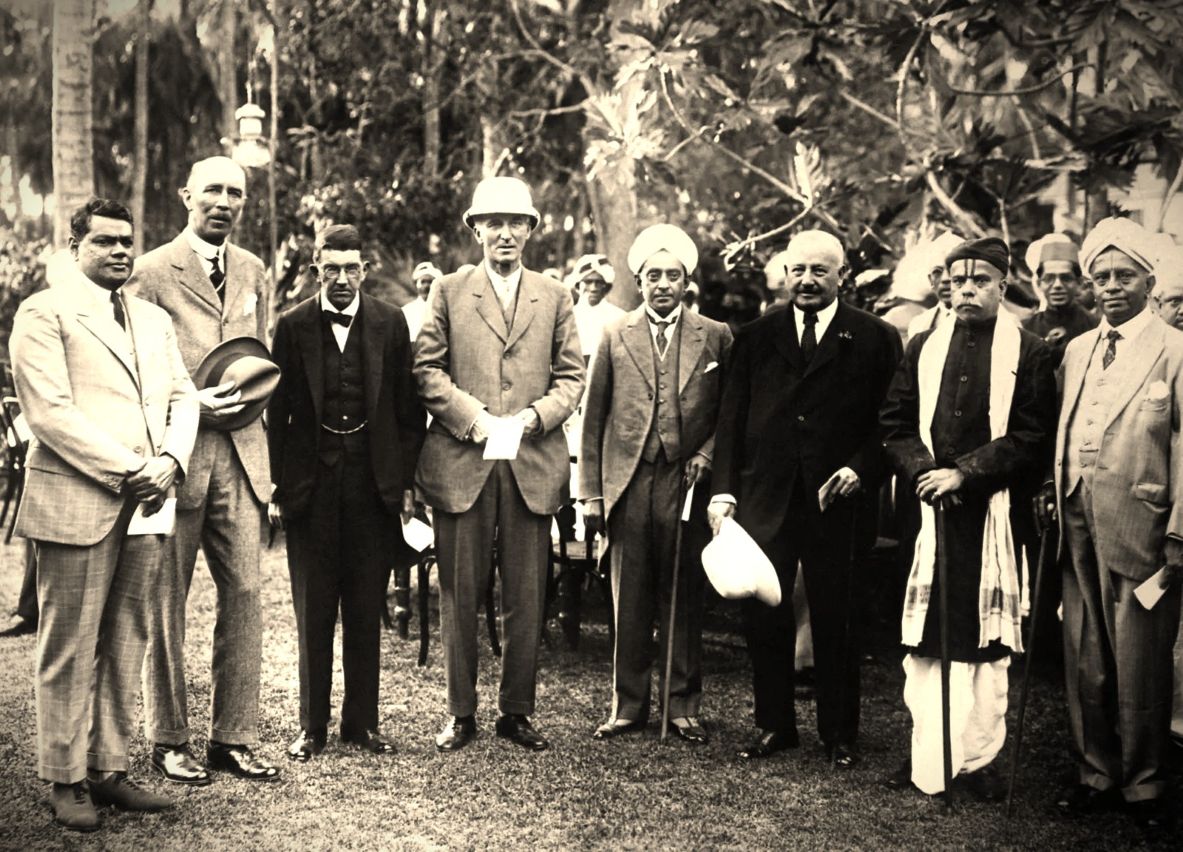
But the most remarkable admission of treachery comes from the Muslim leader, Manlana Mokammed Ali, who is despised throughout the Islamic world for his change of face. He said: “From a rebel against the Government, I have become a traitor to my country, and I am now working with the Government. I say that I can work even with the devil, if it is to be, like this work, in the cause of God!”
The second characteristic of speeches was that even those who wanted Dominion Status did so in order to protect British capital, to preserve the Empire and to fight the battles of British imperialism. Jayakar, who pretended to speak for Young India, declared: “If India were given Dominion Status today, in the course of a few months the cry for independence would die of itself” and he added that “India was quite capable of furnishing the Empire, if ever the time comes, with all the fighting material she may want”. (In other words against the Soviet Union.) He gave the assurance that there would not be “any kind of inroad upon the vested rights of the commercial classes”.
The main work of the Conference is being carried out through committees, each committee representing an issue of paramount imperialist importance. The Federal Relations Committee, the Burma Committee, the North-West Frontier Committee, the Defence Committee, the Minorities Committee these show at once the imperialist aims.
Before the Federal Relations Committee began work, the question of the separation of Burma was taken up and decided in order to remove that country from the discussions of the Conference. For military reasons-as a land, naval and airbase, for the organisation of war on the Burma-Chinese frontier, and for commercial reasons in the interests of British shipping and oil capital and of British heavy industry, British imperialism resolved to separate Burma administratively. The Burmese sent to the Conference do not represent any Burmese mass organisations, but only the so-called People’s Party created by the Government. The Grand Council of All-Burmese Associations has protested in a long memorandum and numbers of Burmese have protested by telegram and written memoranda. A notable document has just been Issued by Burmese in London exposing the imperialist manoeuvres involved in the separation of Burma. But the question was arbitrarily decided without discussion, and Earl Russell, presiding over the Burma Committee, categorically “reminded his colleagues at the outset that the question whether or not Burma should be separated from India did not arise”, but that they were there “to consider the nature of the conditions of such severance”.
Originally the question arose whether Burma and India should be under a unified military control, but Sir William Birdwood the Commander-in-Chief, declared in favour of a separate “defence” organisation for Burma. The Burmese insist on a declaration that separation shall be accompanied by a declaration that Burma shall receive “Dominion Status”, but the Committee “recognised that the Government would no doubt wish to preserve an open mind in regard to the nature of the future Constitution of Burma”.
Having got Burma out of the way, the question of the Indian Constitution was taken up and the basis of discussion was provided by a memorandum drawn up by Lord Sankey. There was a unanimous declaration in favour of a unitary federal form of Government for all India and the new element in the situation not foreseen in the Simon Report nor in the Government of India’s Dispatch, nevertheless deliberately brought about by British imperialism was the adherence of the Princes to the idea of immediate participation in an All-India-Federation. The Social Democrat Ramsay MacDonald stated in admiration that “the declaration of the Princes had revolutionised the situation”.
The Federal Relations Committee has published its preliminary proposals with regard to the Constitution, the main. points agreed upon being the following: The Imperialist State is to be re-formed and re-named. Instead of British India with its various provinces and the few hundred Indian States, there is to be a Federal Union in which the component parts shall be the federating provinces of British India. and such. Indian States or groups of States as may enter the Federation. It must be remarked that the States are not obliged to enter the Federation, and that “the army, foreign affairs, political charges” will be reserved to the Crown and will not come within the jurisdiction of the Federal Legislature. We shall therefore have three elements in the Federal Government: firstly, the Crown, i.e. the direct interests of British imperialism, such as the army and foreign affairs: secondly, the Indian Princes jointly and severally, and thirdly, the bourgeoisie and landowners of British India.
The Indian Provinces of which a few more may be expected by the elevation of Sind, Orissa and the N.W. frontier province to the status of provinces, will receive full autonomy including the control of the police and of finance, but the Governors are to have an absolute power of veto. The question at issue now at the Conference is how far the Central Federal Executive is to be made responsible to the Legislature. There is likely to be a system of dyarchy introduced at the Centre, so as to keep the army and foreign relations out of Indian hands, but owing to the fact that the princes will be in the Government, an adjustment is possible without endangering British imperialist domination.
The entry of the princes into the Federal Legislature, which is to have two Houses, an Upper House called the Senate and a Lower House called the House of Representatives will bring in an extraordinarily strong reactionary majority. As against the fifteen or sixteen provinces there will be hundreds of States.
In this connection it is important to note the demand made by a smaller Chief (Chief of Sanell) undoubtedly at the instigation of the imperialists. that “the claims of all States regardless of size shall receive due recognition”.
We can easily foresee what “legislation” will be brought in by the new “Federation” regarding the workers and peasants and what steps will be taken to organise the war against the Soviet Union.
The “enormous difficulties” of granting “responsible self-government” to India are being deliberately illustrated by the Conflict that has been taking place between the Muslims and the Hindus at the Conference. Ramsay MacDonald has been unsuccessfully playing the role of conciliator, but the Muslims insist on separate electorates Imperialism insists also on separate electorates in order to keep these religious communities at loggerheads. No agreement has yet been arrived at. But the Hindu-Muslim question does not exist outside the ranks of the job-hunters. The workers and peasants are united in their economic and political demands, and so soon as they free themselves completely from the “guidance” of their bourgeois and petty bourgeois leaders, the whole “Federal Union” of the imperialists and their agents will be annihilated and the true Federal Republic of the Workers and Peasants established.
International Press Correspondence, widely known as”Inprecorr” was published by the Executive Committee of the Communist International (ECCI) regularly in German and English, occasionally in many other languages, beginning in 1921 and lasting in English until 1938. Inprecorr’s role was to supply translated articles to the English-speaking press of the International from the Comintern’s different sections, as well as news and statements from the ECCI. Many ‘Daily Worker’ and ‘Communist’ articles originated in Inprecorr, and it also published articles by American comrades for use in other countries. It was published at least weekly, and often thrice weekly.
PDF of full issue: https://www.marxists.org/history/international/comintern/inprecor/1930/v10n60-dec-31-1930-Inprecor-op.pdf
 Revolution's Newsstand