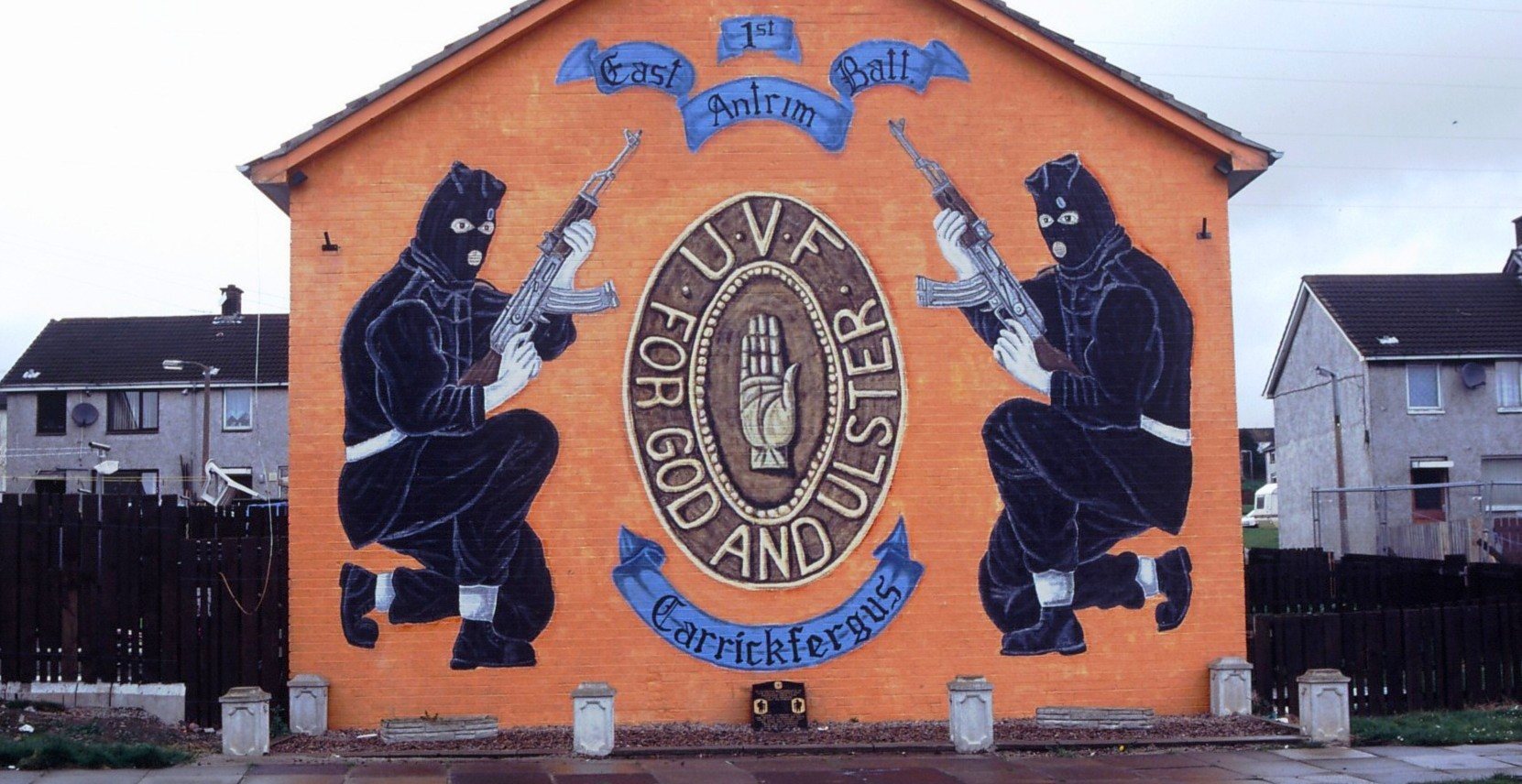
Jackson with superior piece on the role of Protestant loyalism as a bulwark of reaction and British imperialism in Ireland, and its historic manufacture to suppress Protestant republican radicals in the aftermath of the 1798 Rebellion. Written during the Treaty negotiations which would, in part, create Northern Ireland
‘The Red Hand’ by T.A. Jackson from The Communist. No. 70. December 3, 1921.
WE have heard and shall hear so much about Ulster its rights, its fears, its loyalty, and its security–that it is necessary to get a right understanding of this the crux of the whole Irish difficulty.
It will be remembered that at the end of 1920 the British Parliament, instigated by Lloyd George, decided to partition Ireland into two areas, upon each of which was imposed a local pseudo-Parliament. In neither area was it accepted with cordiality in the northern one it was tolerated because in its full working it would give that area a constitutional machinery of domination over all Ireland. To secure this end it was requisite that the Nationalist Irish should accept and work the scheme. This they were not fools enough to attempt. Nor could the Black-and-Tan Terror, martial law, executions and pogroms crush them into compliance. The scheme therefore was still born and the world was presented with the spectacle of a pseudo-“Ulster ” endowed with the “Home Rule” that it had sworn to wade in blood to prevent, and a Nationalist Ireland held under martial duress by an Empire it had sworn to cast off.
Now we learn that the truce is almost at an end and the negotiations will break down–because Ulster will under no circumstances accept the place of part of an Irish “Dominion.” And to prepare the public mind for this breakdown of the “peace” negotiations everyday has brought its news of battle, bomb, and bloodshed in the streets of Belfast.
The truth of the whole matter is that there is not, never was, and never will be any such thing as a United Protestant Ulster constrained by its fears to concert measures of self-defence against the ferocious bigotry of the Catholic South. The territory of the Northern Parliament is not Ulster–it is only a part of that province. Three out of the nine counties of Ulster were excluded from the “Northern ” Territory, expressly because they were almost unanimously Nationalist and Republican. Of the six counties that were included none is exclusively Protestant and Unionist, and what is more, sect for sect in each of them, the Catholics are the largest denomination. Tyrone and Fermanagh have Catholic-Republican majorities. In two out of three constituencies of Down, in one out of two in Armagh, in Derry city and districts of Belfast the Republicans and Nationalists are in the majority over the Unionists. Tried by the plebiscite test which the Allies in their wisdom applied to Schleswig- Holstein and to Silesia, not one single county nor one single borough–except Belfast, and that only barely–would escape inclusion in a United Irish Republic. Why, then, the trouble? The answer is to be found in the economic and political history of the British Empire during the last century.
It is difficult for the victims of British newspapers to realise, but it is none the less true, that Ulster for long was the germinating centre of all resistance to British rule in Ireland. Not Southern Catholics, but Northern Protestants first raised the standard of a United Irish Republic and until Easter Week, 1916, at the head of every insurrection against British rule was a leader who was a Protestant, an Ulsterman, or both.
In the rebellion of 1798 Ulstermen from Belfast, Armagh, and Antrim fought simultaneously with the men of Wexford and Galway for their common ideal of an Irish Republic. And because of that, and not in spite of it, the Orange Society was formed to do by stealth and malevolence, by corruption and clamour, by bombast and brutality, all those things which have made the name of “Ulster” (which they usurped) carry the significance that it does.
The Orange Society, formed on the model of freemasonry, was at its formation an illegal “White Guard” conspiracy. Illegal because of laws passed to crush the “Oakboys” and “Steelboys” of Ulster equally with the “Whiteboys” of Munster. A conspiracy because at a time when the Society of United Irishmen was in its first form of an open and legal organisation carrying on the work of the Volunteers of ’82–Protestants all, these Volunteers!–the reactionary landowners of the North and the wealthier bourgeoisie of Belfast took alarm at the events of the French Revolution, and at the growth of solidarity, regardless of religious distinctions amongst the peasant and proletarian population of Ireland. Just as in Russia of the Tsars and in London during paroxysms of jingo mania we get an unholy alliance between the reactionary aristocracy and the most degraded sections of the slum proletariat, so in Ulster in the form of the “Orange” Society, the ferments of the French Revolution begot from the fears of “White” counter-revolutionaries and the brutality and cupidity of greedy peasants and urban slum-proletarians a force for the disruption and terrorism of all potential revolutionary forces.
It began in the jealousies of Protestant farmers angry because of the fancied advantages received by the Catholic neighbours at the hands of the Dublin Government. Its methods (in its formative years as the “Peep o’ Day Boys”) were those midnight raids ostensibly in search of arms, but in reality, for provocation and insult, which the Black and Tans have since reduced to a science. When the Catholics thus persecuted banded together as the “Defenders” to protect their lives, their persons, and their holdings from destruction, injury and spoliation, the “Peep o’ Day Boys became exalted under aristocratic patronage into the “Orange” Society–using a revolutionary reputation as camouflage for purposes of malignant counter-revolution.
The “Defenders” being penalised as a “secret and illegal” Society, and the ferments exacerbated by the policy of Pitt and Castlereagh (using the “Orangemen as instruments), culminating in the Rising of 1798–the “Orange” Society became a fashionable and loyal thing.
And thus it has remained in the imagination of every dupe of triumphant authority and every foe to the aspirations of the common people. In itself the Orange Society has, in these latter days sunk into a cross between the decadent Freemasonry of the Clyde area, a small gaffer-ridden job-trust, and British Legion a herding under aristocratic patronage of brawny dupes capable of any work requiring an indifference to pain received or inflicted and a cheerful incapacity to realise the baseness of the ends for which they are used.
The recent history of Ulster points the moral and adorns the tale.
By all the rules of the Parliamentary game Ireland had won Home Rule” (for what it was worth) in 1912. The Bill had become an Act, it had received the Royal Assent, only time was required for its due materialisation.
There were those, however, who knew better. British Imperialism had been so thoroughly committed to resistance to the Irish demands that a victory for “Home Rule,” worthless though it might be to Irish Nationality, was a defeat for them, and a defeat inflicted by the hands of the “popular” element in the community. The victory of Home Rule would be therefore a victory for the “lower orders” over the “superior” and privileged ones in the Empire. This could not be borne with patience and hence Carson, Smith, Craig, and the rest of Ulster “ramp” which on the one side demoralised British Liberalism and on the other intensified into ripening the revolutionary republicanism of the Nationalist mass of Irishmen. What followed we all know–the Volunteers, both Ulster and Irish, Connolly and Easter Week.
In 1919, despairing of bringing the Irish into submission by any other means, the British authorities commenced their policy of intensive terror.
Ulster’s part in this was prepared, as usual, by a series of mass meetings, and took the form of a pogrom during which the Nationalist quarters were invaded by an armed rabble headed by the stalwarts of Carson’s Volunteers. The pogroms extended–with the approval of Craig and the leading Orange orators–into a wholesale driving forth from the shipyards and workshops of Belfast of every Catholic and every Trade Unionist who manifested solidarity with them. I could fill a page with details of the horrors which accompanied this outburst–homes burnt, children shot on their home doorsteps, bombs flung into houses, churches and street crowds. When at length the I.R.A. appeared in arms to defend their comrades and compatriots, the “Orange” Black Hundreds retired and the military appeared for the first time.
This was at the end of July, 1920. A month later similar outbreaks occurred and the endeavour to expel Catholic workers from their jobs and homes was reduced to a system. Workers everywhere in “Orange” Ulster were called upon to sign a declaration of allegiance to George V., and of repudiation of Sinn Fein–the penalty of refusal being assault, discharge, expulsion, and an attack upon their homes. Called upon to restore order,” the responsible authorities enrolled the “Carsonite ” Volunteers as special constables and the merry game went on.
In September, October, and again in November, the same thing; then a lull until March, 1921, when another pogrom commenced to be resumed early in April.
The elections for the Northern Parliament in May were prefaced by a week of pogroms and accompanied by scenes of barbarous violence.
After the poll an Ulster Leader (Col. Chichester), in his address to the electors remarked that” too many Sinn Fein votes had been polled.” He added that “they had got to wipe out Sinn Fein from the six counties.”
From then until now Belfast and its vicinity has been an almost constant turmoil. Thousands of workers have been driven from their work and their homes. Dozens of homes have been burnt; many lives lost. Only when in self-defence the Republican Irish take arms in self-defence do British newspapers pay attention to the conflict.
In everywhere in Ireland except Orange” Ulster, the coming of the truce has meant a cessation of strife. There where British authority is supreme (and not the Irish Republic) horror follows horror and slaughter, slaughter.
The latest is the now famous secret circular, issued by a Divisional Commissioner of the R.I.C. to his subordinates, instructing them to enroll volunteers for a Loyalist defence corps “such volunteers to be selected for their suitability to act as battalion commanders” in their areas, and to be given a “free hand ” in organising a military corps capable of acting in an emergency.
Dublin Castle and Downing Street alike repudiate this circular. Craig, Premier of the Northern Government, to which control of the R.I.C. in Ulster has been hurriedly transferred, has ordered it to be “withdrawn.” Still, as the circular itself avows itself prompted by reports of the “growth of unauthorised defence corps “this withdrawal will delude nobody.
The whole truth can be put in a nutshell.
“Ulster” is a tool wielded by British Imperialism which will never surrender to a proletarian movement or one of proletarian potentiality so long as it possesses the power to resist by force and arms.
PDF of full issue: https://www.marxists.org/history/international/comintern/sections/britain/periodicals/communist/1921/n070-dec-03-1921-The-Communist-CPGB.pdf
 Revolution's Newsstand