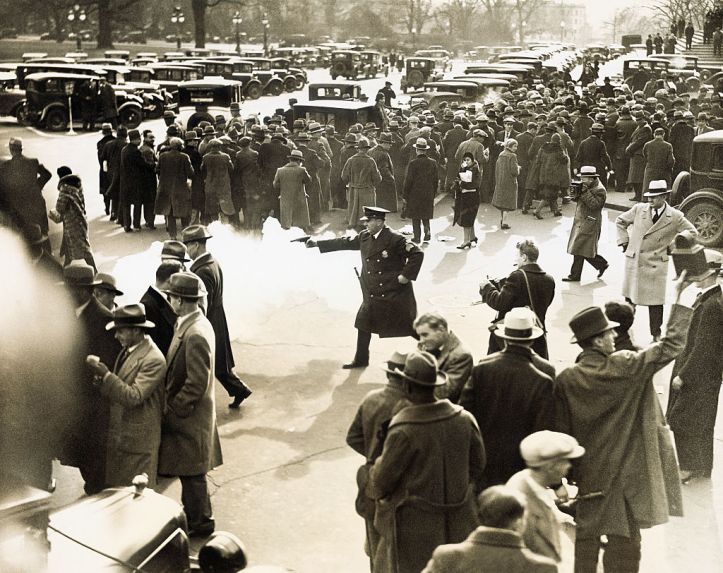
In response to a wave of new deportation laws with associated raids and violence unleashed early in the Great Depression by the Hoover administration, the work of the National Council for the Protection of the Foreign Born was revived. Louis Kovess on the tasks facing the five hundred delegates to the National Conference of the Council in Washington D.C. in the late fall of 1930. A solidarity rally on December 1st by the conference and supporters saw activists beaten and arrested as watching members of Congress cheer on the police.
‘Tasks of the National Conference for the Protection of the Foreign Born’ by Louis Kovess from The Daily Worker. Vol. 7 No. 285. November 28, 1930.
THE chief task of this conference, opening Sunday. Nov. 30. 11 a.m. at. Press Club, Washington, D.C., will be to make clear to millions of foreign born and all other workers in this country, that from now on the persecution of the foreign born workers will rise to the extent as never before. For this reason the foreign born workers together with the Negroes and white native workers must unite and struggle, to beat back the attacks.
Why are the basses and their government determined to pass new laws against the foreign born? Because the workers do not stand more for unemployment, eviction, wage cuts, slave driving, hunger, misery. A great wave of struggle is starting. Organization into the unions of the Trade Union Unity League, strikes against wage cuts, struggle for immediate unemployment relief and for the adoption by Congress of the Workers’ Unemployment Insurance Bill, these are the things the bosses are afraid of. So they want to weaken the working class, divide their ranks, turn white against Negro. Negro against white, native born against foreign born, terrorize the Negro and the foreign born, so they can crush the native, foreign born and Negro separately and force them to suffer the starvation and persecution and carry the burden of the economic crisis.
What are the tasks of this conference?
To unite the foreign born workers together with the native white and Negro workers for a concrete program, for action.
On a national scale—to mobilize the masses to demand from Congress to abolish those paragraphs of the Immigrations Laws which provide the basis for deportation of foreign born workers. Under the pretext that they are for “force and violence against the government.” On the basis of this paragraph the bosses can deport strikers, picketers, workers fighting for immediate relief, against eviction, etc. To abolish those parts of the immigration laws, which limit the number of immigrants to an insignificant number. The abolition of the Harris law aimed against the Mexicans, and the paragraphs barring Chinese, Japanese and Hindoos. Same time the conference should take a definite stand against anti-labor legislation (criminal syndicalist and sedition laws, etc.) on the basis of which the ruling class jails foreign born and native workers alike when their struggle against wage cuts, or unemployment relief. It is also necessary to take a determined stand against the lynchers of Negroes demanding death penalty against them. There are many other questions which must be taken up at the national conference and formulated as the concrete demands of the foreign born and other workers from the Congress. But demand alone does not bring results. The committee presenting the demands to Congress must have the support of hundreds of thousands of workers, ready to fight for these demands and organized in a solid front capable to fight.
On a state scale—Besides fighting for these national demands the organizations of foreign born, Negroes and native white workers must be organized to fight for concrete demands from the state legislatures. For example, there are states where foreign born do not receive the same accident insurance as the native born. In many states foreign born cannot be employed at public works. There are many discriminating state laws. The organizations unitedly must struggle for the abolition of these laws. Mass delegations representing tens of thousands of workers who are determined to struggle for these demands must present them to the state legislatures.
On local scale—There are many municipal ordinances discriminating against the foreign born and Negroes. Foreign born or Negroes cannot be employed on city jobs, etc. But it is not sufficient to present the demands to the municipal administration. The demands presented inside the municipal buildings must be backed by militant demonstrations outside.
In mines, mills, factories the foreign born, native white and Negro workers must organize joint committees of action against discrimination. For example: In many factories only those foreign born can get work, who have their first papers. Even more cases only citizens. What is still worse, thousands of foreign born workers are laid off to make the native workers believe that they will be replaced by native born workers. But this is not the case. This is the usual lay off of workers, but in this case with the aim of creating competition and struggle amongst the native and foreign born workers for jobs. This leads to antagonism and the boss is the only winner. When the workers are divided, the next step is wage cut and further speed-up. Can then the native born workers alone fight successfully against these wage cuts? The situation is the same with the Negroes. The foreign born work- not work, who have their first papers. [sic] Even dismissal of Negroes also, together with the native white workers. They must unite against foreign born or Negroes getting lower wages than the native white. They must all get the same wages. And more than the miserable wages they receive today. But for all these demands they must organize and struggle.
Against the Cable, Ashwell and Blease Bills and the proposals of the Fish committee, all aimed for the registration, photographing, finger printing and deportation of foreign born, foreign born workers must struggle, unitedly with the rest of the working class. Also, for asylum for political emigres and for the release of the political prisoners, against the deportation of Serio and the other foreign born workers.
Just as the conference takes a definite stand against the domestic policy of the government based on persecution and terror, so this conference must take a stand against the foreign policy of the government, the sharpest expression of which is the provocation for war against the Soviet Union, together with France, England, Poland and the Russian monarchists. Defend the Workers’ Republic must be a slogan of action of the conference.
It will be the task of this conference to consolidate the forces represented at the conference and go forward, to win over other hundreds of thousands of workers, for the above and similar demands, which must be worked out and clearly formulated at the national conference, with the actual participation of all the delegates in formulating these demands.
The Daily Worker began in 1924 and was published in New York City by the Communist Party US and its predecessor organizations. Among the most long-lasting and important left publications in US history, it had a circulation of 35,000 at its peak. The Daily Worker came from The Ohio Socialist, published by the Left Wing-dominated Socialist Party of Ohio in Cleveland from 1917 to November 1919, when it became became The Toiler, paper of the Communist Labor Party. In December 1921 the above-ground Workers Party of America merged the Toiler with the paper Workers Council to found The Worker, which became The Daily Worker beginning January 13, 1924.
PDF of full issue: https://www.marxists.org/history/usa/pubs/dailyworker/1928/1928-ny/v05-n282-NY-nov-28-1928-DW-LOC.pdf
 Revolution's Newsstand