Under threat, the bourgeoisie wars against the Enlightenment that birthed it.
‘The Return to Supernaturalism’ by Franc Conner from The Proletarian. Vol. 3 No. 2. November, 1920.
As the scepter begins to slip from it, the old bourgeois society is growing reactionary, is reaching out for weapons it formerly scorned. There is a marked change of front towards science and the supernatural.
This changed attitude is strikingly reflected in the article entitled “The First Works”, by Basil King, in the July Cosmopolitan. The article consists, largely, of alleged revelations given by the spirit of a famous man whose real name the writer avers that he is not at liberty to reveal.
The views of the distinguished spook are reactionary. He declares that man has neglected a sacred trust, and, on this account, all nature has gone wrong. The following utterances are a bijou:
Evil having once taken root in the heart of man, he proceeded to misuse…all the living creatures of God with which he found himself surrounded…He abused the animals, subjecting those of the pliant nature to the yoke, and causing the fiercer to rebel. Thus began the age-long battle between man and beast, whereby man drove the beast into the wilds and caused the gulf of terror to divide those two equally loved creations of God. That which man was given to help he oppressed and repulsed, thus delaying by thousands of years the development which the animals would have acquired by his guidance and co-operation. The animals, thrust back on themselves ran wild and produced evil–whole species whose mission, apparently, is only to take part with destructive forces.”
In this palaver, the proven scientific fact is ignored that the lower animals overran the earth aeons before man appeared; that these animals were equipped for attack and defense with their natural weapons and armor; that terrific combats were waged in the animal world, that there were carnage and slaughter ages before the first primate stood erect.
In the same article the writer mentions with approval that formerly devastating storms, earthquakes, and plagues were regarded as instruments of divine vengeance, that they were legally styled “acts of God.”
As far as “The First Works” is concerned, modern science is thrown on the junk heap. There is an obvious purpose to discredit evolution, to hark back to enslaving dogmas that science has shattered, to shackle men with old time superstitious fear of natural phenomena.
The write-up is not unique of its kind. Others of the same stripe are current in various periodicals.
In “The Slayer of Souls”, a serial by Robert W. Chambers, that has been running in Hearst’s, New York in the grip of the blizzard is casually mentioned as “smitten by God.”
There’s a reason for this unscientific propaganda. He that flies may read.
Formerly, the bourgeois society joined hands with science. As Anton Pannekoek ably explains in his “Marxism and Darwinism,” there were two reasons for the line-up. In the first place, the truths of evolution met with approval because there was plainly an evolution of society as well as an evolution of the physical world. The doctrine of evolution confirmed the bourgeois order.
Then, again, science was dealing smashing blows to old traditions, superstitions, dogmas, that feudalism had been using as supports.
Feudalism was superseded, yet it was trying, by hook or crook, to keep itself alive as long as possible. It discredited science. It had disgraced, imprisoned, murdered, scientists. It leaned on its efficient, well-organized, loyal church (the Catholic church) which was using its thundering voice of authority to keep the masses in subjection.
Of course the bourgeois society ranged itself on the side of science, and, of course, its leaders were skeptical in religion. Monarchists brought forward the infidelity of men like Tom Paine as an argument against republics. The name of God was ruled out of the Constitution of the United States.
Now, we’re under different stars. Capitalism, in turn, has fulfilled its mission, and is no longer efficient. The mighty machines are here. The method of production and the political system are again swearing at each other. To bring harmony out of the present chaos, a new social order is called for.
The bourgeois society is in its death grapple with the proletariat. It is looking around for all sorts of weapons, barricades, temporary defenses.
It is subtly discrediting evolution, for evolution no longer takes its part. Instead, evolution confirms the rule of the proletariat, and the old society isn’t keen to have the rule of the proletariat confirmed. It wants to put over the idea that the present order, with capitalist republics, is the last word in human society.
In its desperate straits, the old system calls on religion, on the influence of the supernatural for aid. “The devil was sick, the devil a monk would be. The devil got well, the devil a monk was he.” Only, “the devil” in the doggerel (though unrepentant) presumably feared a taste of his own brimstone, a dip in his own fiery lake. The bourgeois society (which will not get well) fears the proletariat.
It would be glad enough to put the fear of the wrath of God, or of earthquakes or something into the hearts of the wage-workers.
For instance, if the Italian workingmen, who are giving their masters so much trouble, could be made to feel that the recent quakes in their distracted peninsula were “acts of God”, visitations of divine vengeance on them for their rebellion, they could be kept in subjection much more easily.
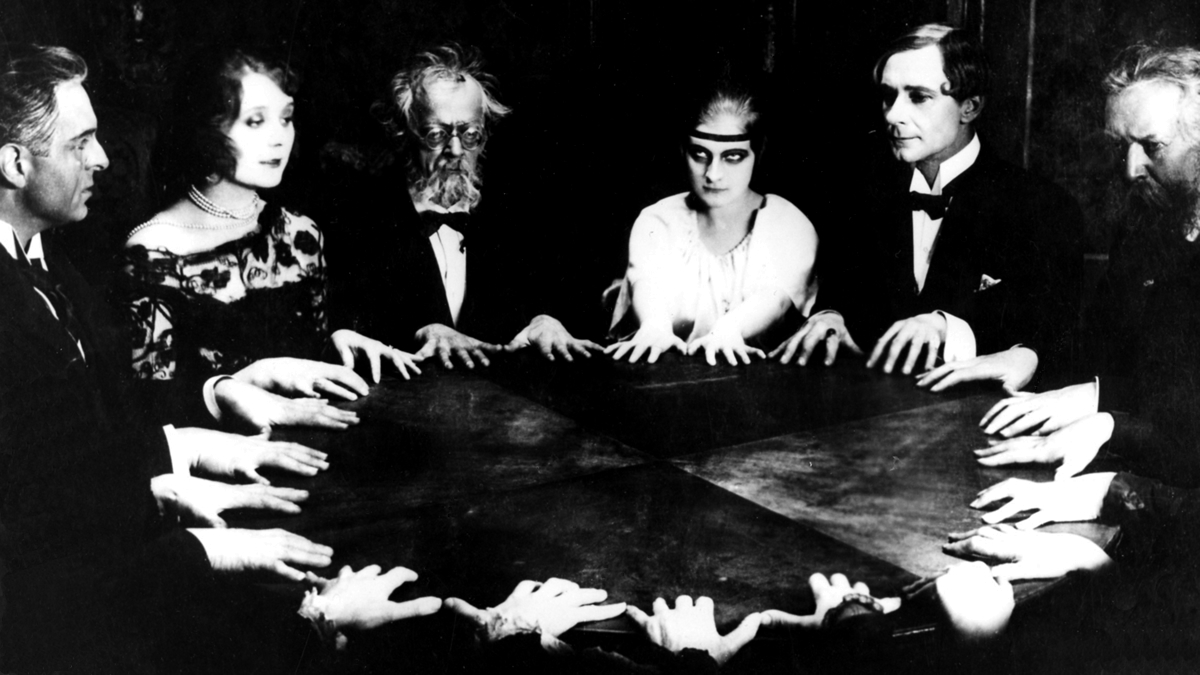
So the tocsin has sounded. The supernatural, once scoffed at by leaders of the bourgeoisie, is now treated with respect, enlisted as an ally. Spiritualism is boosted (the article by Basil King illustrates this). Even the humble ouija board has its place.
Mighty efforts are put forth to revivify the churches. Priestcraft is a whip over the people. Pulpits are making an ideal platform for reactionary propaganda. Even communion Sundays are marked by diatribes against radicals.
Right in line are such attempts as the interchurch. movement (now defunct); the big centenary fund of the Methodist church, with the large quota of conversions assigned even to small rural churches; the Baptist drive for the million dollar fund, and for the million tithing signatures.
In harmony with other efforts to increase the drawing power of the church is the increased reliance on ritual; the strange new tolerance, on the part of churches formerly Puritan, for the seductive appeal of forms, gowns, and musical selections of the kind formerly associated with the Catholic (or feudal) church. A glance at the Easter week programs of some of these churches is most illuminating.
The intentions of the church are loyal, it knows the voice of its master (capitalism), and can be depended on in every crisis. The best organized church of all, the Catholic church–which has survived feudalism, and adapts itself to capitalism as need requires- is exerting all its remaining strength. Nevertheless, the church, as a whole, is a broken reed. Its vitality is necessarily being sapped, for it is closely bound up with the life of the present order.
The interchurch movement has collapsed, leaving large numbers of churches so deeply in the hole, financially, that their work is in danger of being seriously crippled. In spite of the centenary fund, the Methodist church is falling behind, numerically.
The bourgeois themselves took power from the church in the early days. They clipped its wings, divested it of authority.
Yet, no matter how powerful, it could not stay the flood. Nor can dikes be set up by promoting occultism, and the fear of the supernatural, outside of the church.
The bourgeois society has outlived its usefulness, and is now trying to prolong its life beyond the allotted span. It is fighting for time, against evolution; and the individual, or the social order, that attempts to stem the irresistible tides of evolution, is predestined to failure. It is like trying to sweep back the mighty Atlantic with a broom.
FRANC CONNER.
The monthly organ of the Proletarian Party of America, The Proletarian originally served a left wing faction in the Socialist Party of Michigan led by John Keracher, and was printed in Detroit and Chicago from May, 1918 until July, 1931. The Proletarian Party then published Proletarian News, from 1932 until 1960. Part of the early Communist movement, the Proletarian University and the Proletarian refused to join with others in going underground after the Palmer Raids, though it eschewed electoral politics. The Proletarian Party attempted to gain admittance to the Third International to no avail. The Party eventually took over the left wing publishing house Charles H. Kerr & Co.
PDF of full issue: https://www.marxists.org/history/usa/parties/ppa/1920/1100-proletarian-v03n02-opt.pdf
 Revolution's Newsstand