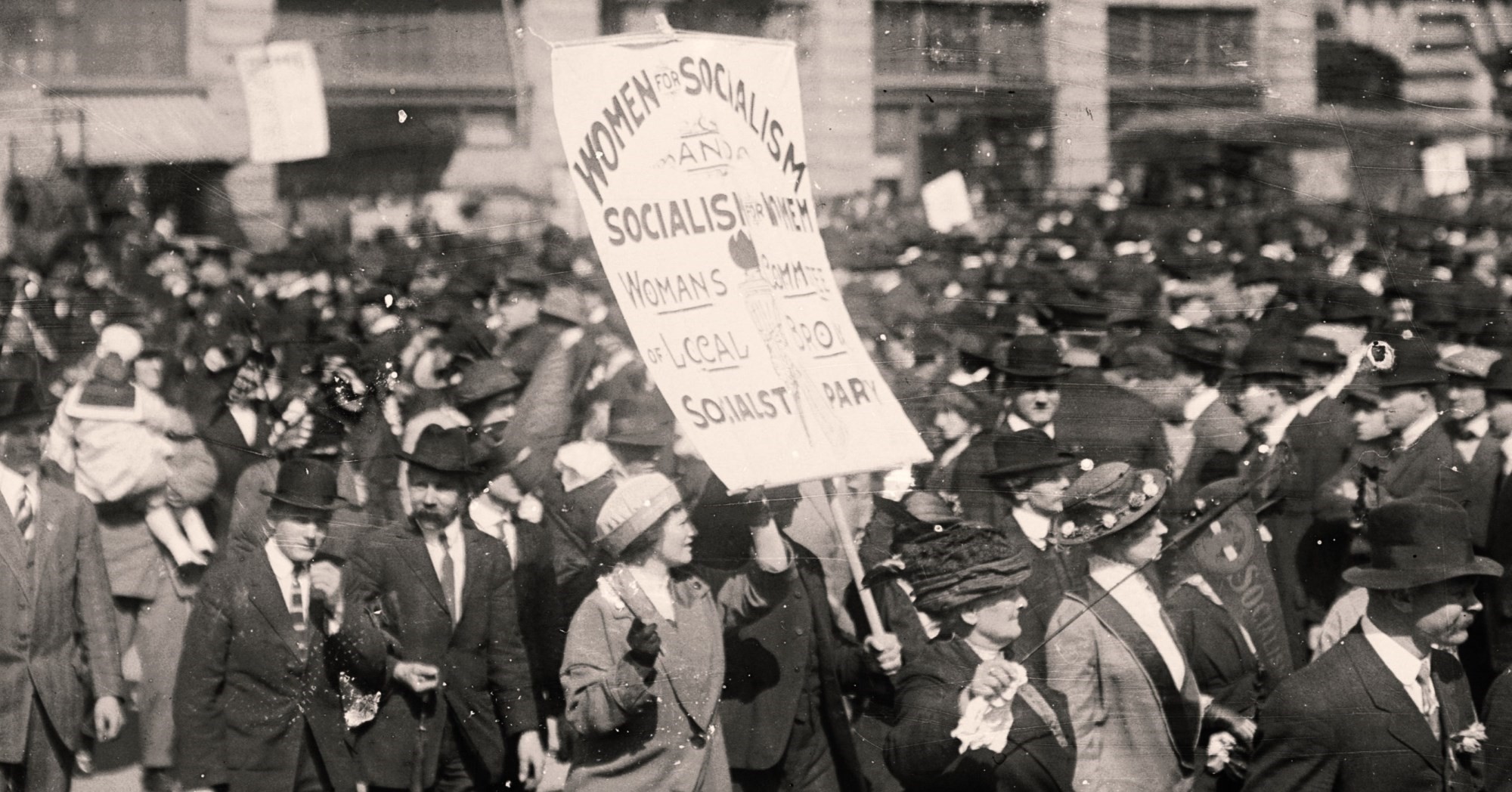
Meta Lillenthal Stern, ‘Hebe,’ was among the most important women Marxists of her generation. A ‘red diaper baby’ born to First Internationalist parents, she met comrades like Alexander Jonas and Friedrich Fritzsche as a child, had memories of Haymarket and Henry George, and her own path to Marxism. A prolific writer and translator, best known for her effort in translating the full text of Bebel’s ‘Women and Socialism,’ was a leader of the Socialist Party’s Women’s Deportment, inspired and helped to found International Women’s Day, and was an editor of the venerable New Yorker Volks-Zeitung.
‘Votes for Working Women’ by Meta L. Stern from The New York Call. Vol. 5 No. 142. May 21, 1912.
Tramp. tramp. tramp
A vast and silent army they go marching by in the early light of morning on their way to office, store and factory, thousands of them in every big city, millions of them in the whole country, the women who toil for wages, the working women of today.
They are a new type of womanhood. They are, on the contrary, the only true type of womanhood, for women have always toiled since civilization began and they always will toil because all true human dignity is founded on productive labor.
The grandmothers and great-grand-mothers of these millions of working women have been workers and producers too in their day, but the character of their work was radically different. They worked at home and the product of their toil was usually intended for immediate consumption by their own families. They owned the tools with which they worked and they were their own taskmasters, determining their own hours of work and the amount and nature of their products.
But the modern working women rust leave their homes to perform their labor, for they are only part of a gigantic system of production destined to supply the large and complicated needs of society. They no longer own their own tools, but perform just one specialized task with the aid of complicated machinery, and their hours of work, the articles they produce, the conditions surrounding their daily task, are quite beyond their individual control.
With the invention of machinery and the rise of the factory system, with the application of steam-power and electricity, woman has become a social producer, and the change that revolutionized her economic position brought about a complete change in her relation to organized society as well. The modern working woman has outgrown the four walls of home that comprised woman’s sphere in her grandmother’s day. For she has been called forth to work side by side with men, to be self-supporting and often to support others by her toil. The man’s world has become her world. The human sphere has become her sphere.
The modern woman has exactly the same burdens to bear and the same aims to strive for as her brother toiler. She is confronted by the same, Industrial problems of overwork and underpay and insanitary conditions. She must face the same fierce competition on the overcrowded labor market and the same tragedy of unemployment. But besides bearing the same burdens as the working man, the working women has still a few special burdens of her own to bear: the age-long burdens of her sex. If the man’s working hours are long, the woman’s are still longer. If the man’s wages are low, the woman’s are still lower. If insanitary conditions threaten the man’s health and life, in the woman’s case these same insanitary conditions threaten the health and life of generations still unborn.
Thousands of women today are working under conditions unfit for human beings. At unguarded machinery they are risking their nimble fingers, the only source of income they possess. In fire trap buildings, they are risking their lives. Badly ventilated workrooms, filled with particles of flying dust, weaken their lungs and make them susceptible to tuberculosis. Long working hours ap their strength and vitality. Dangerous occupations make them physical wrecks in a few years and render them unfit for wifehood and motherhood. In the case of married women workers appalling infant mortality is a concomitant of woman labor. But with all these sacrifices even the woman who performs a man’s work does not get a man’s wage. Everywhere we have unequal pay for equal work. The voteless sex is cheap.
If the women have always worked and always must work, why should their work be accompanied by so many wrongs and horrors? Because our social conditions have not been adjusted to the great economic change: because industry, although it largely depends upon the work of women, is not adapted to the needs of women; because women themselves have no voice in shaping the conditions under which they must work.
Women of leisure may demand the ballot for abstract reasons, justice and equality. But working women need the ballot. They need it as a means of self-defense in the terrible competitive struggle that marks our present industrial system. They need it to protect their very health and life and the future of their children. We are living in an age of social awakening. It has long since been recognized that the welfare of the workers cannot be entrusted to the goodwill of individual employers. Therefore the State exercises its right of control and by labor legislation seeks to regulate to some extent working hours and conditions of employment.
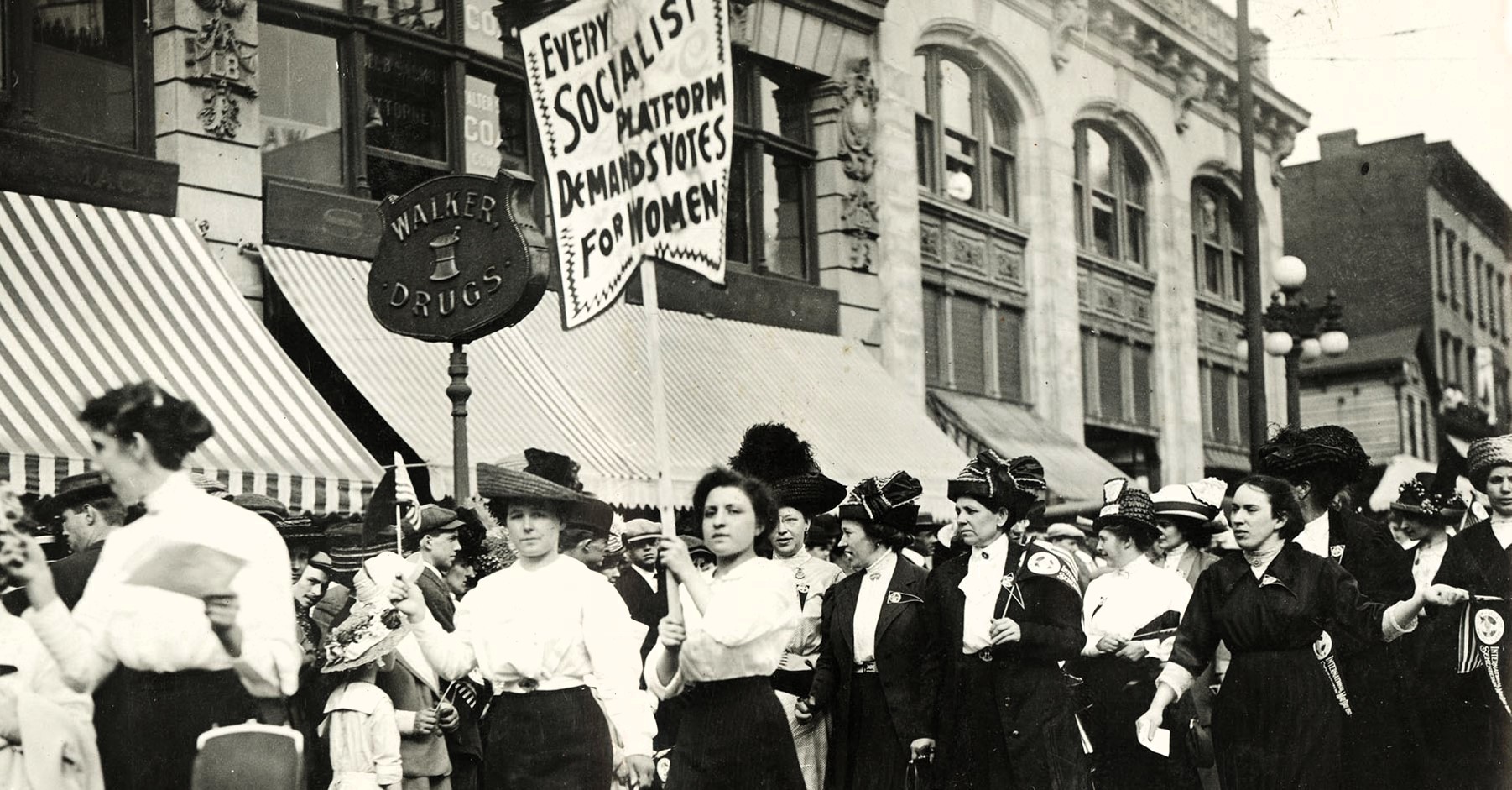
Workingmen, by the right of suffrage, are able to exert a powerful influence upon labor legislation. They are able to elect men to office who will represent their interests and thereby can compel the enactment of laws that will improve their condition. But working women are politically helpless. They cannot voice their demands at the ballot box. They are not represented in the law-making bodies. They cannot compel the enactment of laws that would lighten their burdens. While workingmen have two weapons for self defense. the labor union and the ballot, working women are only just learning the use of one and entirely lack the other. Industrial organization and political activity constitute the two powerful arms of the labor movement. Men are free to use both their arms. Women are struggling with one arm tied.
Give working women votes and you will give them an opportunity to help themselves more than charity or welfare work or middle class attempts at reform can ever help them. Give working women votes, and they will legislate child labor out of existence. Give working women votes, and they will shorten their long hours workday and establish a decent living wage, thereby combating prostitution more effectively than all your moralizing could combat it in a hundred years.
The Socialist party is the political representative of the working class. Since the working class consists of women as well as men, since women, in fact, form a large and ever increasing proportion of the working class, the Socialist party stands prepared to fight the woman’s battle as valiantly, an unflinchingly as the workingman’s. To remove the bonds that hold the working woman in double slavery, to combat the crying evils that today make woman’s work a curse instead of a blessing, to give women political freedom as a means of winning economic freedom, it for this that the Socialist party demands votes for women.
The New York Call was the first English-language Socialist daily paper in New York City and the second in the US after the Chicago Daily Socialist. The paper was the center of the Socialist Party and under the influence of Morris Hillquit, Charles Ervin, Julius Gerber, and William Butscher. The paper was opposed to World War One, and, unsurprising given the era’s fluidity, ambivalent on the Russian Revolution even after the expulsion of the SP’s Left Wing. The paper is an invaluable resource for information on the city’s workers movement and history and one of the most important papers in the history of US socialism. The paper ran from 1908 until 1923.
PDF of full issue: https://www.marxists.org/history/usa/pubs/the-new-york-call/1912/120521-newyorkcall-v05n142.pdf
 Revolution's Newsstand