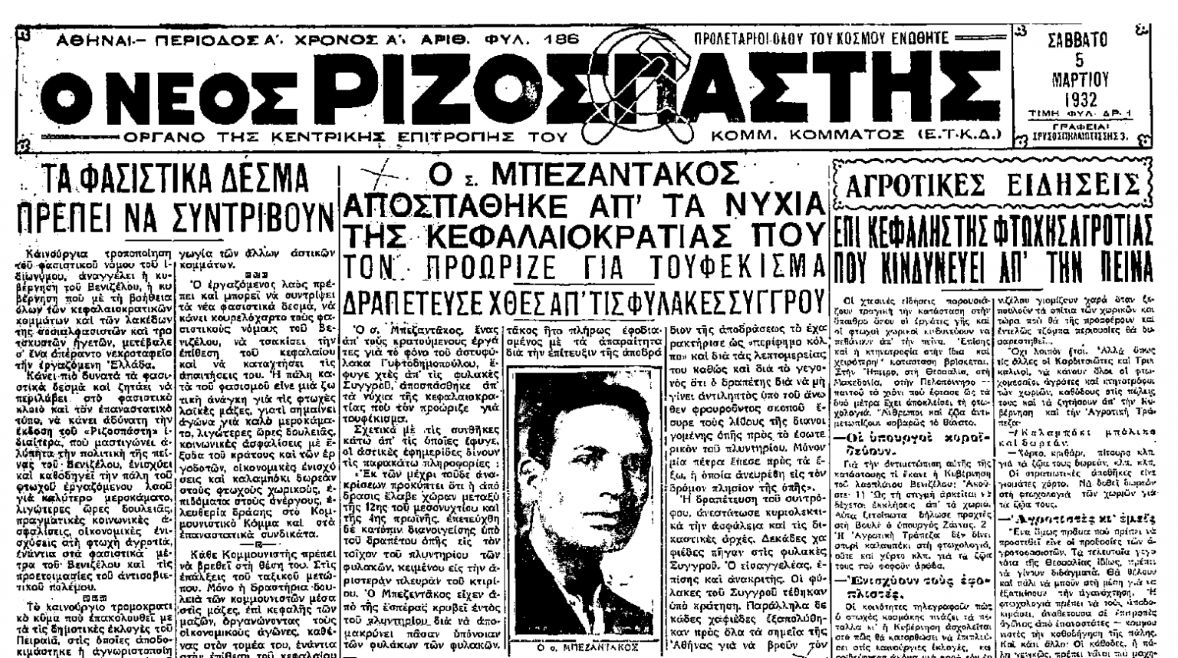
Kostas Grypos on the background and results of Greece’s 1932 election as the Communist Party breaks through, winning 5% of the vote and 10 seats in parliament. A major figure in early Greek Communism, then editor of Rizospastis, Karagiorgis would later play a central role as Communist military leader in the Resistance and Civil War.
‘Communist Election Victory in Greece’ by Kostas Grypos (Karagiorgis) from International Press Correspondence. Vol. 12 Nos. 43 & 44. September 29 & October 6, 1932.
The Elections in Greece.
Athens, 26th September 1932. The elections to the Greek Chamber of Deputies took place yesterday (Sunday). Exact details are not yet available, but it is already clear that the Veniselos Party will have the majority over the Popularist Party of Soldaris and that the communists have made considerable progress. The communists have had no members in the chamber up to the present, but it is now thought that have won several seats.
The elections were held at a time of crisis of the whole of Greek economy. In addition there is a credit crisis and a collapse of the State finances, which, after prolonged and desperate appeals for help to the League of Nations and the British capitalists, led to the official bankruptcy of the State and the abandonment of the gold standard.
The immediate results were a doubling of the price of all goods and the employment of dictatorial customs measures which throttled imports, whilst the world crisis and the economic retaliatory measures of the other capitalist States ruined the export trade.
The only way out of this crisis left to the bourgeoisie was a savage and ruthless super-exploitation of the working class and of the whole toiling population. This is the path which was actually pursued. In all branches of production wages were reduced by 30 to 50 per cent. Where the eight-hour day existed it was abolished. Many thousands of women and children had to take the place of the men. The peasants are actually dying of starvation; they have sold their cattle and are absolutely ruined. Greece is the relatively most heavily taxed country in the Balkans. The villages are tyrannised by the tax officials and gendarmes. The relief measures adopted by the government for the peasants, i.e. a provisional moratorium for their debts to private creditors, led to an immediate bankruptcy of small businessmen and tradesmen, especially in Macedonia and Thessaly.
The author and bearer of this programme is Venizelos, who had the overwhelming majority of the Parliament and Senate behind him. At the elections in 1928 he indulged in a passionate, monstrous and shameless demagogy. He promised the working masses that within four years he would so transform the whole of Greece that it would not be recognisable. The four years have passed…In these four years peasants were killed by gendarmes because they could not pay a tax of 28 drachmae. There were big miners’ strikes resulting in killed and wounded. Nearly a thousand revolutionaries are permanently confined in the prisons, where they are perishing. Three Macedonian revolutionaries were shot. The Communist Party is illegal in reality. Its press is confiscated in the post; all its functionaries are persecuted. The revolutionary trade unions are dissolved. The notorious “Communist law” gives every gendarme the opportunity to proceed against everybody ruthlessly. Fascist laws against the State officials, against the freedom of the press and for the fascisation of education have been issued.
Nevertheless, this savage policy of depriving the toiling masses of their political and economic rights in no way rendered easier the path of the Greek bourgeoisie. The last twelve months has been marked by a number of big miners’ strikes, peasants’ revolts, hunger marches (which in the autumn and winter of 1931/32 embraced the whole of Thessaly and the whole of Macedonia), strikes in the towns, indignation on the part of the petty bourgeois strata, demonstrations of the small tradesmen in Macedonia and Thessaly and strikes of officials.
The crisis and the rising of the working masses led by the proletariat in the towns caused a rapid differentiation in the political camp of the bourgeoisie. The parties which in the four years of Venizelos’ rule were absolutely united in the policy of economic and political suppression of the working population, opened a systematic fight against Venizelos. Due to the inner contradiction between the remnants of feudalism (monarchist party) and the various strata of the bourgeoisie, the fight assumed exceedingly acute forms. Venizelos tried to make use of these contradictions by opening a new big campaign on the eve of the elections against those who “undermine the Republic”. Under the same pretext of “defending the Republic” he organised the military League, with branches in the whole of Greece.
Venizelos expressed his intention of carrying out a change of the Constitution as a basis for the military fascist dictatorship. On the other hand, discontented and monarchist officers and non-commissioned officers, headed by the ex-dictator Pangalos, have organised an anti-Republican opposition within army.
The Communist Party of Greece is the only Party which organises and leads the resistance of the proletariat and shows the working population the revolutionary way out of the crisis. It was under the leadership of the Party that there was set up the united front of the workers and peasants for the election campaign, which realised in broad revolutionary action the united front of the struggle of the masses from below against the reformist, agrarian and Trotzkyist leaders. The Party organised a series of meetings in nearly all the towns of Greece. In spite of all persecutions, the united front put forward 107 candidates and contested every constituency. The election fund of the united front war raised exclusively from contributions of workers, peasants and members of the middle class. Many peasants offered wheat and food because they had no money.
In face of this splendid action the Government resorted to desperate measures in order to throttle it. Most of the candidates, all members of the central election committee and most of the members of the local election committees are in prison, charged with high treason. The election funds were confiscated. The fight was continued, however, by the rank-and-file members of the united front.
The Communist Election Victory in Greece.
Never before in Greece have elections been carried out under conditions of such terror against the working masses as in the Parliamentary elections which took place on September 25 last. The oppressive measures which during the preceding period of four years were the usual methods of Venizelos, were tremendously intensified on the eve of the elections. Thousands of proletarian fighters are in prison or banished. The delivery of the Communist press through the post is prohibited, so that large districts of the country are without any Communist paper. Most of the 106 candidates of the united front of the workers and peasants, led by the Communist Party, were arrested,
The central committee and many local election committees were arrested on the charge of “high treason” on account of the slogan “Right of self-determination for the Macedonian people up to complete separation”, and the Communist central organ in Athens and the district organ in Salonica were persecuted. Special permission had to be obtained from the local authorities in order to hold any election meeting. In many districts, chiefly in the agrarian districts where the influence of the Communist Party is relatively weak, participation in the election was rendered almost impossible by the prevailing terror. In Macedonia, the fascist bands on the day of the election closed and partly plundered the election committee rooms of the Communists. The Communist election helpers at the polling booths were all arrested and detained for 24 hours.
All this did not prevent the Communist Party from carrying on a magnificent agitation before the election. Over 130,000 working people were mobilised under the Party flag. The terror in Macedonia, Thrace and Thessaly collapsed as a result of the resistance of the masses. In these provinces the Communist Party mobilised larger masses than any bourgeois party. Also in Athens and Piraeus thousands of working people took part in the big legal meetings and in the illegal street demonstrations. The working youth actively participated in the election agitation; they put forward four of their own candidates. Many quite rural districts, especially in Thessaly, Mytilene, Macedonia and Thrace, took an active part in the fight. The agrarian party, whose programme is indistinguishable from that of Venizelos, was compelled to come before the peasants with a demagogic Communist mask and declare: “When we seize power we will bring Communism”.
The final results of the elections are as follows: Liberal party (Venizelos) 102 seats, formerly 218; Monarchist People’s party (Saldaris) 96, formerly 16; Progressive party (Kafendari) 15, formerly 3; Communist Party 10, formerly none, and, a senator returned in Thessaly; the agrarian party 10; the “peasants and workers” party (Papanastassiu) 6, formerly 18; the national radical party 5 and the other parties 6. The complete figures of the votes cast for each party are not yet known. It is certain, however, that the Communist Party of Greece, under conditions of frightful terror, has increased its poll 22-fold compared with the last election in August 1929. It has thereby polled the highest vote in the history of the Party and sent its representatives into Parliament and the Senate; a thing it was unable to do at the last election. But the most characteristic feature of this election is that the Communist Party has achieved the position of third or second, and in some cases even first, party in nearly all the proletarian districts which are of great importance in the political and economic life of the country. Thus it has advanced to the third party in the capital town of Athens with over 7000 votes and two seats, as third party in Salonica with over 7000 votes and three seats. It has won half of the total votes of the Jewish nationality of Salonica and captured one of the two Jewish seats.
Characteristic of the turn of the masses to Communism is the collapse of the Republican party of Papanastassiu, which was able to retain only six seats. In order to catch votes, Papanastassiu recently changed the name of his party from Republican Union to “workers and peasants party”. The agrarian party suffered a similar collapse. It had, on the one hand, actively supported all the measures of Venizelos against the poor peasants, on the other hand, however, it came before the various strata and categories of the peasants with a number of mutually, contradictory programmes and demands. But with all this demagogy it was unable to return more than 10 candidates, of whom several have already announced their allegiance to Tsaldaris and Kafandaris, so that it is very questionable whether the party will be able to form a Parliamentary fraction.
The rest of the Republican parties have suffered a severe defeat. Not even the Republican leaders Kondylios and Zavitsanos have been elected. The leaders of the reformist trade unions, who months ago founded a “socialist” party, ran their candidates on the lists of the Papanastassiu party, the agrarian party, and in Salonica even on Venizelos’ party. In spite of this they did not obtain a single seat.
Whilst in the proletarian and progressive districts of North Greece and Thessaly the Communist Party has become the most important factor after the Venizelos party, in the backward, mainly agrarian, districts of Peloponnes, Epirus, Rumeli and the islands, the monarchists received nearly all the votes of the masses who are disappointed in Venizelos.
The big success of the Communist Party is to be appreciated all the more as for two years it was torn by fractionist struggles, and it was only a short time ago, with the active support of the Communist International, that it obtained a united leadership and was able to liquidate fractionalism. The recent even more splendid election success of the Communist Party of Bulgaria shows, together with the election success of the Greek party, the rapid turn of the oppressed working population of the Balkans to Communism.
International Press Correspondence, widely known as”Inprecorr” was published by the Executive Committee of the Communist International (ECCI) regularly in German and English, occasionally in many other languages, beginning in 1921 and lasting in English until 1938. Inprecorr’s role was to supply translated articles to the English-speaking press of the International from the Comintern’s different sections, as well as news and statements from the ECCI. Many ‘Daily Worker’ and ‘Communist’ articles originated in Inprecorr, and it also published articles by American comrades for use in other countries. It was published at least weekly, and often thrice weekly.
PDF of issue 1: https://www.marxists.org/history/international/comintern/inprecor/1932/v12n43-sep-29-1932-Inprecor-op.pdf
PDF of issue 2: https://www.marxists.org/history/international/comintern/inprecor/1932/v12n44-oct-06-1932-Inprecor-op.pdf
 Revolution's Newsstand