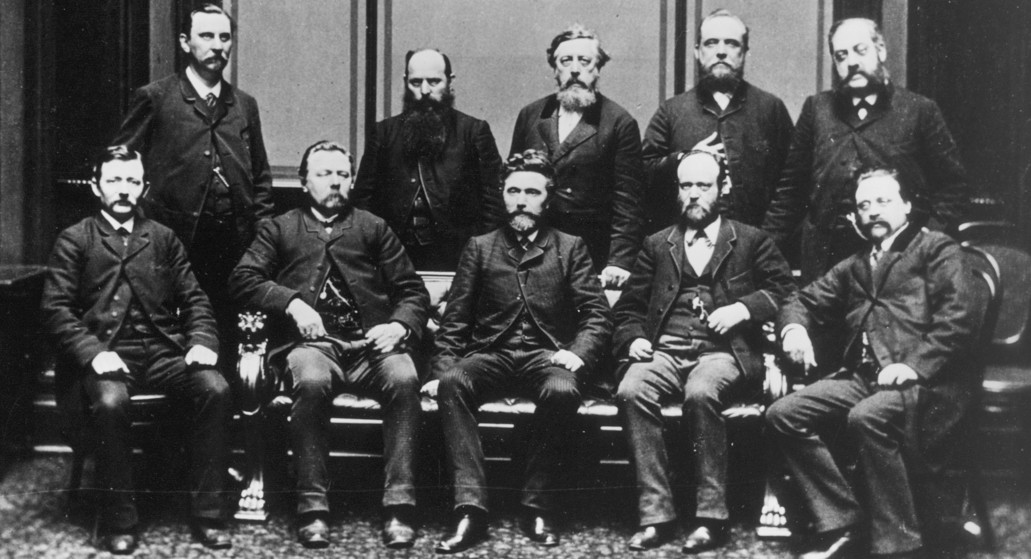
We tend to remember German Social Democracy in its parliamentary, and increasingly conservative, years. However, more than a decade of semi-underground work during the Anti-Socialist Laws was a heroic period for the Party. Below, the hard work begins to pay off as Berlin elects Wilhelm Liebknecht to the Reichstag in 1888 with 62% of the vote. The Laws would elapse in 1890.
‘Liebknecht Elected by a Big Majority’ from Workmen’s Advocate (New Haven). Vol. 4 No. 36. September 8, 1888.
A CLEAN VICTORY.
Berlin Socialists Cover Themselves with Honor–In Spite of Bismarck and his Satraps–Strategic Skill of the Workingmen.
BERLIN, August 30, 1888, In the election of the Sixth district of this city today William Liebknecht, Socialist, was successful, receiving 26,067 votes out of a total of 41,791.
That’s what the cable dispatch reported a few hours after our last issue went to press. The total vote was smaller than usual. This election was held in order to fill the vacancy made by the retirement of Hasenclever, who was recently afflicted with hopeless insanity.
The following review of the situation before the result of the election was known was published in the New York Herald of the 31st ult., and will be of interest to our readers:
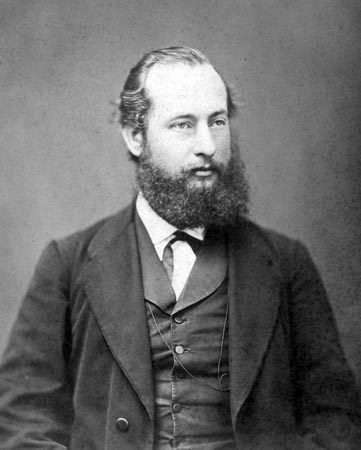
“In the Sixth Electoral District of Berlin the voters will be called upon today to elect a representative to the Reichstag in place of the former incumbent. William Hasenclever, who became incurably insane. The district is one of the most densely populated ones, its inhabitants chiefly consisting of storekeepers and workingmen. Hasenclever was a Socialist, and in all probability his constituents will return a member of the same political faith. The socialist candidate is William Liebknecht, well known as one of the most prominent men of his party, a friend and disciple of the late Karl Marx.
“The authorities in Berlin have made enormous efforts to prevent Herr Liebknecht’s election. The minor state of siege proclaimed in Berlin since 1878 under the provisions of the anti-socialist law of that year, vests the police practically with dictatorial powers as far as the socialists are concerned. The rights of free press and free meeting are denied to them: even the collection of funds for campaign purposes is prohibited. And yet, in spite of all this, and of the numerous arbitrary arrests of socialist workers, the election of Liebknecht will be a foregone conclusion.
“For in the guerilla warfare carried on between the German police and the radical element the latter has developed great strategic skill and superior generalship. Secret organizations cover the capital of Germany with an impenetrable network. They consist of small groups, under tried and trusted leaders, connected among themselves but loosely, in order to diminish the dangers of detection. Each district works under a single leader, who holds his place of trust by choice of the minor leaders.”
[This is not quite correct. There are no leaders, in the sense in which it may be understood in this country. The socialists in meeting decide upon their policy, and the so called leaders simply act as executiver, just as with the Socialist Labor Party of the United States–ED.].
“His orders are obeyed with the greatest promptness. He sees to it that campaign documents are printed secretly and distributed in a most efficient way, through the workshops as well as through the residences of his fellow workmen. The ballot are distributed in the same way. The campaign documents are tersely written, and appeal to the feeling of the liberty-loving Germans They set forth the outrageous tyranny of the government, as well as the complaints of the muzzled wage earners. Though the active members of the secret organizations number probably not more than one thousand in the district, they have the sympathy and co-operation of the whole working class. The wives, sisters and sweethearts of Berlin socialists are often among the most energetic political workers, collecting money, distributing documents and carrying messages to places where it would be dangerous for well known socialists to show their faces. The prospect of arrest and subsequent imprisonment has cease to frighten this incensed people. As in Ireland, imprisonment for political offenses has become rather an honor than a disgrace in the German Empire.
“There is no house, however humble, that is not reached by these indefatigable workers. Besides, the fly-leaf copies of the Social Democrat, the weekly socialist organ, published at Zurich, are distributed, and every one of them circulates among scores of readers.
“The socialists, prevented from having meetings of their own, invade the meetings of their opponents and manage to make themselves heard. If their intrusions result in breaking up such meetings and in the arrest of some of their spokesmen, they don’t mind it a bit but go right ahead, insisting that they will have their say, the coercion and espionage system to the contrary notwithstanding.
“The anti-socialist law has practically unified the laboring class in Berlin. The election of Liebknecht, who in 1848 bore the musket in the revolutionary army, will prove this anew. That law was one of Bismarck’s greatest political blunders.”
The great victory announced above will be the better appreciated when our readers look over the following figures:
In 1867 the Socialist vote in the same district of Berlin was 33. In 1871 it increased to 1,264. In 1874, 3,161, and at a supplementary election the same year 6,010 Socialist votes were cast. In 1877 it had risen to 12,751, in 1881 to 17,378, in 1884 to 24,465, and in 1887 it reached the highest notch, 30,457, while the opposition parties, the Progressists and Conservatives, polled 11,750 and 16,836 respectively.
This year was an “off year,” but the Socialists polled 26,077 votes against the Progressists’ 7,305 and the Conservatives’ 8,108.
Here is an instance of perseverance against fearful odds, such as the working people of America have not as yet had to contend with.
The Socialist Labor Party of the United States rejoice with their German comrades, and the sturdy American rooster crows over the victory.
Es lebe die Sozialdemokrati!
The Workmen’s Advocate (not to be confused with Chicago’s Workingman’s Advocate) began in 1883 as the irregular voice of workers then on strike at the New Haven Daily Palladium in Connecticut. In October, 1885 the Workmen’s Advocate transformed into as a regular weekly paper covering the local labor movement, including the Knights of Labor and the Greenback Labor Party and was affiliated with the Workingmen’s Party. In 1886, as the Workingmen’s Party changed their name to the Socialistic Labor Party, as a consciously Marxist party making this paper among the first English-language papers of an avowedly Marxist group in the US. The paper covered European socialism and the tours of Wilhlelm Liebknecht, Edward Aveling, and Eleanor Marx. In 1889 the DeLeonist’s took control of the SLP and Lucien Sanial became editor. In March 1891, the SLP replaced the Workmen’s Advocate with The People based in New York.
Access to PDF of full issue: https://www.loc.gov/resource/sn90065027/1888-09-08/ed-1/?sp=1&q=Liebknecht&r=0.018%2C0.271%2C0.524%2C0.258%2C0&st=pdf#viewer-pdf-wrapper
 Revolution's Newsstand