
The I.L.G.W.U. had one of the most robust and successful cultures of social unionism. Below, how Local 25 purchased a former resort in Pennsylvania’s Blue Ridge Mountains to create Unity House, a retreat and educational center for its members that would become a central institution of the union.
‘The Story of Unity House Operated by the Garment Workers’ by Macien Lucas from Butte Daily Bulletin. Vol. 2 No. 255. June 17, 1920.
Unity House, or Unity Village, as it is often called, the summer resort of the New York Ladies’ Waist and Press Makers’ union local 25 of the International Ladies Garment Workers’ union, will be open to receive guests on June 12. This independent co-operative summer home of the girls of local 25 is situated in the Blue Ridge mountains of Pennsylvania, near Stroudsburg.
The resort comprises about 700 acres, with a large lake, 10 cottages, and a central house which is open to all. The estate was recently purchased for the sum of $85,000 by local 25, a portion of this sum being raised by a contribution of each member’s wages for work on Washington’s birthday, and partly by bonds sold to members. The house was rented by this union last year and successfully run as a vacation home, Rebecca Silver being the manager.
This will be the first year, however, that local 25 will be able to spend the summer in a home purchased with their own money and veritably their own.
The local has now had a vacation home for four summers. Their new and permanent home is the most beautiful that they could find after scouring the country for available places. It is about three hours from New York city, and last summer they entertained 1,700 guests at the home. The majority of those who stayed there during the summer were members of the union, although when there is room and other friends of the girls wish to go there, they are permitted to do so. There are accommodations for 500 people at Unity House, which was formerly Forst Park hotel; and which was one of the largest hotels in the Blue Ridge mountains.
The main house has a dining room accommodating 500 people, and a large hall where they can gather for concerts, lectures, or other entertainments. The house is equipped with electricity, baths and all modern conveniences. A laundry run by the house was open one day a week last summer to all those who wished to do their own laundry. The house also has its own bakery.
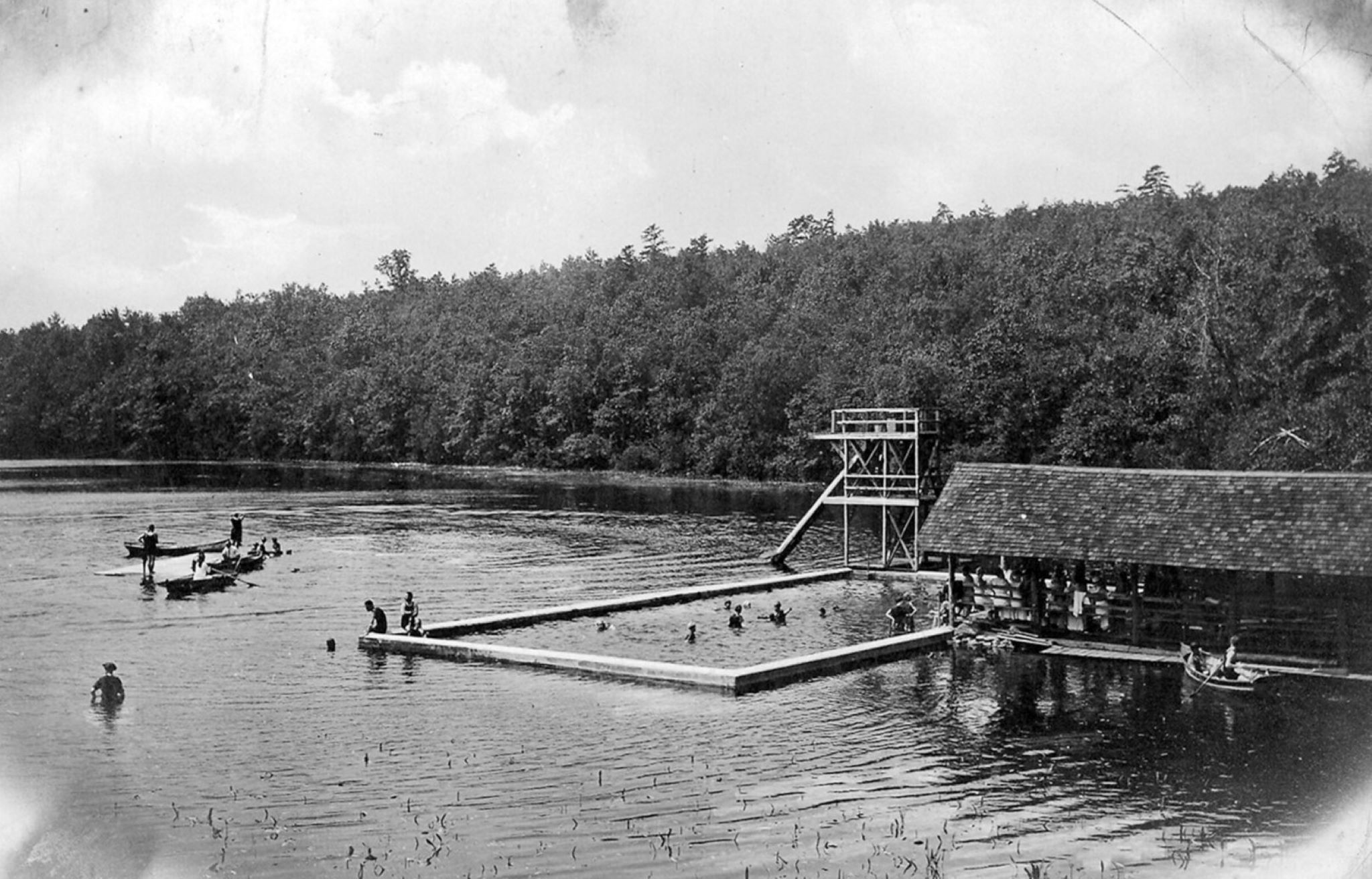
There is a post office at Unity House which is paid for by the government, being part of the regular postal system. A store is also provided, where sodas, candy and other refreshments are sold to the guests. There is a boathouse on the lake, which is easily accessible to the houses, and boats are rented for a small sum.
A lifesaver was stationed at the lake last summer, in order to prevent possible accidents. There are 50 bathhouses at the lake, and for the use of these nothing is charged. Mrs. Lucy Retting, who took charge of the instruction in gymnastics, gave the girls lessons in swimming. A cement pool was constructed in the lake for those who did not know how to swim, and in the shallow water in this pool many of them learn to swim. Mrs. Retting also taught games and dancing out of doors when the weather permitted.
The fee charged for room and board at the home has been so low as to permit everybody to enjoy the extraordinary privileges and beauty of Unity House very much less than the girls would pay for much inferior accommodation at the ordinary summer resort. The house was entirely self-supporting last summer.
There is an electric plant on the place which furnished the power needed for the house. For recreation, there is a tennis court, and even a bowling alley. There is also a small hospital, with a nurse in charge, for the benefit of anybody who may need medical advice. For the coming year a contract has been made with a neighbor for all the eggs his few thousand chickens lay.
“The most noteworthy thing about the undertaking.” says Jennie Matyas, one of the girls of local 25, “is that it was bought and is now managed by a committee of our members. Workers who were never taught anything about real estate or hotel management have undertaken to buy and run this difficult and expensive institution. The committee that bought the house was headed by Rebecca Silver. She is one of our girls, who stepped out of a shop for a short time.
“Although the entire committee worked on it, this present property is really the child of her soul. She it was, who, with incomparable concern and effort wrung the price down from $150,000 to the present $85,000. The house was bought last year in May, when our winter-long strike had drained the local treasury and sapped the energy of the workers. Many of us were so carried away by the bitter fight that we had little thought left for a thing so luxurious as a summer home. But Rebecca, although she was active in arranging speakers for the strikers, kept close to her intrusted mission of providing us with a home where we could rest and forget.
With grit and determination, and with ability and diplomacy, she and the committee secured for our union that which has gained us national and even international fame and admiration.”
The Butte Daily Bulletin began in 1917 in reaction to the labor wars in Montana, the Speculator Mine fire killing 168 miners; IWW organizing, and the murder of IWW organizer Frank Little in Butte. Future Communist leader and IWW organizer William F. Dunne and R. Bruce Smith, president of the Butte Typographical Union published the paper as an outgrowth of a strike bulletin with the masthead reading, “We Preach the Class Struggle in the Interests of the Workers as a Class.” It became daily in August 1918 and in September 1818 officers raided their offices and arrested Dunne and Smith on sedition charges. An extremely combative revolutionary paper, while unaligned, it supported the struggles of the Left Wing in the SP, reflecting the large radical Irish working class of Butte also supported Ireland’s and the Bolshevik revolution, as well as the continued campaigns of the IWW locally and national as well as the issues in Butte. It ran until May 31, 1921.
PDF of full issue: https://www.loc.gov/resource/sn83045085/1920-06-17/ed-1/?sp=1&st=pdf&r=0.293%2C0.121%2C0.244%2C0.12%2C0#viewer-pdf-wrapper
 Revolution's Newsstand