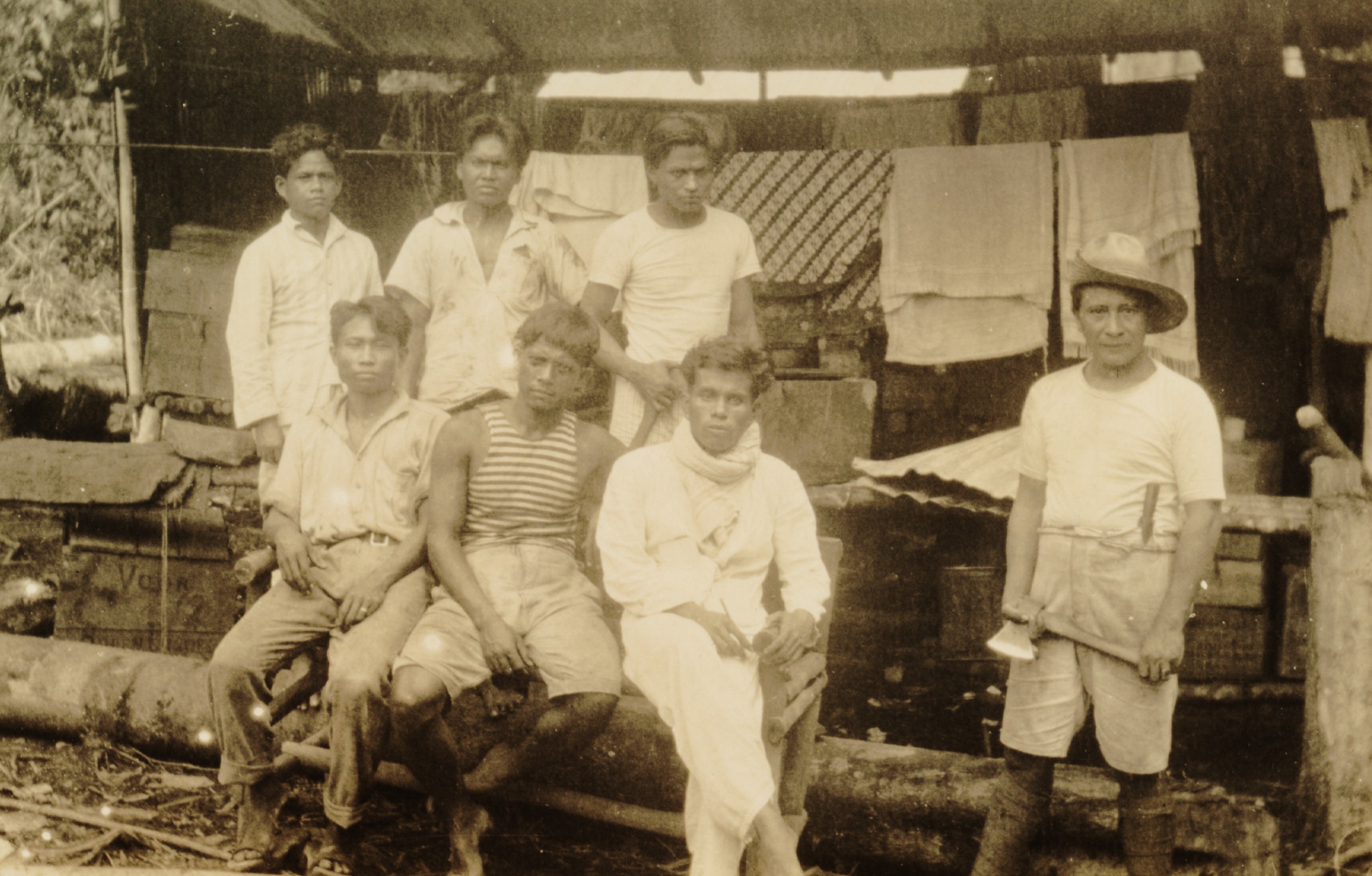
Opened in 1927 after a series of nationalist and Communist risings, the notorious Dutch concentration camp of Boven-Digoel, isolated in the South Papua interior, saw thousands of both activists (and their families) and innocents sent to brutal exile. A report on the situation as it was investigated in 1931.
‘Upper Digoul: A Monument of Dutch ‘Civilisation’ in Indonesia’ by P. De Groot from Communist International. Vol. 8 No. 7. April 15, 1931.
THE purpose served by the plains of Siberia for Russian Tsarism, and the islands of Lipari for Italian Fascism is served by Upper Digoul for Dutch domination in Indonesia.
In the dark days at the end of 1926 and the beginning of 1927, when the revolt of the oppressed masses in the islands of Java and Sumatra had been drowned in blood, the Dutch imperialist butchers loosed their dastardly vengeance on the revolutionaries who had caused them such hours of supreme disquiet.
The insurgents in hundreds were mowed down by arms or hanged by “judicial” decree, without the pretext of a trial. With the noose on their necks, they died with the cry on their lips, “Hidoupla Communis,” (Long live Communism). Thousands of them filled the prisons, where, according to the Government, there are still 2,600 up to the present day. But this was not sufficient for the Dutch “civilisers.” They wished to wipe out completely the revolutionary organisations, both the Communist Party and the National Revolutionary organisation of the Sarekat Rajat, by getting rid of the “dangerous” cells. Relying on “extraordinary powers,” almost 2,000 persons suspected of belonging to these centres and against whom no definite charge could be made, were deported by administrative decree.
As a place for deportees, the Government chose the “sub-department” of Upper Digoul in Central New Guinea. On the banks of the River Digoul, places were cleared in the virgin forest inhabited only by wild Papuan tribes. In this “least civilised part of the world” according to their own admission, Dutch imperialism wished to bury the colonial revolution of Indonesia.
AN OFFICIAL REPORT.
In April, 1930, three years after its foundation, the Dutch Government sent a member of the Governmental Council of the Dutch Indies, Mr. Hillen, to Upper Digoul to look into the situation.
The motive of this mission is not clear.
Probably, the Government began to find the cost of the camp a little too high. In fact, according to the calculations of Mr. Hillen, the camp at Upper Digoul costs the Government about £82,500 a year.
As the avarice of the Dutch bourgeois shopkeepers is the only passion which might moderate their cruelty, we may justifiably consider this to have been the initiative for Mr. Hillen’s journey.
Mr. Hillen sent a written report which was discussed in the Chamber of Deputies. From this document, in spite of the natural camouflage of an official report, we can gain an idea of the situation of our comrades who are interned there. Above all, by its conclusions we can let the international proletariat judge the barbarism of Dutch imperialism, which wreaks its vengeance on hundreds of poor peasant and workers, of whom they are forced to state now, after three years of indescribable suffering, that they are absolutely “innocent,” even in their eyes.
THE CAMP AND ITS INHABITANTS.
In his report1 Mr. Hillen describes the situation of the camps as he found them.
There are two encampments, one called Tanah Merah, the other called Tanah Tingih. In all, there are 1,175 people interned with their families who followed the interned into exile. Upper Digoul contains 2,000 people. The interned are classed in five categories:
Working on Government service—110
Day Workers—380
“Naturalists”—225
Tanah Tingih—70
Living at their own expense—350
Invalids—40
Those working on Government service are internees who by their conduct have won the confidence of the commandant and who perform the duties of police agents, telephone employees, instructors, etc. They receive a small salary.
The day workers are internees who carry out clearance work for the Government. They receive one Dutch florin per day. Those who live at their own expense are the internees who have still resources of their own or who work for others. The “naturalists” are those who persist in the policy of non-co-operation, even in exile. They refuse to work for the government. Seventy of the internees are isolated from the others at Tanah Tingih, several kilometres away. They refuse all contact with the authorities and refuse to work.
The “naturalists” and the Tanah Tingihites receive a ration valued at twelve Dutch florins a month (about £1). We shall see what this means in relation to the prices of commodities at Upper Digoul.
Most of the internees belong to the intelligentsia, or semi-intelligentsia, old employees and instructors. There are only 5 per cent. of peasants among them. The average age is 32. In addition to the internees, Upper Digoul is occupied by a garrison of six Infantry Brigades with officers, N.C.O’s, etc. At the top there is all the government machinery, two assistant residents, a military commandant, a police superintendent, two military doctors, etc. Each of the “big bugs” gets at least a thousand Dutch florins a month.
CONDITIONS OF LIFE AND WORK.
The cost of living is high in Upper Digoul.
The prices mentioned by Mr. Hillen in his report are exorbitant for Indonesia. Dried fish costs one florin per kilogram, an egg costs 10 to 12 cents, a banana 10 to 12 cents, a cucumber 60 cents, a fowl 2.25 florins, cocoanut oil .75 florins a litre, salt .32 florins a kilogram; vegetables and fruit are excessively dear. The common food, katjang idjou, costs .4 florins a kilo.
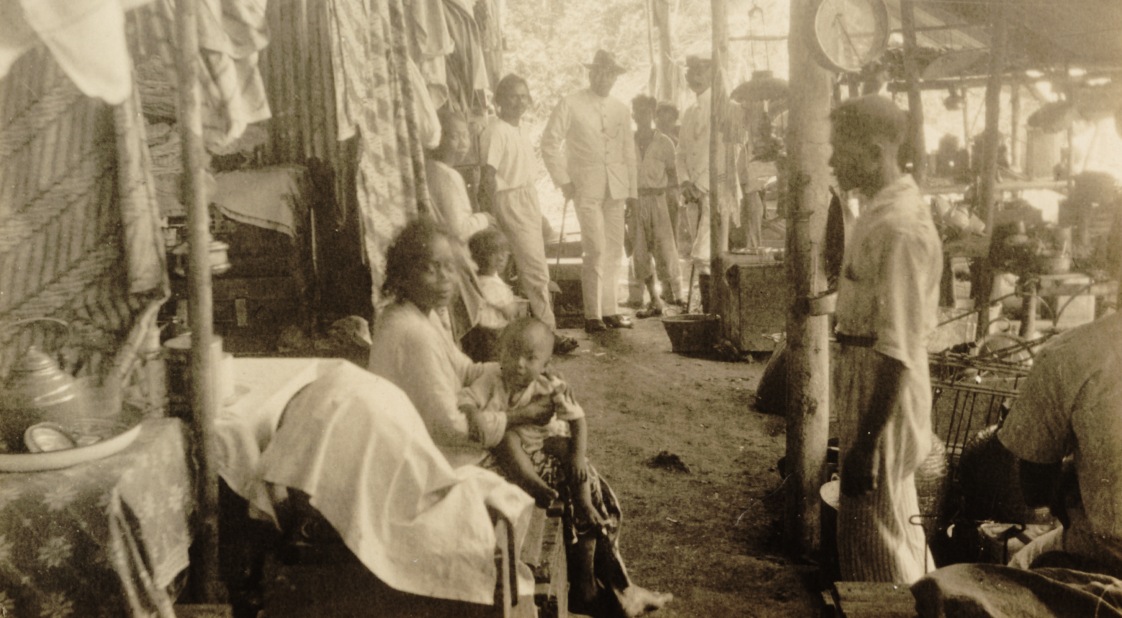
In view of these prices, we can imagine what is represented by a wage of one florin per day, or a ration valued at .4 florins per day which is received by the “naturalists” and the Tanah Tingihites, or the subsidy of 20 florins a month received by the invalids.
To avoid dying completely from hunger, and since they have no longer any money to obtain commodities, the unfortunate people try to get some vegetables from their little plots of barren land. The land is sterile at Upper Digoul. The Government tried to utilise the labour of the internees to clear land for sowahs (rice fields), but without any result except that of torturing the interned day workers. Mr. Hillen stated himself that this work is too severe for people unaccustomed to work in the fields.
MALARIA AND BLACK-WATER FEVER.
“Tanah Merah and Tanah Tingih are haunts of malaria,” coldly states Mr. Hillen in his report. Tropical malaria is rampant, followed by black-water fever. Mr. Hillen reports that at the beginning of 1930, there were 360 suffering from fever in February, 162 in March, 147 in April, and 136 cases of malaria in May. Thus, in February, 17 per cent. of the population were suffering from malaria. The previous year, the percentages varied from 15 to 17 in winter, and 6 to 14 for the rest of the year. From July 1st, 1928, there have been 72 cases of black-water fever per year. In all, there were 159 cases up to May, 1930. No fewer than 14 persons have died of black-water fever, 13 have died of malaria in 1929 and 4 more in the first five months of 1930. These are the official figures given by the military doctor. There is no guarantee of exactness. For that matter, Mr. Hillen speaks only of the internees. From another official source, “Government Communications,” in May, 1929, we find that the mortality among children at Upper Digoul was 95.67 per thousand during the first year of the internment and 49.75 per thousand during the second year. From the end of March, 1927 to the end of February, 1929, 32 children died out of 64 who were born. This gives a 50 per cent infant mortality.
Dutch imperialism is acting like the God of the Old Testament, and is carrying out its vengeance to the third generation!
After this, we need not inquire as to the general state of health of the internees. Mr. Hillen himself quotes the book of the English doctor, Manson (Tropical Diseases) that patients suffering from black-water fever must be immediately sent away from the infected area for a period of a month to a year. Mortality from the disease is very high.
Naturally, the internees are not sent away at all; they must remain at Upper Digoul where a painful death inevitably awaits them. The Government is always “attempting to improve matters.” “We should not go by the English proverb of killing the Communists by inches,” says Mr. Hillen. What a good Government! It gives quinine to the internees to make them more or less immune. The fact that Mr. Hillen himself caught malaria at Upper Digoul proves that the remedy is not efficacious against malaria. It is necessary to take at least .6 grammes a day without a break for several years. But this means to be poisoned. Of course the Government does not like to kill the Communists by inches! It adopts the better practice of killing them by yards!
THE “REFRACTORIES.”
The Tanah Tingih camp is reserved for the “refractories.” These are the people who not only declare themselves, like the “naturalists,” in spite of all punishments, to be the open enemies of the Dutch régime, but those who also refuse to do any work for it, and who abstain from any contact with their oppressors.
In his report, Mr. Hillen describes his visit to Tanah Tingih. He entered it, accompanied by half a dozen of the “big cheeses,” the Commandant, the Assistant-Residents, etc. But the internees took no notice of them, pretended not to see them, and certain of them expressively turned their backs. The military doctor gave out that he was making a visit to the internees, but no one came to him. Proud and implacable, the internees have the strength, in spite of years of suffering, to show their deep hatred for their jailers. They understood the purpose of Mr. Hillen’s visit. They were aware that he had the power to propose to the Government to liberate them. A docile attitude would have opened for them the prospects of liberty, of deliverance from the hell of Upper Digoul!
But they persisted in their magnificent hate, they preserved an attitude worthy of the oppressed classes of Indonesia in face of the representatives of imperialism. Our prisoner comrades of the anti-imperialist war did not flinch. They showed, these 70 “refractories” of Tanah Tingih, with their wives and children, the irreconcilable determination of the exploited masses of the workers and peasants of Indonesia, to fight to the end against the yoke of the Dutch bourgeoisie. But this spirit of struggle is not confined to the internees in Tanah Tingih.
In September, says Mr. Hillen, 200 internees in Tanah Merah demonstrated against a reduction of rations for those who refused to work for the Government. Thirty of them were imprisoned. For there is also a prison in the great prison building of Upper Digoul, a barrack where the sun of New Guinea burns through the galvanised iron roof. It contains regularly at least thirty prisoners who are being punished for negligence at work, relates Mr. Hillen.
ESCAPES.
During the existence of the camp, 67 internees in all have risked attempts at escape. They have all miscarried.
Most of the fugitives were obliged to return after wandering vainly in the virgin forest, hunted by wild Papuans, without food or water.
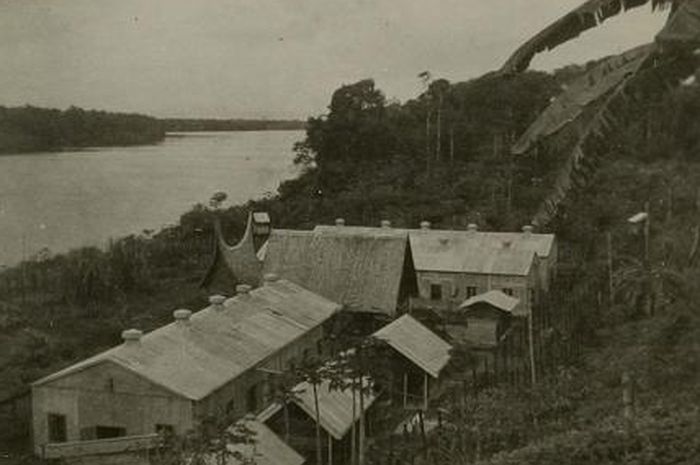
At the beginning of this year, some of them reached British territory. The authorities, representing the MacDonald “Labour” Government, as good colleagues of the Dutch imperialists, arrested them at Thursday Island and handed them over to their jailers. A Dutch Government vessel came triumphantly to Thursday Island to carry them back to Upper Digoul! Four fugitives are missing. It is not known whether they have died of hunger and starvation or whether they have fallen under the arrows of the Papuan tribes who form the “natural” guard around the camp. Digoul is the torture chamber of Dutch “civilisation.”
What a touching solidarity between the head hunting savages2 and the most Christian Government represented at the League of Nations in Geneva by the Junker Mr. Loudon.
THE INNOCENTS.
Mr. Hillen questioned 610 internees, almost half of them. He states that most of the internees have not the slightest notion of the meaning of Communism or the Communist Party or the Sarekat Rajat. Hillen also states of a considerable portion of the inhabitants of Tanah Merah that “the motive for their internment is not solidly founded.” He timidly touches on the “possibility of error committed in good faith” as a result of the “great haste” with which the local government had to act “in order to obtain the desired effect on the population.” “My investigations gave me the opinion,” says Mr. Hillen, “that the question of internment has in reality been carried too far in certain quarters.”
He proposes to set at liberty during the next two years 412 of the 610 internees whom he examined.
Thus, men, women and children are sent to the horrors of Upper Digoul. They are exposed to tropical malaria, to black-water fever, quinine poisoning. They are forced to work to the limit of their powers for a wage of a florin a day, the value of a kilogram of dried fish. They are allowed to die of hunger, to be devoured by illness! And after three years, a gentleman is sent who questions them and concludes that they are treated thus “without well-founded motives” because of “great haste”!
This is a gross lie which is used by Mr. Hillen for the purpose of excusing the Government which is guilty of the torture not only of those who have committed the crime of adopting the slogans of the Communist Party of Indonesia, but of others who have not even done this!
In the Chamber of Deputies at the Hague, in the session on October 21, 1930, the Minister of Colonial Affairs, de Graaff, stated that the internments took place for a period of three years, and that there is no question of haste whatever or of “errors” on the part of the local decorated scum.
On the contrary, the Minister states coldly that the “operations” were carefully controlled by the director of “justice,” by the Council for the Dutch Indies and by the Government itself.
TOWARDS THE LIQUIDATION OF UPPER DIGOUL?
In his report Mr. Hillen proposes the gradual liquidation of the camp at Digoul. Apart from some hundreds whom he proposes to liberate in two years, he wishes to transfer the “refractories” to another locality which will be “more healthy” but above all, less expensive. In the discussion in the Chamber, the Social-Democrats associated themselves with these propositions.
The Dutch social-imperialists in Indonesia after the insurrection demanded the hanging of Communist “assassins.” “Het Volk,” the organ of the Social-Fascist party in Holland, directed by the “good” Mr. Albarda, formally defended the right and the duty of the Government to set up the camp of Upper Digoul “in the interests of the order and safety…of the Indonesian population”!
This does not prevent their adopting an indignant pose and demanding from the Government the liberation of those who are “innocent” in the eyes of a member of the Indonesian Government such as Mr. Hillen, and the transfer of the “refractories” to a “healthier” internment camp. These hypocrites at the same time, naturally declare themselves against the propositions of the Communist fraction in the Chamber, who demand immediate and total amnesty, the immediate and complete liquidation of the Upper Digoul, all other camps, and the repeal of “extraordinary powers.”
Meanwhile, the Dutch bourgeoisie do not think of changing their colonial practice. Through the mouth of their Minister of Colonial Affairs, they declare that “the institution of internment is necessary in Indonesia in the interests of order and public quiet…” “There is necessary,” says His Excellency de Graaff, “a preventive institution of a political character which has been considered necessary for dozens of years and of which the necessity is confirmed in practice.” (Chamber of Deputies, October 21st, 1930.)
Immediately after the rebuff given by the Hillen report, the Government liberated 219 of the “innocents” and gave the order to make plans for a new internment camp.
But the most cruel oppression and exploitation of the masses of Indonesia, of which the camp at Upper Digoul is only a characteristic episode, continues and sharpens under the influence of the unprecedented economic crisis.
The real and active support of the proletariat of Holland and of the whole world is necessary to help the workers and poor peasants of Indonesia to organise their struggle and to march, along with them, for the immediate liquidation of the camp at Upper Digoul and the “extraordinary rights,” for a complete amnesty and for final liberation from the yoke of imperialism.
1. Report of Mr. W.P. Hillen, member of the Council of the Dutch Indies, to His Excellency the Governor-General, concerning the camp at Upper Digoul. Weltevreden, July 22nd, 1930.
2. The Papuans have the amiable habit of cutting off the heads of their enemies from other tribes and of any other person who does not please them.
The ECCI published the magazine ‘Communist International’ edited by Zinoviev and Karl Radek from 1919 until 1926 irregularly in German, French, Russian, and English. Restarting in 1927 until 1934. Unlike, Inprecorr, CI contained long-form articles by the leading figures of the International as well as proceedings, statements, and notices of the Comintern. No complete run of Communist International is available in English. Both were largely published outside of Soviet territory, with Communist International printed in London, to facilitate distribution and both were major contributors to the Communist press in the U.S. Communist International and Inprecorr are an invaluable English-language source on the history of the Communist International and its sections.
PDF of full issue: https://www.marxists.org/history/international/comintern/ci/vol-8/v08-n07-apr-15-1931-CI-riaz-orig.pdf
 Revolution's Newsstand