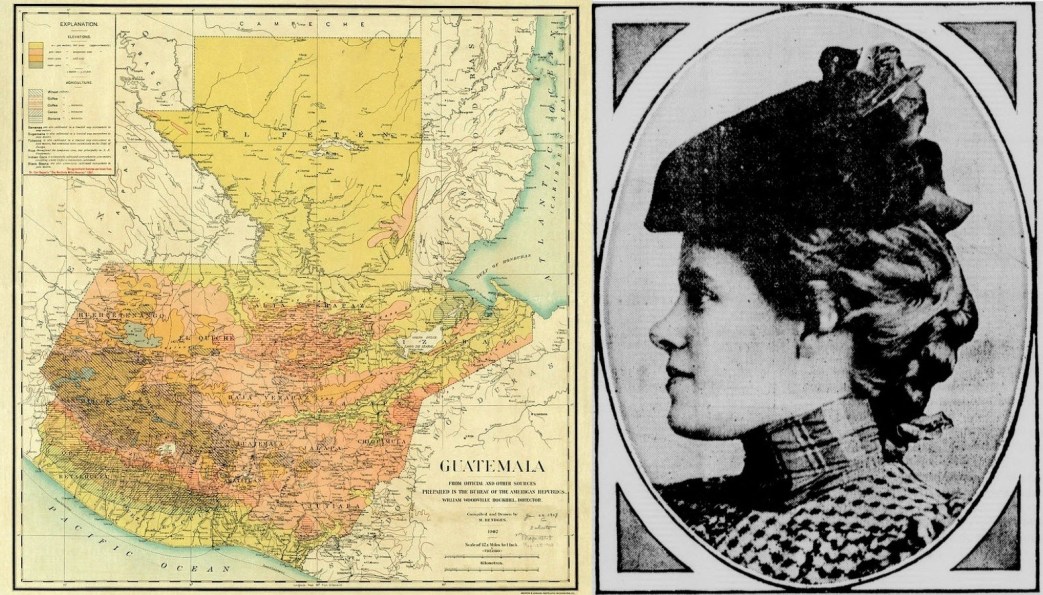
Joining the ISR editorial staff in 1908 when Charles H. Kerr split politically and personally from A.M. Simons, moving the journal to the left, Mary E. Marcy became lead editor of the Review in January, 1910. She then also began using the ‘Jack Morton’ pseudonym, perhaps to mask multiple contributions to issues, perhaps to say things an editor ought not to. Below is an article that is useful in seeing the development of Marcy’s thinking. Slyly attacking the Party’s anti-immigration wing, Marcy points out that ‘defending jobs’ is a fantasy by blocking immigration if U.S. capital, which cares for profits not jobs, can make greater profits by exploiting lower standards of living in other countries like Guatemala. If workers understood how their exploitation worked, they would not stand for it. The solution in the ‘real’ world was for U.S. workers understand this realty and to unite with Guatemalan workers against their common exploiters. Education was therefore the chief task of revolutionaries. There is an ‘evolutionary’ logic in Mary’s argument, held by nearly all her contemporaries as well, in which the inevitably of capitalism creating its own grave-diggers also assumed the inevitability of those grave-diggers digging. Which are, of course, two different things. Several years after this, the crisis of World War One would have Mary’s thinking itself evolve, and turn that logic on its head. Only by digging graves does a worker become a grave-digger. Her strategy of revolution shifted from making the gave-digger conscious of their role, to getting the working class to act, to dig graves, in order to become the grave-diggers of capitalism. Action became the chief task of revolutionaries.
‘Capital in Guatemala’ by Jack Morton (Mary E. Marcy) from International Socialist Revolution. Vol. 11 No. 6. December, 1910.
ALL “good Socialists” know that in the United States our capitalist employers must necessarily give workingmen and women wages enough to buy food, clothing and shelter, because all these things are necessary to the life of the workingmen. And capitalists must have wage-workers.
It is a notorious fact that all they do give us is enough to live on. It matters not where you go, whether you are mining for the Guggenheim interests in Alaska, where “wages are way up,” or feeding coal into the new blast furnaces in the Celestial empire among our yellow skinned brothers of the East, where wages are “way down,” you always find that you get just about enough in your pay envelope to enable you to live and appear to hold down the job the next day.
And this explains why capitalists are investing money in industries in Guatemala, Central America. There men, women and children do not need much to keep them in working condition. Delicious tropical fruits grow and flourish everywhere. The climate is mild. Reed or rush huts cost almost nothing and neither steam heat nor coal fires are necessary to the welfare of the proletarians. Besides the natives are not at all particular about the make or cut of their clothes. Loose, home-spun shirts and trousers or skirts constitute a costume that equals the best one’s neighbors can muster.
Now if Capital can gobble up the lands in a country like Guatemala, so that the lives of the propertyless natives depend upon their getting work, there is not much left to be desired—from the Capitalists’ point of view.
And so they are flocking to Guatemala. The United Fruit Co. of Boston owns the largest banana plantation in the country. It covers 5,000 acres of land and exports annually 300,000 bunches of bananas, the total exports from all sections of Guatemala being 1,500,000 bunches.
Concepcion is perhaps one of the most interesting of the many large plantations. It covers 155,00 acres near the pacific coast, and produces ten thousand tons of sugar and 20,000 bags of coffee a year.
The big plantations have miles of private railroad and small cars to bear the coffee and sugar cane from the fields to the factory or shipping point.
The Pacayal estate produces the very finest grade of coffee. Here 8,000 acres are growing the coffee berry. In bloom the fields are a delight to the eye and flaunt myriads of fragrant blossoms.
Here the native Indians count three bushels of berries a good day’s work. Their pay is sometimes as high as seven cents a twelve-hour day and a bamboo hut thrown in. The coffee berries are promptly pulped and shot into fermenting tanks where the gummy coat on the hull is removed. Three bushels of coffee berries, for which the employers pay 5, 6 or 7 cents, produce 30 pounds of the very finest grade of coffee bean.
A recent traveler in Guatemala reported a most astonishing sight at Cantel, where she found a cotton factory of the most modern type run almost entirely by Indian women and children, who exhibited a marvelous dexterity.
As I talked with our visitor who related her experiences in Central America and who was loud in her praise of the American thrift and industry that was invading the lands, I thought much about the aims of Socialism.
We have been talking about excluding our comrades from Asia and India who come to America to find work; we have fancied that they would take our jobs from us. We have dreamed foolish dreams wherein we saw visions of our brothers from the East excluded from our shores; and we have seen the American workers securing higher wages and shorter hours as a result of this exclusion. And then a new problem confronts us. For we find that Capital has crossed the border line between the United States and Mexico and gone beyond into Central America. There she has built factories and stretched plantations. She has gone yet further; she has carried our jobs TO THE CHINESE and the Hindu. She has reared steel mills and cotton mills in the Far East.
And so we find that our dreams were mistaken visions only. If we prevent our brothers from across the border lands from coming to us, Capitalism and Modern Industry will go to them. There is for us no escape. In spite of our own errors, Capitalism throws us back again into the ranks of the revolution. We see at last that we can not save ourselves alone any more than our English or Italian or German comrades can work out the salvation of the English, Italian or German workers.
Our escape from wage-slavery lies only through the freeing of all the workers of the world. Struggle as we may, Modern Industry is reducing us all to the same low level. By it caste is being borne down in India; skilled workers are reduced to the ranks of unskilled workers as the machine displaces them; proletarians from all over the world flock to the high priced labor market; capitalists all over the world build factories in a low priced labor market.
And so we have ceased to boast. Pride is no longer a part of us. We are thinking only of how best to reach our brothers and sisters of every color, creed or nationality with the great hope that lies in the Revolution. We have fought and failed as individuals, but we have learned at last that the struggle is an international one. To the proletarians of all the world, we say:
For your own sake; for our sake; workers of the world, let us unite. We have nothing to lose but our chains!
The International Socialist Review (ISR) was published monthly in Chicago from 1900 until 1918 by Charles H. Kerr and critically loyal to the Socialist Party of America. It is one of the essential publications in U.S. left history. During the editorship of A.M. Simons it was largely theoretical and moderate. In 1908, Charles H. Kerr took over as editor with strong influence from Mary E Marcy. The magazine became the foremost proponent of the SP’s left wing growing to tens of thousands of subscribers. It remained revolutionary in outlook and anti-militarist during World War One. It liberally used photographs and images, with news, theory, arts and organizing in its pages. It articles, reports and essays are an invaluable record of the U.S. class struggle and the development of Marxism in the decades before the Soviet experience. It was closed down in government repression in 1918.
PDF of full issue: https://www.marxists.org/history/usa/pubs/isr/v11n06-dec-1910-ISR-gog-Corn-OCR.pdf
 Revolution's Newsstand