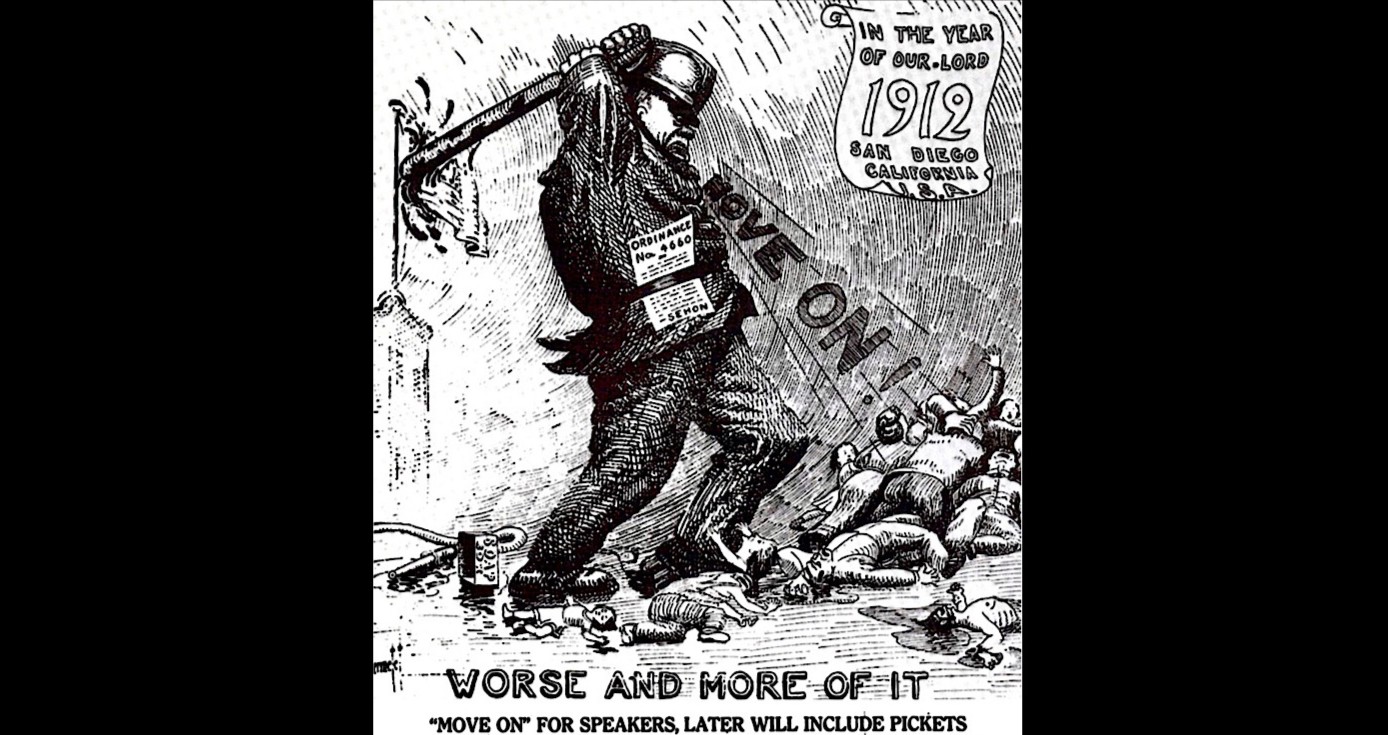
For decades, California with its criminal syndicalism laws, had a reputation for being, outside of the South, among the most hostile states in the country to labor organizing, and labor organizers. A concerted attack by Oakland police of I.W.W. street speakers and hall meetings sees arrests and hospitalizations on February 3, 1912 coinciding with the large-scale free speech fight underway in San Diego.
‘Oakland Police Thugs Active’ from Industrial Worker. Vol. 3 No. 51. March 14, 1912.
OAKLAND POLICE INVADE INDOOR MEETING CROWD SLUGGED IN AUDITORIUM AND LAWRENCE TACTICS USED–SEVERAL IN HOSPITAL.
The I.W.W. has been speaking at Eleventh and Broadway for years and when the police ordered them to cease their use of the corner without giving reasons for the action the workers held a conference. They continued the use of the corner for several nights without molestation, but were finally ordered to keep off. Ninth and Broadway was assigned to them and on Sunday, February 3, they marched to the corner set for them by the police only to he met by 100 patrolmen armed with night sticks. When the speaking commenced the police thugs charged the crowd using their clubs viciously upon speakers and bystanders alike. Despite the fact that signed permission to use the corner was given and the permit present at the attempted meeting the attack took place, and B.E. Hayes, secretary of local 174, I.W.W., together with John Dyke and C.E. Foster, was arrested.
Aided by recruits from San Francisco, and other radicals from Oakland, a parade was attempted. The marchers formed at I.W.W. headquarters proceeded up Washington street with the red flag at their head. The police automobile filled with patrolmen in charge of Captain of Police Lynch swung full speed into the procession, and returning quickly proceeded to bludgeon all in the street, even the usual Sunday night throng who had taken no part in the affair.
The regular Sunday night meeting of the Socialists was in session at the Hamilton Auditorium and the members of the crowd made that their objective point. The meeting was about to adjourn when the marchers arrived and announced another meeting to be held in the hall. The police auto approached the spot in front of the hall and the rebels united in three cheers for free speech.
The meeting in the hall had not gotten under way when another police auto appeared and the reserve police jumped from it clubbing those who had not yet entered the hall, driving them inside. Here the police followed them and those who were quietly seated in the hall received a taste of “Lawrence tactics.” The Oakland World in a special issue gives the following account of what then occurred. “For the third time indiscriminate clubbing was resorted to. Many of the audience inside the hall were quietly seated and were thunder struck when they found the hall filled with striking and cursing blue coats.”
The police seemed beside themselves. Women were roughly pushed and prodded to the doorway; men were beaten to the floor and flung bruised and bleeding down the stairs, where they lay on the pavement unconscious. County Organizer Frank Strawn-Hamilton, who was in the rear of the hall, was beaten over the head by two policemen and, dazed and streaming with blood, hurled to the pavement below. Inside the hall the policemen were striking with an abandoned brutality. They ran men down the aisle; they climbed over the backs of seats after them. When men fell under their blows, they beat and clubbed them as they lay.
Comrade J.B. Chestnut, chairman of the meeting, was dragged from the platform, receiving a severe scalp wound from a patrol man’s stick. C.A. Bascom, a Berkeley Socialist, was beaten into insensibility, and flung bodily to the sidewalk.
But the crowning infamy of all came when a maddened patrolman attempted to club Comrade H.C. Tuck, editor of the World, who is nearly 60 years of age and totally blind. The blows would undoubtedly have fallen on his head but that Comrade Mace stepped in between and warded them off. No attention was paid to the pleading of his blind wife, who clinging to him, called pitifully to the frantic policeman not to strike her sightless husband.
While the raid was being made upon the hall, J.H. Fones, a Socialist and labor agitator, who has been speaking on the streets for years, was arrested at Thirteenth and Jefferson streets. Holding aloft a banner, he vigorously asserted his right to free speech. He was surrounded by policemen and blows were rained upon him. Dragged to the police station, he was again set upon, and once more the brave defenders of the city glutted their vengeance on an old man of over sixty, striking and kicking him as he reeled in the cell, bleeding profusely from a scalp wound and with one hand disabled by the breaking of bones in his wrist.
Leo B. Mihan, a student at Berkeley, while walking along the street with two ladies, upon pointing out a policeman who had maltreated some of the women, was seized and taken to the station, charged with violating the “move-on” ordinance. The ladies were roughly handled by the officer making the arrest. When he had Mihan in the booking room, the officer asked him who his friend was with the bleeding head from whom he had been separated on the street. When Mihan promptly replied, “He is the assistant editor of the World,” the officer responded, “So you, too, are one of those—-Socialists,” and struck Mihan in the face. Comrade Fones, who was in the booking room witnessed the blow and saw the youth reel to the floor.
George A. Houghton is a cripple. He was standing at Ninth and Broadway. When the police rushed the crowd Houghton was compelled to hold on to a rod extending from an awning. A policeman ordered him to move on. Houghton told him he was a cripple and unable to run. The officer swung his heavy night club and struck him a savage blow on the left hip. The man was suffering with hip disease in the right hip and narrowly escaped being sent to the hospital with an injury that might have resulted fatally.”
These brutal attacks are a part of the systematic plans of the M. and M. to break up all labor organizations on the Pacific Coast and to stop free speech in hopes of stemming the rising tide of discontent.
The Oakland local believing that the whole affair is intended for the above purpose and has as an additional reason a drawing away of support from the San Diego fight has decided to let matters rest and to concentrate all forces upon San Diego. The following telegram has been received at this office.
“The thugs unite with Gen. Forbes to declare war. Militia is held in readiness. We have enough men here. Concentrate all forces upon San Diego.”
In this struggle there is no place for doctrinaire disputes but all men with red blood in their veins must unite to win the fight in San Diego and from there march upon Oakland to give that city a well deserved trimming.
The Industrial Union Bulletin, and the Industrial Worker were newspapers published by the Industrial Workers of the World (IWW) from 1907 until 1913. First printed in Joliet, Illinois, IUB incorporated The Voice of Labor, the newspaper of the American Labor Union which had joined the IWW, and another IWW affiliate, International Metal Worker.The Trautmann-DeLeon faction issued its weekly from March 1907. Soon after, De Leon would be expelled and Trautmann would continue IUB until March 1909. It was edited by A. S. Edwards. 1909, production moved to Spokane, Washington and became The Industrial Worker, “the voice of revolutionary industrial unionism.”
PDF of full issue: https://www.marxists.org/history/usa/pubs/industrialworker/iw/v3n51-w155-mar-14-1912-IW.pdf
 Revolution's Newsstand