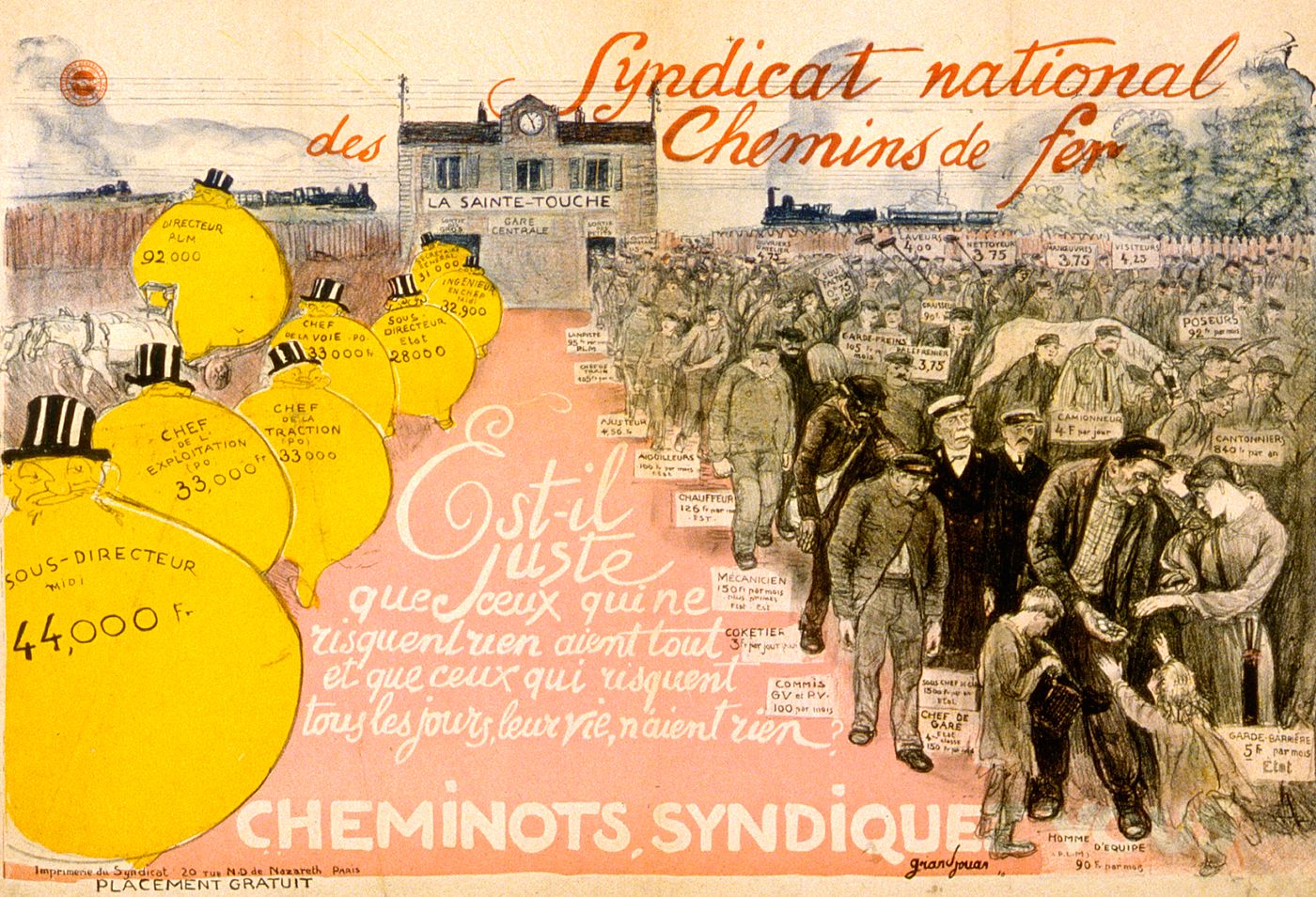
Next in his letters from France, Foster reports on the issues at play in the C.G.T.’s coming Toulouse convention, as well as the case of Dulery, a French soldier executed in Algeria for hitting a oppressive officer.
‘News of Our Fellows in France’ by William Z. Foster from Industrial Worker. Vol. 2 No. 29. October 8, 1908.
NEWS OF OUR FELLOWS IN FRANCE
Paris, Sept. 29, 1910. At the present time the matter of most absorbing interest in French labor circles is the approaching convention of the C.G.T., which takes place at Toulouse during the week of October 3-10.
After the regular order of business has been disposed of at the convention the floor will be open for a special order of business. This special order of business has been limited by previous regulation to the discussion and consideration of not more than four questions. The four questions to be determined beforehand by a referendum of the whole C.G.T. This year, owing to the similarity of some of the questions, there will be five up for consideration. They are: 1. Old Age Pensions; 2. Shortening of the Working Day; 3. Collective Contrast-Commercial capacity of the Syndicats-Compulsory Arbitration; 4. Anti-militarist Propaganda; 5. Accidents to Workers.
The politicians are making a strong effort to secure control of the C.G.T. and some of the questions will be bitterly contested. One of these is “Commercial Capacity of the Syndicats.” The political element is imbued with the idea of inaugurating a series of co-operative institutions, such as Belgium and some other countries have, but they are opposed by the direct action element on the well-taken ground that for the C.G.T. to acquire property would be to render it conservative. Its members would hesitate to take the daring steps that have hitherto marked the progress of the organization, through fear that the authorities would seize these properties.
An effort will also be made to place a boycott on wine, the price of which has gone soaring recently. Two weeks ago sugar was boycotted by the federal committee, but owing to the extreme necessity for sugar the boycott has been a failure. It is thought that a boycott on wine for a week, or some other definite length of time, declared in the convention at Toulouse, will have a much different effect. Although this convention is but of the French Syndicat, two delegates or students, rather, are expected from English unions. Some surprise has been expressed that the I.W.W. hasn’t sent a delegate. However, if it is at all possible to gain admittance to the convention without credentials there will be at least a member of the I.W.W. present. Toulouse is a long way from Paris and yours truly isn’t overburdened with the needful, and I don’t know how the “ridin” is, yet I will get there somehow, provided they will admit me. During the past week the plumbers’ strike was declared off and the men have returned to work. The men achieved but a partial victory after their long fight, as many of the bosses have refused to accept the terms of the union. However, for those kind of gentlemen the second act of the play is about to commence, as the men have resolved to “intelligently sabotage” their work. As this gentle diversion of the Syndicalists usually includes the judicious destruction of property, some of these egotistic contractors may yet wish they had come to terms.
The agitation for the general railroad strike goes on apace. The propositions of the workers have been refused. Their masters consider a minimum scale of $10 as too exorbitant and now both master and slave are preparing for war. The word is being passed to the workers, to stand ready to receive the strike order they have already endorsed, and to leave their posts the moment the order is given. When this order comes it will come suddenly, as the C.G.T. is determined not to give the masters a moment’s warning if it can be avoided. It is probable that this matter will he delayed at least until after the convention at Toulouse. At present there are several strikes in Paris. One of these is that of 250 employes of one of the largest dry goods stores in the city. It is the same story of women and girls working for wages that are insufficient to keep body and soul together. As usual, scabs have been hired to take the places of the striking women and girls. Many of the gentle scabs have lost their locks and “near” locks at the hands of strikers armed with scissors. The outcome is doubtful, as the firm is one of the largest in Europe and the workers of Paris are as yet so poorly aware of their interests that they continue to patronize the store in spite of the C.G.T. boycott. That this boycott is not altogether ineffective, however, is evidenced by the firm plastering the city with posters describing wages and working conditions of their slaves, which, judging their gorgeous flights of fancy, must have been written by an ex-American employment agent.
A MILITARY MURDER.
A matter that has caused much bitterness in the ranks of the revolutionists was the official assassination at Biribi, Algeria, of the soldier Dulery. Dulery was a somewhat simple minded boy, the son of hardworking parents in Paris. He didn’t enjoy the “patriotic hardships” of soldiering in Algeria and he showed, his dislike in such a manner as to win for himself the bitter hatred of his “superiors.” One of these in particular was accustomed to ill-use and strike the boy until one day the latter turned upon him and gave him a well deserved beating. For this terrible offense against “his country” Dulery was sentenced to death, and after waiting in jail six long months waiting for a pardon he was taken out and shot.
While Dulery was in prison there was another soldier, Graby, confined there, also sentenced to death. He had confessed to brutally murdering an old woman for what money she had. However, Graby was fortunate enough to be the son of a police official and the gracious President Fallieres saw fit to pardon him. All supplications for a pardon, for the semi-foolish Dulery went unanswered. “Justice” demanded that he should die. On the announcement of his execution the “ante-militarist” fairly frothed at the mouth. Special editions of their paper were gotten out, giving the details of the slaughter in vivid language. Hundreds of posters were stuck up at the principal street corners of the city. These advised the soldiers to use for themselves the weapons that their masters have so confidingly placed in their hands and also to seize control of France when the next order for the mobilization of the troops is given. Throngs of people surrounded these posters, which were boldly signed by many of the well-known revolutionists, and doubtless the wholesome advice they contained was not entirely lost. The leading capitalist papers of the city devoted on an average about two lines apiece to the murder of Dulery.
W.Z. FOSTER.
The Industrial Union Bulletin, and the Industrial Worker were newspapers published by the Industrial Workers of the World (IWW) from 1907 until 1913. First printed in Joliet, Illinois, IUB incorporated The Voice of Labor, the newspaper of the American Labor Union which had joined the IWW, and another IWW affiliate, International Metal Worker.The Trautmann-DeLeon faction issued its weekly from March 1907. Soon after, De Leon would be expelled and Trautmann would continue IUB until March 1909. It was edited by A. S. Edwards. 1909, production moved to Spokane, Washington and became The Industrial Worker, “the voice of revolutionary industrial unionism.”
PDF of full issue: https://www.marxists.org/history/usa/pubs/industrialworker/iw/v2n29-w81-oct-08-1910-IW.pdf
 Revolution's Newsstand