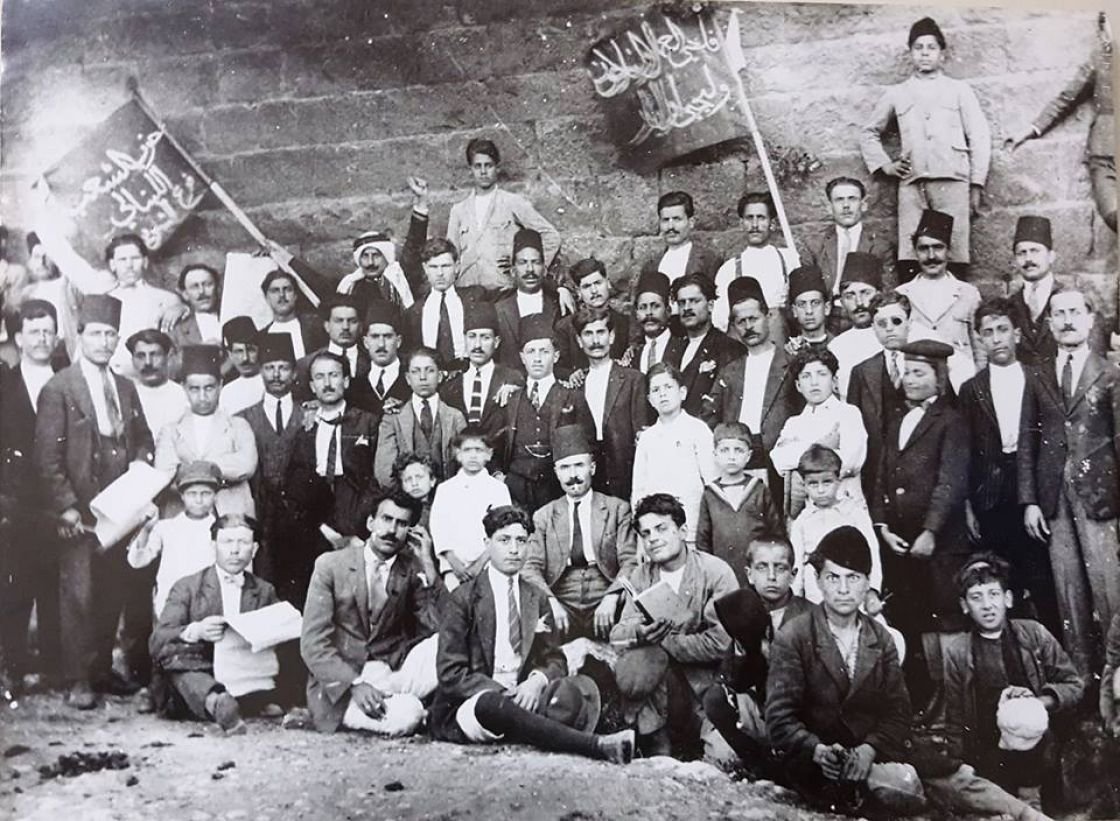
French imperialism attempts to entice the Syrian bourgeoisie into accepting its rule by outlawing trade unions and clamping down on their competitors for national leadership, the Communist Party.
‘The Trial of the Communist Party of Syria’ by El Souri from International Press Correspondence. Vol. 1 No. 47. September 3, 1931.
The trial of six Syrian communists commenced on 18th August, before the Court Martial at Beirut. Madeyan and Tadig Dadorian were sentenced to three years’ hard labour each, Georges Rached, Panos Tramaissiau and Agob Berbédrossiau to two years’ hard labour each, and Missah Karamahlan was acquitted. Counsel for the defence was the French communist deputy Berthon. Telegrams expressing solidarity were received from a number of towns in Syria and Asia Minor. The trial has made a deep impression in Syria and the Near East, and the influence of the Communist Party on the masses is growing.
The accused were arrested in March last. At that time the French police in Syria hastened to declare that the Communist Party of Syria had been liquidated. But the C.P. of Syria, to the great chagrin of the imperialists, is now stronger than ever. The founding of the Communist Party of Syria in July 1930 and its activity since then have greatly helped to frustrate the plans of the imperialists to enslave the people of Syria still further.
A part of these plans has already been realised. The pipe-line from Mosul conveying the French share of oil has been laid to the Syrian port of Tripoli; the cultivation of cotton has increased from 90 tons in 1920 to 2320 tons in 1930; French capital invested in Syria amounts to more than 6 million francs; the exports from Syria to France amount in value to 86 million francs a year and the imports from France to Syria amount in value to over 200 million francs a year. Syria is swarming with French soldiers. Considerable military works have been carried out on the North East coast of Syria. It is planned to build a railway line from Tripoli to Nakura on the frontier of Palestine, whereby the Paris-Constantinople-Tripoli line will have connection with Cairo, to build a railway from Tripoli to Abu Kelmal along the length of the pipeline to Mesopotamia, to enlarge the harbour of Beirut from 40 to 70 hectares and to carry out big irrigation works in order to promote the cultivation of cotton, etc.
In order to carry out their plans the French capitalists are striving to come to an understanding with the native bourgeoisie. The trade union movement has been strictly prohibited. Several workers have been imprisoned in the fortress of Kadmus for having organised a trade union committee in Beirut in 1928. 11 other workers from Zahli have been imprisoned because they protested against the dissolution of their trade union in 1930. In Lebanon alone no less than 130 newspapers have been prohibited.
The imperialists are endeavouring to extend their positions by an agreement with the Syrian bourgeoisie, which is represented by an organisation known as the “Kutle Wottania”, which, since the closing down of the Constituent Assembly of Syria has been carrying on a stubborn fight against the imperialists. The leaders of this organisation have shown themselves ready to come to an agreement. This agreement, however, is not easy, for the idea of independence is very strongly rooted in the Syrian people. Therefore, in order to carry out this agreement it is necessary to break the activity of the masses. To a certain extent this has already been done: less by the activity of the imperialists than by the action of the nationalist leaders who have constantly preached passivity. In the middle of 1930, Ponsot, having considered the moment arrived for carrying out his plans, proclaimed the final constitution of Syria, then went to Paris on leave.
It was then that the Communist Party of Syria appeared on the scene. Its first act was to expose the plans of the imperialists and the intentions of the nationalist leaders. The Communist Party of Syria has roused the anti-imperialist spirit of the people; it has awakened new forces among the workers and peasants; it has raised new questions which have been hitherto neglected in Syria, including the question of the agrarian revolution.
The results of the activity of the Communist Party of Syria are considerable. In the course of the year’s activity of the Party numerous strikes have taken place. Movements of the people, such as the boycott of foreign concessionary undertakings have shaken the whole country. Finally, anti-imperialist demonstrations were held in Tripoli, which were organised by the Communists in spite of the resistance of the nationalist leaders.
The position has thereby been completely changed. The nationalist leaders were obliged to resort to fresh manoeuvres in order not to lose their influence. For this purpose they submitted conditions for their participation in the Syrian Parliament envisaged by the Constitution.
Whilst, however, negotiations are still going on between the nationalists and the imperialists, the latter have launched a fierce attack against the Communist Party of Syria. When Ponsot returned in November last he issued a decree under which revolutionary propaganda is punishable with 5 years’ hard labour. In June last he issued a decree forbidding all meetings. It came to wholesale arrests and trials. Severe sentences were pronounced. Torture became a system. The persecution of the Communist Party of Syria has been crowned by the trial of the six Communists before the Military Court in Beirut. In spite of all the terror, the Communist Party of Syria is gaining ever greater influence among the exploited masses of Syria.
International Press Correspondence, widely known as”Inprecorr” was published by the Executive Committee of the Communist International (ECCI) regularly in German and English, occasionally in many other languages, beginning in 1921 and lasting in English until 1938. Inprecorr’s role was to supply translated articles to the English-speaking press of the International from the Comintern’s different sections, as well as news and statements from the ECCI. Many ‘Daily Worker’ and ‘Communist’ articles originated in Inprecorr, and it also published articles by American comrades for use in other countries. It was published at least weekly, and often thrice weekly. Inprecorr is an invaluable English-language source on the history of the Communist International and its sections.
PDF of full issue: https://www.marxists.org/history/international/comintern/inprecor/1931/v11n47-sep-03-1931-inprecor.pdf
 Revolution's Newsstand