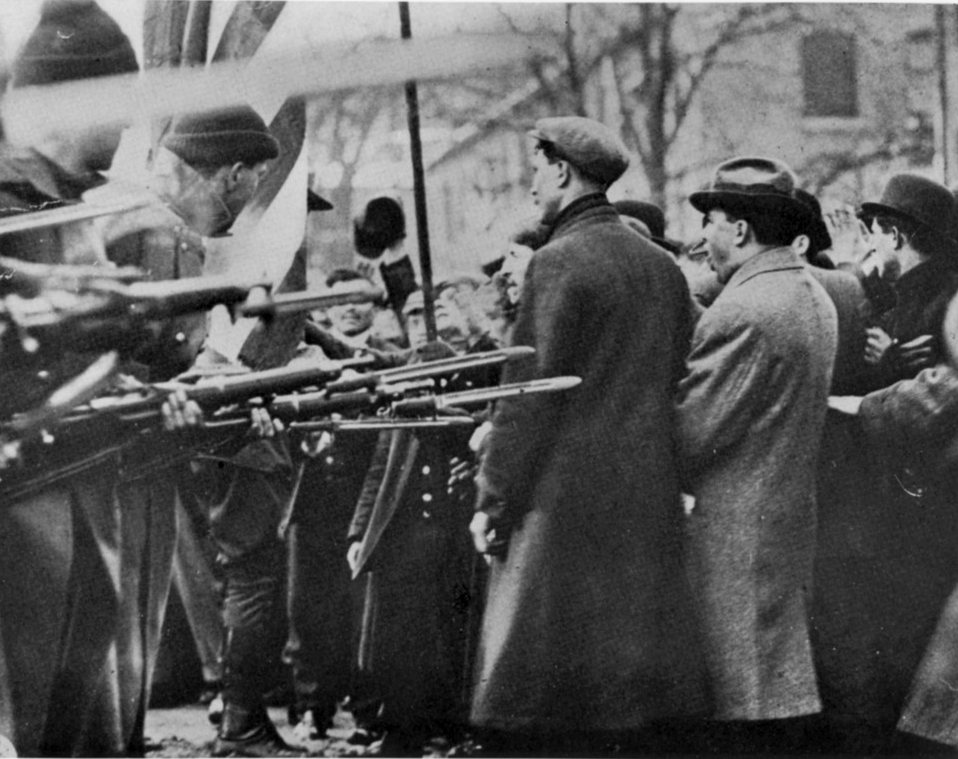
Unable to break the solidarity of the 30,000 multi-national strikers at Lawrence, Massachusetts, the bosses turn to violence causing the deaths of Anna LoPizzo, immigrant from Italy and John Ramey, a teenage textile worker and Syrian immigrant.
‘Militia Used on Strikers’ from Industrial Worker. Vol. 3 No. 46. February 8, 1912.
STRIKERS UNABLE TO MEET MILL-OWNERS—WOMAN KILLED GLANCING BULLET–SOLDIERS BAYONET YOUNG SYRIAN TO DEATH–JOSEPH J. ETTOR ARRESTED.
The textile strike in Massachusetts, caused by the cutting of wages of operatives when the hours were reduced by legislative action, still continues. The workers are making a brave stand and there is such solidarity that victory seems certain. The strikers have been endeavoring to confer with the mill owners but their efforts have not been successful. Strike leader Joe Ettor refuses to allow any settlement which does not include all strikers. The mill-owners wish to deal with the men individually or by departments. Chairman Howland in proposing such action to Ettor on the 25th, said in part:
“I think this conference ought not to end here. If we were to deal with committees from one branch of the industry or another, could we not accomplish more than by dealing with a large committee representing all branches? And if we are unable to reach an agreement tonight, we might postpone.
“I urge going on tonight. We have already talked with the manufacturers with a view of having them adopt the plan of conferences you propose.”
A further proposition to have that mysterious third person called the public form a part of the conference brought protests from Ettor and from Gilbert Smith, the leader of the English strikers. “It seems strange,” said Ettor, “that the representatives of the other side, while these workers were still at work, could always deal with them without appealing to outsiders. And if they are here–and they are here–let them come out and speak for themselves now.
“They weren’t afraid of the workers while they were still in the mills, and they needn’t be now. The only difference is that then the workers were their economic slaves–now they are their equals.
“This all doesn’t look to me like very clean play–these men are not playing fair. If they are willing to make arrangements let them come in here and arrange for a conference. We are willing. But we can make no arrangements through a third party.
“There is no use making arguments on the differences in industry. We prefer to talk those over with the employers.
“There is only one lash of hunger which the employers have wielded over these people, and now there is only one union for them to deal with.”
A member of the Mule Spinners’ Union, a portion of whose members have not yet left their work, said that this organization never experienced any difficulty in obtaining a conference with the mill officials. Oliver Christian, National secretary of the Loomfixers, declared that negotiations were in progress between that organization and the mill officials when the crisis came. The loomfixers, too, are included among those still at work.
In stating the attitude of those whom he represented. Ettor said that the matter resolved itself into the question not of whether those who were at work were willing to meet the operators, but rather those who were on strike. The latter are the ones who have raised the issue and those who have remained at work are not necessarily a part of the strike.
An ultimatum issued to the employers under Ettor’s orders embody demands that all the strikers become affiliated with the Industrial Workers of the World; that a 15 per cent wage increase be granted on a basis of 54 hours a week; that the premium and bonus system be abolished in the textile mills; that double pay be given for overtime work and that the strikers be allowed to return to work regardless of any part they may have had in the strike.
The Dartmouth mill of New Bedford has announced a discontinuance of their former fining system. This is supposed to be for the purpose of lulling the men to sleep. They had previously deducted from the pay of all weavers when imperfections occurred, claiming that the amounts would be returnable at the end of the year. This was in order to avoid the state laws against fining the men. The men who did not work a full year got no returns and the whole thing was but a scheme to evade the law.
On the 29th street rioting is said to have taken place and in the disturbance a shot was fired from the crowd, the bullet glancing and causing the death of a woman, Anna Lopez. Street car windows were broken by missiles in the hands of persons in the gathering. The militia was order out the following day, and their allowance of ball cartridges was doubled. The actions of these hired murderers can best be judged by the following report, in the Boston Globe.
Lawrence, Mass., Jan. 30.—John Ramy, an 18-year-old Syrian boy, was bayoneted in the back as he fled from a squad of militia on Elm street today. The police and officials did everything possible to keep the affair quiet. The police admit the boy was doing no wrong. He is not expected to live.”
Ramy has since been reported as having died.
Knowing that the key to the entire strike situation lay in the hands of the I.W.W. organizer, Jos. J. Ettor, the mill owners have made every effort to discredit him. They have even resorted to the planting of dynamite on nearby premises, and would have placed the dynamite in Ettor’s desk in strike headquarters had the place not been carefully guarded. Seeing these methods had failed the employers caused the arrest of Ettor on the night of the 30th on a charge of accessory to murder, claiming that the strike leader was responsible for the death of Anna Lopez. Expecting arrest Ettor had made arrangements to give bond, but this was not allowed. It is simply a scheme to take Ettor away from the scene and thus break the power that the I.W.W. is exerting in the strike. Haywood’s recent meeting greatly aroused the enthusiasm of the men, and it is now reported that Elizabeth Gurley Flynn is working among the strikers in the district. The strike still looks favorable to the strikers.
The Industrial Union Bulletin, and the Industrial Worker were newspapers published by the Industrial Workers of the World (IWW) from 1907 until 1913. First printed in Joliet, Illinois, IUB incorporated The Voice of Labor, the newspaper of the American Labor Union which had joined the IWW, and another IWW affiliate, International Metal Worker.The Trautmann-DeLeon faction issued its weekly from March 1907. Soon after, De Leon would be expelled and Trautmann would continue IUB until March 1909. It was edited by A. S. Edwards. 1909, production moved to Spokane, Washington and became The Industrial Worker, “the voice of revolutionary industrial unionism.”
PDF of full issue: https://www.marxists.org/history/usa/pubs/industrialworker/iw/v3n46-w150-feb-08-1912-IW.pdf
 Revolution's Newsstand