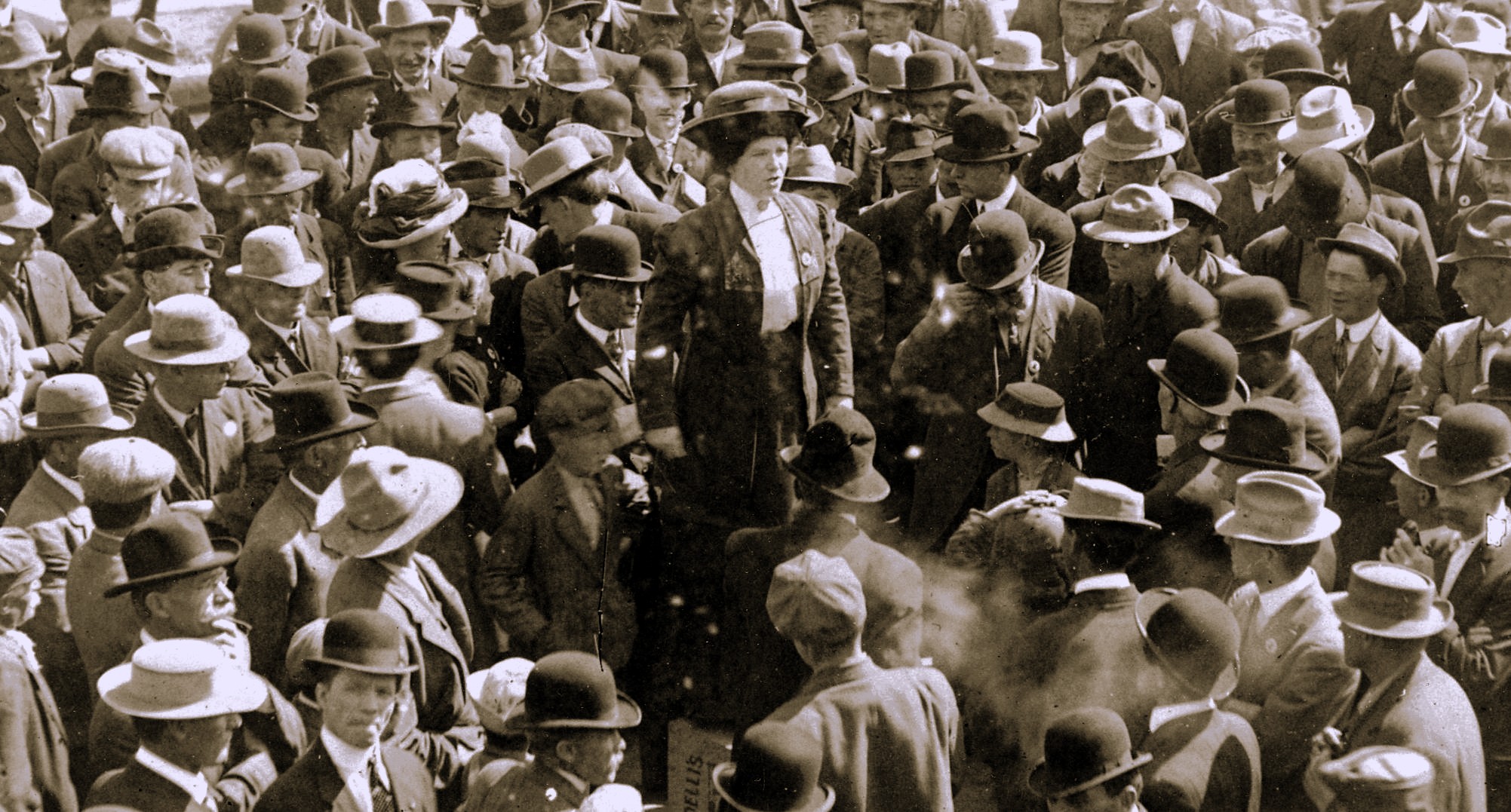
What has always been a struggle, the Daily Worker with advice on public campaigns for free speech.
‘Suggestions to Speakers at Free Speech Test Meetings’ from The Daily Worker. Vol. 1 No. 361. March 11, 1924.
1. The most important point to bear in mind is that free speech can be won only by speaking.
When unlawful obstacles are placed in the way, the meeting should, if possible, be held notwithstanding, and the speeches made.
If the authorities interfere unlawfully, it may be desirable for the speaker to continue until arrested or forcibly prevented from continuing, if counsel advises that by such a course a clear-cut issue of free speech can be successfully raised.
That issue can generally be raised successfully if the interference takes place on private property where there is no technical violation of laws as to admission fees, fire regualtions, obstruction of traffic, and the like. It is important to bear in mind that police orders are not law nor are the edicts of officials other than courts or judges. When injunctions are issued or legal proceedings pending, no step which may give rise to a contempt proceeding should be taken except upon the advise of counsel. For in contempt proceedings the legal question is often as to the existence of the judicial power rather than as to the propriety of its exercise. A person who thinks that he has raised a big question of fundamental rights by risking punishment for contempt of a wrongful court order may often find that he has merely raised a side issue.
2. No speaker should submit to preliminary censorship by the police or other authority. No authority has the right to censor in advance what he has to say. Speakers should however bear in mind that the usual purpose of test meetings is to establish the right to speak, not to test the validity of laws penalizing certain kinds of speech or advocacy. They should refrain from predictions, prophecies or suggestions which hostile interpretation might twist into violations of criminal syndicalism and sedition statutes.
3. In case the police close the hall and thus prevent scheduled meeting from taking place, efforts should be made to secure another meeting place. Even if it involves having a much smaller audience. At any rate, the newspapers are going to run the fact that the hall was closed by the police, and if the publicity man is on his job, all that is said at the smaller meeting (even if it is held in a private house) can be given to the newspapers and will get space. The important point is to show that even in the face of unlawful police opposition, those who believe in free speech are determined to hold their meeting at whatever cost. Before resorting to another location, every effort should be made to get the police to open the hall and rescind their orders.
4. If the meeting is stopped after it starts and the police attempt to adjourn it without arresting any speaker, an arrest should be forced, unless it would involve danger of disorder by others than the police. The best way to force the arrest is to keep on speaking. If the police refuse to arrest but endeavor to molest the speakers by putting hands on them, it constitutes a case of assault. Witnesses should be secured and a case brought against the offending officers, or, if possible, their responsible superiors. Whoever has charge of the meeting should refuse to adjourn upon the orders of a police officer if the officers refuse to make an arrest, so that the issue can be tested in the courts. If the officer attempts to disperse the audience, he may advise the audience to stay in their places unless there is risk of disorder and violence. Persons wrongfully arrested should, upon their release, bring civil suits against the officials responsible. Theoretically, of course, the public authorities ought to proceed against law-breaking officials. Experience has shown, however, that they are unlikely to do so and that when they do they are apt to conduct them faint-heartedly. In England notable vindications of civil liberty have been obtained by private suits.
5. It a speaker is unlawfully arrested and the meeting allowed to proceed, see that a red-hot protest is made against the conduct of the police and send a committee from the meeting to police headquarters to make a protest and to see if something can-not be done to get the speaker released without further proceedings. Send the committee to the daily newspaper offices to give an accurate account of what happened. Otherwise the newspapers will get the story from the police.
6. Where meetings have been interfered with by official lawlessness, state a protest meeting for the earliest practicable date. At that meeting make the subject only that of the right of free speech, repeating in substance what was said at the previous meeting as an evidence of exercising that right. Get persons not connected with the meeting and as of great prominence as possible in the community either to address the meeting or to sit on the platform. Get a signed protest from prominent ministers, lawyers, officials and other sympathizers and see that it reaches the newspapers. Have a written resolution adopted at the meeting and signed by as many of those present as possible. Have this transmitted to the police and to the newspapers.
7. Publicity. Wherever there is any issue of free speech or assemblage, it is important to get the newspapers to see it. To that end it is essential to furnish them with copy. Get to the city editors directly either with a clear statement of the facts thru someone who knows how to talk to a newspaper man or thru statements written out in advance. The best thing to do is to employ a local publicity man who is familiar with the local newspaper (and with the wire services out of the community whenever any issue of more than local significance is involved.) It is important also to see the chief writers of each of these papers quite independent of the news story, so that they will understand the facts, and not base their editorials upon biased hostile reports.
8. In all cases where arrests are likely at a free speech meeting, an able attorney should be consulted in advance and engaged to be present. His advice will often assist the speakers and managers to raise in a clear-cut fashion the definite issue of free speech which officials (under cover of unevenly enforced local ordinances as to traffic, permits, collection of funds, safety appliances, etc.) are often astute to prevent. Bail should be provided for. The attendance of disinterested and responsible witnesses should be procured.
The Daily Worker began in 1924 and was published in New York City by the Communist Party US and its predecessor organizations. Among the most long-lasting and important left publications in US history, it had a circulation of 35,000 at its peak. The Daily Worker came from The Ohio Socialist, published by the Left Wing-dominated Socialist Party of Ohio in Cleveland from 1917 to November 1919, when it became became The Toiler, paper of the Communist Labor Party. In December 1921 the above-ground Workers Party of America merged the Toiler with the paper Workers Council to found The Worker, which became The Daily Worker beginning January 13, 1924. National and City (New York and environs) editions exist.
PDF of full issue: https://www.marxists.org/history/usa/pubs/dailyworker/1924/v01-n361-mar-11-1924-DW-LOC.pdf
 Revolution's Newsstand