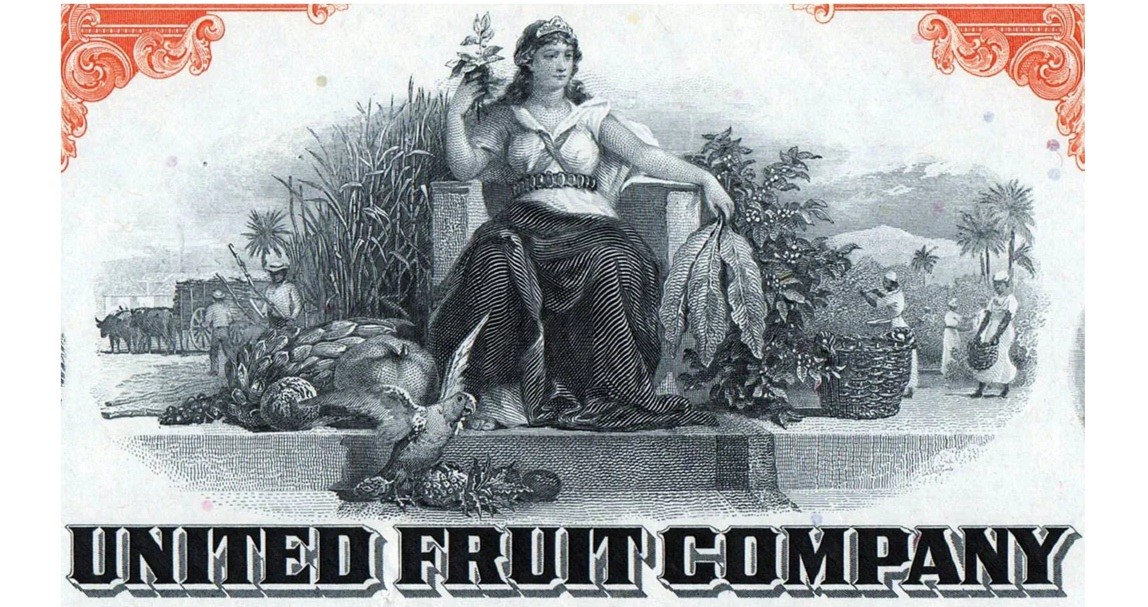
Writing during the U.S.’s 1924 military intervention in Honduras, hardly the last, the country had already seen direct involvement of United States’ military forces in 1903, 1907, 1911, 1912, and 1919.
‘What Are We Doing to Honduras?’ by Bertram D. Wolfe from The Liberator. Vol. 7 No. 5. May, 1924.
“SPUTTER, sputter, sputter!”
PUTTER, sputter, sputter!” The two giant antennae on the armored warship Milwaukee are spitting out lies about Honduras. “Slobber, slobber, slobber!” Secretary of State Hughes is gushing about the friendly relations between the United States and Latin-America. “Pup, pup, pup, pup-pup!” Yankee machine guns are spewing lead in the streets of Tegucigalpa to protect American lives and property. And the man on the streets in New York or Chicago says: “What is our government up to now? What the hell are our troops doing in Honduras?”
“Our troops are protecting American lives and property. Our troops are defending the American legation from drunken soldiers. Our troops are taking off of the shoulders of the Honduras government the worries of policing their capital city where the soldiers have gotten out of hand and are drunk, where anarchy prevails. Our troops are preventing the English, French, Italian and Chinese governments from intervening. Our troops are not in Honduras at all.”
What are we up to in Honduras?
In January, Hughes was saying anent Obregon and De La Huerta, “We will permit no more revolutions in Latin-America.” On February 1, the legal presidential term of General Lopez Gutierrez came to an end in Honduras. There were three candidates to succeed him and none of them had gotten the majority required by the Honduran constitution. To make matters worse, elements desiring either dictatorship or intervention–which I cannot say–were preventing a quorum in the Honduran congress.
General Lopez Gutierrez continued himself in office, called a constitutional assembly and prepared to reform the constitution so that a new president could be elected constitutionally. On February 6, Hughes recognized him as the de facto government. On February 6, candidate Tiburcio Carias declared himself in rebellion and received the adherence of Candidate Ferrera.
Hughes was still saying smilingly to whom it might concern that the United States would permit no revolutions in Latin-America–but the smile faded on his face and became a frozen grimace as he saw the chance to use the revolutionary Carias, financed by American interests. Let us see what he did to the de facto government whose legality he had recognized the same day the revolt broke out.
The Marines Go First
Within a half month there was one battleship on the Atlantic side and another on the Pacific side of this tiny country which two battleships can almost cut from sea to sea with their fire. The Rochester which had butted freely into the electoral question was backed by the armored cruiser Milwaukee which steamed into Amapala. On March 1, a destroyer was ordered to sail from Jamaica to Puerto Cortes. About the same time the battleship Denver arrived there, this ship being under no less than a rear-admiral, Dayton.
Then the game of landing-parties began for the “see-the-world-and-learn-a-trade” boys. The Consulate in the Port of La Ceiba discovered that it needed “protection.” Thirty-five were landed March 1. On March 3, it was reported that there were seventy marines there, and that they were protecting the consulate in a fight between “bandits” and the federal, legal government.
On the 4th of March, Franklin Morales, “our” minister plenipotentiary and representative of “our” interests in this “interesting” country, reported that shots had been exchanged between our troops and the federals, and that the latter had abandoned the port, after burning a couple blocks of American business buildings. He also announced that the Port was then peacefully occupied, not by “bandits” but by the rebel troops. (The Liberator should offer the prize of a year’s subscription to the reader who can guess what happened to the bandits.)
The next day the Denver steamed to Tela and on the 13th the rebels had gained the Port of Tela, against preceded by an American landing party.
On March 4, Franklin Morales valiantly opposed the collecting of an advance on taxes in the capital, Tegucigalpa. He reported that the capital was about to fall within a day or two and asked that a detachment of marines be sent overland from Amapala where the Milwaukee was anchored, a distance of 100 miles, obliging the troops to pass through the rebel army lines. At the same time he offered to intervene and to arbitrate to avoid a battle for Tegucigalpa. On the 7th it was announced that the capital had surrendered peacefully thanks to his good offices, but he counted the chickens before the shells began to crack for the capital is still in federal hands at this writing.
The heroic overland march began on the seventeenth with 167 marines and nine officers under Commandant Casey undertaking to pass through the rebel lines (with their joyous permission) to “protect the American legation” in the capital. On the same day the Associated Press announced (I quote the heads of a Mexico City Associated Press paper, English section):
TEGUCIGALPA IN UPROAR
Rebels Loot and Burn; Fire at U. S. Legation As Disorder Rules Supreme
The Honduran government responded with the following:
“The U.S. is the only responsible party for the ‘anarchy’ in which Honduras is engulfed. The events that are occurring in our country prove that the White House does not hesitate to unchain anarchy in any country when its governors fail to lend themselves as instruments to the American colossus.
“The First to Go”–But the Last to Leave
On March 20 the Honduras Federal Government notified Franklin Morales that it would “accept no responsibility for what might occur” if the marines remained in the capital, and demanded that they return to their battleship. Morales valiantly replied (our representatives in Latin-America are always valiant, not to say impudent) “that the disembarking of the forces was necessary and that would remain in Honduras until the authorities were capable of giving adequate protection to American interests and that he would accept no responsibility for what might happen if the detachment were attacked.” (Associated Press March 20). And the Department of State with its usual facility for calling black white announced: “It is not intervention, but protection of our interests.” The next day, with its characteristic brazen hypocrisy the same department announced: “The relations between Latin-America and the United States were never more cordial than they are at this moment.”
Tegucigalpa Gets the Falling Sickness
The reader must remember that the capital of Honduras had already “peacefully surrendered” on the 7th. Commandant Casey announced again that it would fall within twenty-four hours on March 24, using the wireless of the cruiser Milwaukee for the purpose. Capt. Anderson of the same ship flashed the fact that the whole army had deserted the de facto government and that only the capital was in federal hands. The close connection between the official diplomatic lie factory and the unofficial Associated Press lie factory is revealed in the A.P. dispatch of the same day:
“Commandant Casey also transmitted by radio, making use of the cruiser Milwaukee, authentic reports prepared by the representative of the Associated Press, which the de facto government did not permit to be transmitted from Tegucigalpa.”
The dispatch in question reported battles in the city, street fighting, and falling of the north, the south, the east, the west and the center of the country into rebel hands.
On March 25, Morales telegraphed that the city was falling. On March 27, there was a new president who was to convoke new elections and a constituent assembly. The old government de facto had passed into history.
On March 29, Morales reported that there was still some fighting but “demoralization was beginning to spread through the Federal troops (which several days earlier had already joined the rebels) so that it was not doubtful that at any moment the rebels would attain a complete victory.”
Tegucigalpa Falls–Like Petrograd
But General Arias, leader of the government forces, fell “like Kelly did” to use a homely and apt bye-word. On April 1, the news leaked through that the federals not only continued to hold the capital but also many other parts of the country and that the rest of the country was slowly mobilizing in the rear of General Ferrera, rebel leader, and were likely to attack him from behind. An April 1 dispatch from San Salvador reveals Ferrera defeated from in front and compelled to abandon three lines of trenches. Also on April 1, the New York Times, which must have its little April fool joke, announced that the rebels had taken Tegucigalpa.
But why go on. The rebels will eventually take the little capital with the big name, not because the people of Honduras want it but because U.S. Ambassador Morales wants it, because Commandant Casey wants it, because Secretary Hughes wants it, because the Morgan Associated Press wants it, because, in a word, “We” want it.
What the Associated Press says is so has a habit of becoming so later on, except where a Communist Party and a Red Army figure in the case. “We” always have plenty of money to make things as “We” want them to be in Latin-America. There’s the canal to protect. There’s oil in central America. There’s the Yankee edition of Berlin-to-Bagdad and Cape-to-Cairo-the 10,000-mile New York-to-Buenos Aires Railroad complete. There’s $4,000,000,000 in investments to protect. There’s all Latin-America to grab. Verily, “the relations of Latin-America with the United States were never more cordial than at the present moment.”
To promote this cordiality we never hesitate at such a little thing as the making of a revolution or the landing of a party of marines or the dispatching of a baby fleet. When Central America was about to unite its five little republics into the United States of Central America, we manufactured a revolution in Guatemala and that ended that little dream. Our modern Persian juggernaut has rolled across the modern Corinthian Peninsula of Central America and Bolivia, Peru, Colombia and Brazil are now in its hands. Its advance will only end with the land’s end at Tierra del Fuego, or with the end of the mighty American empire.
The Liberator was published monthly from 1918, first established by Max Eastman and his sister Crystal Eastman continuing The Masses, was shut down by the US Government during World War One. Like The Masses, The Liberator contained some of the best radical journalism of its, or any, day. It combined political coverage with the arts, culture, and a commitment to revolutionary politics. Increasingly, The Liberator oriented to the Communist movement and by late 1922 was a de facto publication of the Party. In 1924, The Liberator merged with Labor Herald and Soviet Russia Pictorial into Workers Monthly. An essential magazine of the US left.
PDF of full issue: https://www.marxists.org/history/usa/culture/pubs/liberator/1924/05/v7n05-w73-may-1924-liberator-hr.pdf
 Revolution's Newsstand