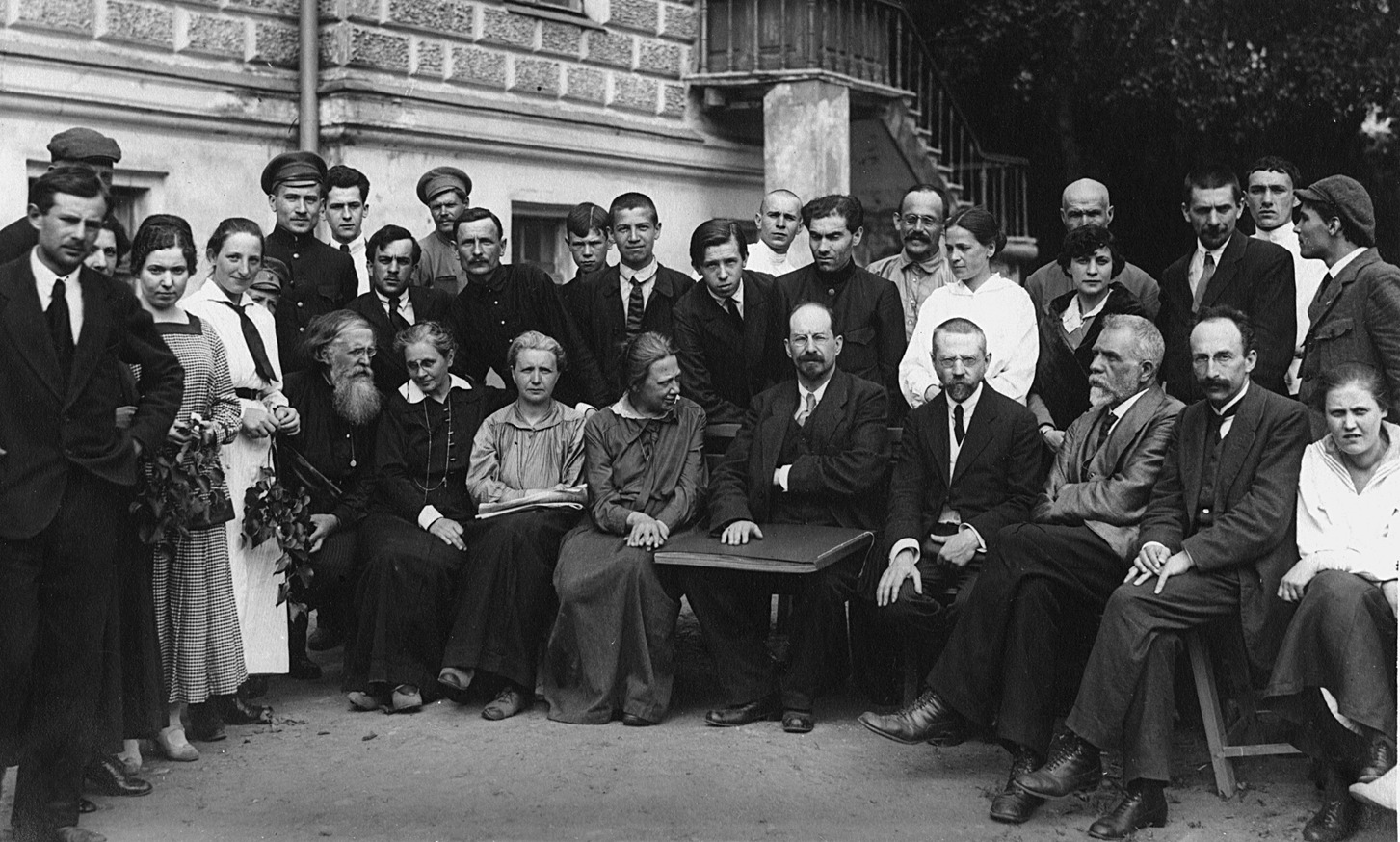
Declaration by the All-Russian Union of Teachers-Internationalists from a unique collection of early Soviet decrees, laws, and regulations on education, schools, theater, and the arts collected by Max Eastman. Published by Louis Fraina’s Socialist Publication Society, producers of the Class Struggle magazine.
‘Declaration of Principles of a Socialist School’ from Education and Art in Soviet Russia in the Light of Official Decrees and Documents Presented by Max Eastman. Socialist Publications Society, New York. 1919.
At the All-Russian Congress of Teachers-Internationalists, held in Moscow on June 6, 1918 as part of the First All-Russian Congress on Education, there was discussed and adopted a declaration of principles of a Socialist school, which runs as follows:
1. Socialism—is a maximum imaginable realization for our epoch in the collective life of humanity, of an intelligently directed coordination of labor—mental, physical, organizing and executive.
2. Within this organization of labor, the best possible system of organization of knowledge, as the best means of cultural development, is a uniform secular school, with free tuition, and compulsory for all children and youths, a working school based on the principle of self-reliance and self-activity.
3. The object of such a school is to pass each individual, regardless of his natural endowments, through a complete cycle of knowledge—beginning with general educational work in the primary stages of the school and progressively advancing towards specialization in the higher and final stages.
4. In a society of toilers the task of caring for children, is the duty of its members from the moment determined by science. Therefore, the infants are taken in charge of communal nurseries; young children—by the so-called “kindergartens”; children of primary school age—by the school communes; and youths—by a free university.
5. A school-commune—where instructions are of a greater duration as compared with other schools, aspiring to realize the ideal of synthetic knowledge and harmonious social intercourse within its inner organization—must serve as a laboratory for the preparation of those social forms which are most appropriate for the contemporary cultural epoch.
6. The function of the State—which in the past was omnipotent and pursued the policy of subjugation of society and domination over it through school institutions—now becomes simpler and more dignified: from a despot over science the State becomes its protector, desirable—during the first period of child-caring—and necessary, for the higher stages of the educational system.
7. The struggle for existence in primitive days—transformed in our epoch to a struggle of classes, and within some classes to a struggle of individuals, demanding subjugation of one person by another—must be changed into an organized cooperation for making nature follow the commands of man, and for the attainment of new truths. Acquaintance with the most essential of sciences, complete familiarization with the technique of one or several of the sciences contributing towards making a human being most adapted for directing functions within the sphere of its special endeavors and executive in all the rest.
8. The circumstances attending the modern transition period, financial and organizing difficulties, limit, to a certain extent, the practical application of the principle of equality of education. Hence, a selection is necessary.
9. Whereas the old pseudo-individualistic school of the nobility and bourgeoisie had applied in its systems of education the principle of selection in accordance with economic qualifications, namely, purchasing a maximum of knowledge, only partially elaborating the latter for its class aims, by a selection of the most capable individuals—the new socialistic school unequivocally denies such qualifications.
10. On the contrary, with inflexible consistency, including that of denying to the rich, but incapable individuals accessibility to higher education—the new school applies selection on the principle of intellectual ability.
11. With the object of a rational utilization of special abilities, having constantly in view the most intensive development of the productive forces of the socialist fatherland, the school—uniform in its primary stages—becomes more complex in its structure as it advances and is finally crowned by a number of special faculties.
12. Likewise, the essential principle of the socialistic School—the principle of productive endeavors, which destroys the bourgeois conception of the two would-be contradictory forms of labor—mental and manual, high and contemptible—assumes in the first stages a polytechnic character and gradually changes it to a special scientific instruction, in the higher stages.
13. Whereas the old school was ever national and chauvinistic in character, the new school must be, in form and substance, a true national school—instructions conducted in the mother tongue, a thorough knowledge of the home country’s physical and social conditions—but it must also be an international school as regards principles and methods.
14. Striving towards a harmonious synthesis of a broad educational culture with a thoroughgoing vocational training, educating the students in the spirit of the international solidarity of labor, only the socialist school has the right to say that it does not turn a human being out a skilled laborer but creates a man.
The Socialist Publication Society produced some of the earliest US versions of the revolutionary texts of First World War and the upheavals that followed. A project of Louis Fraina’s, the Society also published The Class Struggle. The Class Struggle is considered the first pro-Bolshevik journal in the United States and began in the aftermath of Russia’s February Revolution. A bi-monthly published between May 1917 and November 1919 in New York City by the Socialist Publication Society, its original editors were Ludwig Lore, Louis B. Boudin, and Louis C. Fraina. The Class Struggle became the primary English-language paper of the Socialist Party’s left wing and emerging Communist movement. Its last issue was published by the Communist Labor Party of America. ‘In the two years of its existence thus far, this magazine has presented the best interpretations of world events from the pens of American and Foreign Socialists. Among those who have contributed articles to its pages are: Nikolai Lenin, Leon Trotzky, Franz Mehring, Karl Liebknecht, Rosa Luxemburg, Lunacharsky, Bukharin, Hoglund, Karl Island, Friedrich Adler, and many others. The pages of this magazine will continue to print only the best and most class-conscious socialist material, and should be read by all who wish to be in contact with the living thought of the most uncompromising section of the Socialist Party.’
PDF of full book: https://archive.org/download/educationartinso00soci/educationartinso00soci.pdf
 Revolution's Newsstand