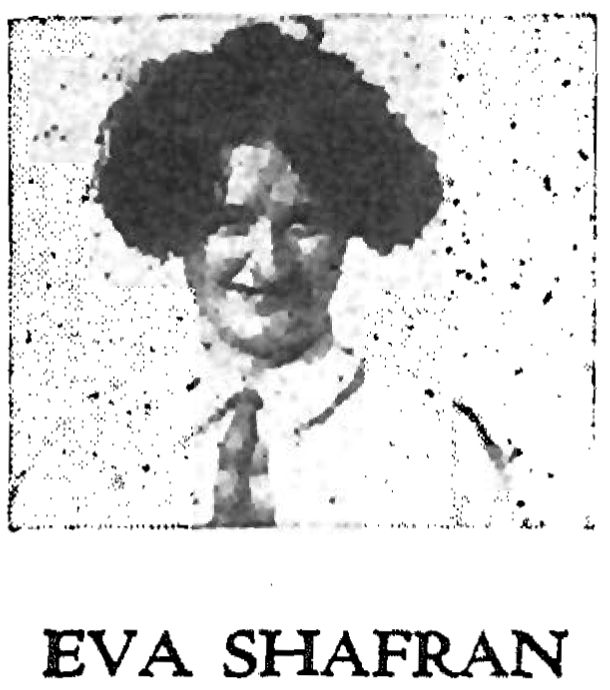
Eva Shafran on the hat-making industry which employed 35,000 workers, mostly women and girls, many Yiddish-speaking, and the good and bad in the Cloth Hat, Cap and Millinery Workers International Union.
‘What About Millinery’ by Eva Shafran from Labor Unity’ Vol. 2 No. 9. October, 1928.
IN the millinery trade the world-wide fight against misleaders of labor is on. But before going into this chapter of the story it is necessary to understand the industry, to realize the problems confronting us. After a process of calculation,1 we may say that the number of employees throughout the United States is between 32,000 and 35,000. The value of products per year in United States is $10,012, 279. So we see that the trade is not such a poor one.2
The most important centers of millinery work are:
New York, $126,119,003 valuation of product; Illinois, $21,012,279; Missouri, $12,734,221; California, $4,143,221; then Pennsylvania, Massachusetts, followed by every other state in lesser degree. The trade is perhaps not one per cent organized, except for New York, where 16,000 to 18,000 workers are sixty-five percent organized: operators eighty percent, blockers eighty and trimmers forty. There are probably seven to eight thousand union members now; the American Labor Year Book gives 10,200 for 1927, figures from union officials.
The millinery trade has a great number of women workers; 8,000 in New York, and, though exact figures cannot be had for the rest of the country, we can say there are thirty-five to forty percent women. They are mostly young girls.
Mechanization plays only a small part in the industry. Its problems are those of changing styles. At present great unemployment is due to the use of felt hats instead of novelties of silk and velvet, which require more work than felt. In a “novelty” the cutter cuts the material, sewing machines are used by the operators and the trimmers and blockers perform their tasks on it. The felt has only to be blocked and trimmed.
Zaritsky, president of the Cloth Hat, Cap and Millinery Workers Union is just a labor bureaucrat, like many others, but has been able for a longer time to fool his rank and file into believing him “progressive” if not even “revolutionary.” The struggle in the Millinery union is therefore not advanced to the stage it has reached in other needle trades. The left wing, as the leader, is fighting, nevertheless, to prevent the union from disintegrating and to keep it a real workers’ union instead of a company union, which last is the goal of Zaritsky and his gang. Zaritsky’s mask of “progressivism” has been somewhat damaged by his attitude in the general struggle of lefts and rights in the needle trades and the rest of the labor movement.
Specific trade issues are also involved. The millinery workers, through hard struggles in the past, won the “week” system of work, instead of the competitive “piece work” system.
Organizing The Enemy
Zaritsky, however, has a desire to be a great president, to deal with “real bosses” instead of “cockroaches,” so he has not only encouraged, but has actually assisted the formation of a bosses’ association in the cap trade, and later wanted to do the same thing in the millinery trade. Zaritsky’s friendship to the bosses, with whom he continually hobnobs, went to the extent of fighting against the workers for a return of piecework in both cap and millinery trades, for a collective agreement in millinery. He seems to have thought he would not have a very hard time putting through his policies, but he was fooled. A great counter attack came from the real workers, and the left wing began to grow stronger and stronger.
Local 43, trimmers, of New York, made up of 4,000 girls, was organized by the left wing in the industry.
It grew to this number from 200 in one year’s time, after the old fossilised leaders had given up all hope of organizing the girls. There were great possibilities of organizing all the workers in this branch of the trade in New York, about 8,000 girls. Boston Local 7 was for years controlled by left wing workers, and was the cream of the labor movement there. In Chicago and in Canada the left wing had leadership and great influence. In other New York locals, nests of the right wing, the lefts were steadily gaining. Zaritsky saw his position menaced and his policies in danger. Therefore he and his group decided to either get control of the trimmers or crush the local. They also decided to crush the Boston local and its left wing leadership. They sold out the Chicago workers to the cap manufacturers, surrendering the strike led by the left wing, to discredit the left wing leadership.
The general executive board of the union was needed to officially sanction these acts in order to preserve the reactionary control and protect the bosses’ interests. So first of all it was necessary for Zaritsky to excommunicate all “evil spirits” on the G.E.B. in order to have these motions unanimously adopted, G.E.B. member Saltzberg, who would have fought all these union smashing schemes to the bitter end, as he also did in the past, was kicked off the G.E.B. and eliminated as general manager in Chicago, a position to which the machine itself had sent him a short time before.
Then came the breaking of Local 43. The local was suspended and a scab local of the international union was organized. At present the members of Local 43 are waging a heroic fight against the employers, who, at the request of the international and the reactionary Local 24 of New York have discharged trimmers in several shops. The leadership of Local 24 is sending scabs against the girls of Local 43, just as the A.F.L. bureaucracy sent scabs to strike break against the millinery workers in 1917 because of a jurisdictional dispute with the Hatters, then opposed by Zaritsky himself.
Local 7 of Boston was broken up by the machine, company union local being organized, and the president of the international, fearing an insurrection from within his own local, asking for an injunction against the workers, asking this from the “justice” of Massachusetts courts, the same “justice” that slew Sacco and Vanzetti.
A Faker Exposed
By all of these actions, the Zaritsky group has exposed itself in its true light. The cap and millinery workers now see the danger that is facing them if this Zaritsky machine remains unchallenged, and their voice in opposition grows ever more powerful. The machine is now frightened enough to begin to play the game of “tolerance.” But the machine has broken locals, aligned with the bosses, used the police, scabs, and courts. It is adopting the Sigman policies of expulsion, throwing workers out of their jobs, and robbing them of their daily bread.
This will surely not frighten the thousands of cap and millinery workers. On the contrary, it will strengthen their ranks and raise their fighting spirit against the attempt of the machine to change the once militant working class organization into a company union, and they will struggle unceasingly to make it serve the interests of the workers, not those of their employers and a corrupt machine.
1. Days of work on government and state publications fail to show accurate figures. In the census of manufactures the millinery industry is combined with lace making, and in the census of population, millinery workers are lumped in with the dealers in millinery. The figure above is secured by a process of eliminating the lace goods workers, and by adding up the number of employees estimated in the different states according to the value of products there, and taking New York, where the numbers are better known, as a basis.
2. The value of fur products, for instance, is $254,265,708, and we may here point out that the number of workers is known; there are 22,908. Fur is one of the smaller needle trades, though the value of products per piece is greater than in the millinery industry, for which 35,000 workers is, therefore, not an unreasonable guess.
In 1924 Labor Herald was folded into Workers Monthly, an explicitly Party organ and in 1927 ‘Labor Unity’ became the organ of a now CP dominated TUEL. In 1929 and the turn towards Red Unions in the Third Period, TUEL was wound up and replaced by the Trade Union Unity League, a section of the Red International of Labor Unions (Profitern) and continued to publish Labor Unity until 1935. Labor Herald remains an important labor-orientated journal by revolutionaries in US left history and would be referenced by activists, along with TUEL, along after its heyday.
Link to a PDF: https://www.marxists.org/history/usa/pubs/labor-unity/v2n09-w28-oct-1928-TUUL-labor-unity.pdf
 Revolution's Newsstand