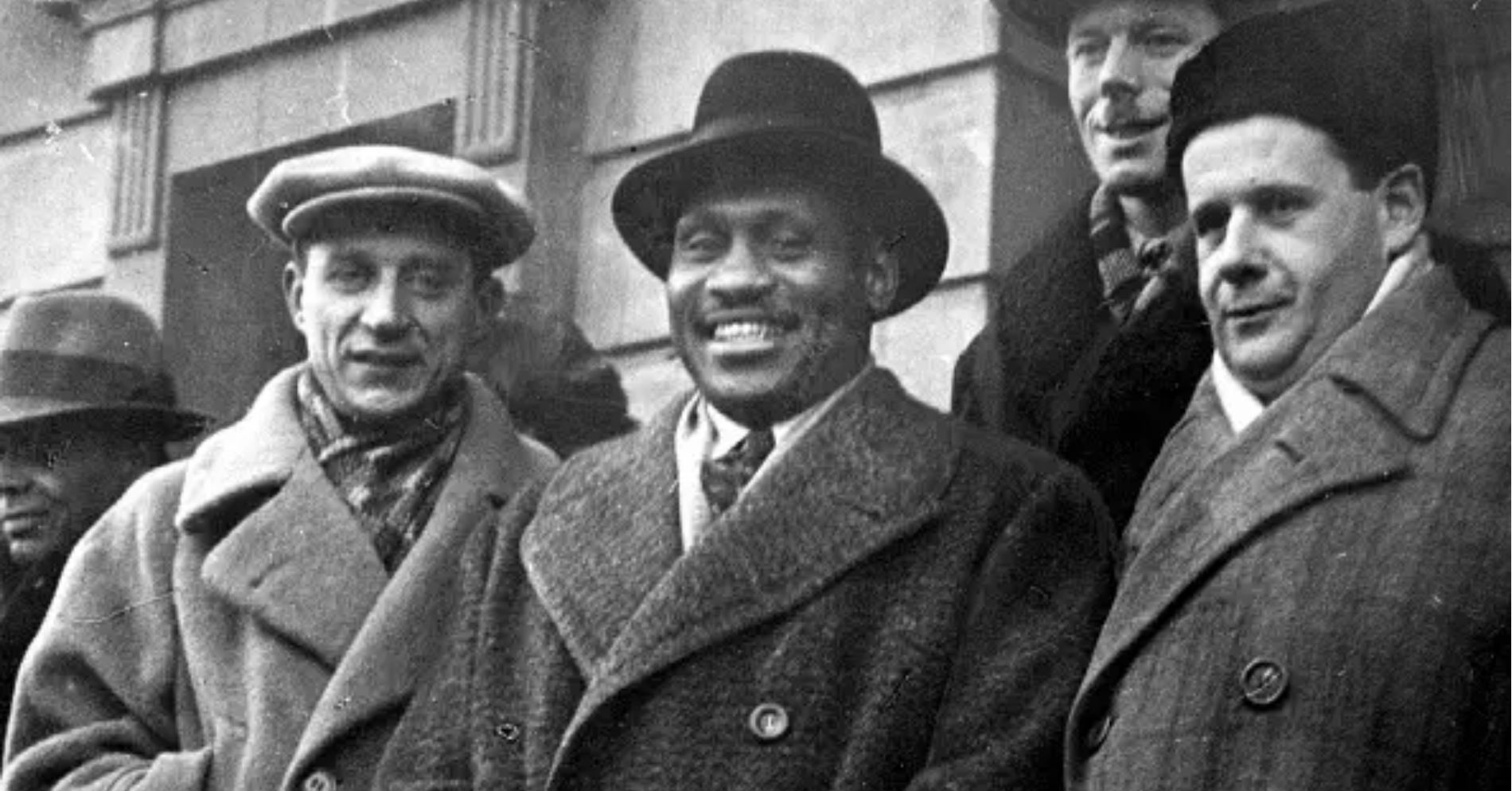
An absolutely fascinating essay by Hughes writing from Moscow after tracking down Black residents of the Soviet capital–artists, workers and teachers–and the attitude of the Soviets towards the Black freedom struggle in the U.S.
‘Negroes in Moscow’ by Langston Hughes from International Literature. No. 4. 1933.
In a Land Where there is no Jim Crow
In the very heart of Moscow, for a great many years now, day and night, night and day, a tall curley-headed Negro stands looking down on the moving life of Russia’s greatest city. Autos and tram cars cross the square, and crowds of people. Overhead airplanes fly. And soon, under his feet, there will be a subway. At night, the lights blaze, electric signs flash and theatre crowds merge. By day, mothers with kids come and sit on the park benches around the square and often say to their children, “Look, there is Pushkin.” And sometimes the children walk up the steps to the foot of the statue and learn to spell out among their first words, the name of the greatest of the Russian poets.
Pushkin! Pride of the Negroes, too, standing in the central square of Moscow. I first read about him years ago as a child in the Negro magazine, The Crisis. The Negro Year Book contains a sketch of his life, as well. And recently, on my long tour of the South, I saw his picture in many schools and colleges in the American Black Belt. I heard colored teachers in Mississippi and Georgia point to him as an inspiration for their oppressed and exploited pupils. And in their graduating orations, black students laud him every year as one of the great persons of Negro blood in the cultural past of the world.
Pushkin! Dead nearly a hundred years. Standing now in bronze in the heart of the Red Capital, looking down on the workers who own the earth; standing with his long black cape thrown about his shoulders, an equal of Shakespeare, Dante, Goethe, in the literature of all time; Pushkin, his books sold and read and studied everywhere by more people than ever before because the Russian masses now are literate; his poems loved and recited by the sons and daughters of workers and peasants; his memory honored by the Soviets even more than it could have been honored by the Tsars.
Pushkin, a great grandson of the Negro of Peter the Great. Of course, by the time the black blood got down to the poet, two generation removed, it was pretty well mixed with the blood of the Slavs and Tartars, too. But Pushkin’s mother was a beautiful mulatto. And Pushkin himself was dark enough to show, in hair and skin, traces of Africa. There is an anecdote current in Russia that Poe, the famous. American poet from Baltimore, refused to shake hands with Pushkin when he looked into his face upon meeting and saw how much it resembled the faces of some of the light slaves in Maryland. Pushkin, however, being a member of the nobility, deemed it beneath his dignity to be insulted by a mere white American—otherwise there might have been a duel of historical and literary importance.
Pushkin died in 1837. Before the end of the century, another Negro of purer blood, a black actor from America, was attracting the greatest of attention ana receiving high. praise for his art from the Russian public. This man, Aldridge, played Shakespeare with great force and power. He specialized in Othello, but also performed King Lear and other roles most successfully and for his performances he was made a member of the famous Imperial Academy of Arts and Sciences in St. Petersburg. In several old books on the Russian theatre, Ira Aldridge is written on at length and his photographs displayed.
From the more recent past, indeed since the October Revolution, two other famous. Negroes have crossed the Russian scene. One is Claude McKay, the poet and novelist, who lived for a time in Moscow, and whose books have been published in Russian.
The other is Roland Hayes, the singer, who was invited to sing in the largest Soviet cities. He sang to immense audiences in the Big Hall of the Conservatory at Moscow, leaving a most favorable impression on the crowds of music lovers who came to. hear him.
Claude McKay is well remembered in the Moscow literary world. His picture and one of his poems may be seen in a text book of the Russian language for foreigners. It is said that McKay wrote a book in Moscow about the American Negroes, too, a very rare book that appeared only in Russian, (now out of print) and is the only factual book he ever wrote. Claude McKay was one of the first of the Negro intellectuals to come to Moscow after the Revolution. He came as a friend and a comrade, and his visit evidently made a great impression, as many people in Moscow still ask visiting Negroes for news of him.
There are, among the permanent foreign working residents of Moscow, perhaps two dozen Negroes, several of whom I have not met as there is no Negro colony; and colored people mix so thoroughly in the life of the big capital, that you cannot find them merely by seeking out their color. Like the Indians and Uzbeks and Chinese, the: Negro workers are so well absorbed by Soviet life that most of them seldom remember that they are Negroes in the old oppressive sense that black people are always forced to be conscious of in America or the British colonies. In Moscow there are no color bars, and the very nature of the Soviet system can never admit any sort of discriminatory racial separation, or the setting apart from the general worker’s life of Negroes or any other minority groups.
Indeed, in Moscow, the balance is all in favor of the Negro. The Russian people know that he comes from one of the most oppressed groups in the world, so the Soviet citizen receives the black worker with even greater interest and courtesy than is paid to most other foreigners coming to the capital. In the Moscow papers and magazines, schools and theatres there is frequent and sympathetic attention paid by writers, teachers and playwrights to the widespread and difficult struggle of the black peoples in the capitalist lands where they are subjected to exploitation and oppression as serfs and colonials. Negroes in Moscow sense at once this great Soviet sympathy for them. Black workers soon feel at home. And most of them resident at present in Moscow have no thought of returning soon to the countries where Jim Crow rules.
Among the foreign specialists in the factories of the Moscow district, Robert N. Robinson is one of the best known. His picture is frequently seen among the udarnik groups (shock brigade workers) whose photos are often displayed in the windows of the Moscow shops. His dark face is thus known to thousands of Muskovites who pass in the city streets. Some two years ago his name flashed across the press of the world as the Negro who was attacked by white Americans in the dining room of the Stalingrad Tractor Plant, said Americans being expelled from the Soviet Union immediately on a charge of racial chauvinism. Thus the Union protects its darker workers from imported prejudice.
Robinson came to Russia in a group of more than a hundred American specialists brought over to work at Stalingrad in 1930. He was the only Negro in the group. Seven other Negro specialists had been contracted, but at the last moment backed out, with the characteristic reluctance of most North. American Negroes to pioneer abroad. (Robinson himself is a Jamaican, B.W.I.) He formerly worked as a gauge grinder at the Ford Plant in Detroit. There, being the only Negro in his department, he has many tales to tell of how his fellow workers attempted to drive him off the job, even putting a short circuit into his machine so that upon touching his tools he would receive a severe shock.
In the Soviet Union no such things have happened. After two years at Stalingrad, Robinson is now working as general tool maker and instructor in the gauge grinding department of the Moscow Ball Bearing Plant. His work, of all in the tool room, requires the most exact precision, demanding an accuracy of up to one-thousandth of a millimeter.
In his spare time, Robinson is a lover of the theatre, especially the opera. He has seen the best of the theatres abroad, London, Paris, New York, and Berlin, but he insists that none of them compare with the Soviet productions, and that the music at the Bolshoi is the finest he has ever heard. And in Moscow there are no Jim Crow galleries.
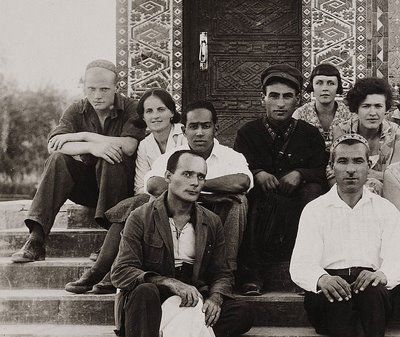
There are other Negro workers in Moscow factories who, unfortunately, I have not been able to interview. And in far away Tashkent, there is a group of American Negroes employed at the Machine-Tractor Station and Seed Selection Station of the State Cotton Trust. Members of this group may be seen occasionally on vacations in Moscow, bringing their Russian wives to the shops and theatres.
Among the oldest Negro residents of the capital are two artists of the theatre and concert stage. Emma Harris and Coretti Arle-Titz. Emma Harris has been in Russia for more than thirty years and is well known by the resident American workers and journalists. Among other things, she is famous for her apple pies. But these pies are among the least of her achievements. Her life story would make a colorful and exciting book.
She came to Europe in 1901 as a member of the “Louisiana Amazon Gods,” a singing group which included Fannie Wise and Ollie Burgoyne, now old and well known artists in the States. After a tour of Germany, a smaller group, the “Six Creole Belles,” invaded Russia and Poland with great success. When this group disbanded, Emma Harris formed a singing trio of her own which performed in the large cities for a number of years. Finally, stranded in Siberia, Mrs. Harris taught English for a livelihood. Upon her return to Russia proper, she appeared as a concert soloist. And during the early days of the war she conducted a motion picture theatre in Kharkov. Later she owned an American Pension in Moscow. During the days of the Civil War she served as a nurse for the revolutionary forces in the Ukraine. Then under Colonel Haskell she worked with the American Relief Association. And after the establishment of the Bolshevik power, she continued active as a speaker and propagandist for the International Red Aid.
One of my first memories of Moscow is Emma Harris speaking at a huge Scottsboro meeting one July night in the Park of Rest and Culture, her dark face glowing in the blaze of the gigantic flood lights, her voice magnified by loud speakers so that thousands -of people could hear. She is more than sixty years old now, but no one would think so. She is full of life and fire. And she has come a long ways from Augusta, Georgia, through the days of the revolution to the red freedom of Moscow.
Corettt Arle-Titz has been in Russia for more than twenty years. She thinks in Russian, and often English words come hard for her now. For a time, she sang with the Emma Harris trio, then she took up the serious study of voice at the St. Petersburg Conservatory, and later with Madame Vladimirova at the famous studio in Moscow founded by Ipolite-Ivanov. She has sung the role of Aida at the Kharkov Opera, and has toured the whole Soviet Union in concert with great success. Her scrap books are full of critiques and testimonials from workers and Red Army men. She has known many of the leading revolutionists and is a friend of Maxim Gorky’s.
At the Moscow school for children of English speaking parents there is a Negro teacher, Lovett Forte Whiteman of Chicago. His field is chemistry, physics and biology. He has lived in Moscow for more than five years, is married and intends to be a permanent resident.
Of those Negroes who came with the Meschrapom film group in 1932, three have remained as workers. Wayland Rudd, the actor, is a member of the famous Meyerhold Theatre. He acts a small Role in Russian in one of the new productions. At the same time, he is taking full advantage of the opportunities which the theatre offers for the study of singing, dancing, fencing and allied theatrical arts.
Homer Smith, a former postal employee of Minneapolis, is now a special consultant in the rationalization of the Soviet postal system. He is credited with the planning and supervision of Moscow’s first special delivery service recently introduced. He is the only American, Negro or white, in a position of high responsibility in the Soviet Post Offices, and as such, is being frequently written about in the press.
The youngest member of the film group, Lloyd Patterson, came directly from his graduation at Hampton Institute in Virginia to the Soviet Union. He is an expert painter, and whereas in America he could work only at simple jobs of house painting, he is employed in Moscow on the interior decorations of the de luxe tourist hotel, Metropole. Patterson is married to a talented Komsomolka who is a painter of pictures, and together they executed some of the best street decorations for the last May Day demonstration.
Although the actual number of Negroes in Moscow is not large, the Muscovites, from reading and from the theatre if not from direct contact, are well-informed on the various phases of Negro life. Each year, a number of books by or about Negroes are published. At present Georgia N***r has appeared in both Russian and English. The Moscow papers follow the Scottsboro case closely. In the theatre, Muscovites have started with Uncle Tom’s Cabin and have lately come down to a very modernistic production of Eugene O’Neil’s worst play, All God’s Chillun Got Wings, called in Moscow, Negro. At the Children’s Theatre there is a playlet called, The Good Little Negro Girl. And recently the manuscript of a new play has been completed by a Russian playwright, Ronn, depicting the struggles of a black boxer in America whose career is hampered by prejudice, and who is exploited by his managers for all the money they can get out of him.
Negro music is popular in Moscow, too. Irma Yunzen, the great folk singer, uses southern melodies on her programs. Sergei Radamsky of New York sang a Negro group during the past season. And it is rumored this fall Paul Robeson is expected to appear in concert. In the Museum of Western Art there is a bust of the American Negro musician and composer, Hall Johnson, done by Minna Harkovy, of the New York John Reed Club.
So modern Negro art, both literature and music, is well represented in the Soviet capital. The music is kept alive not only by Coretti Arle-Titz and visiting Negro artists but by the Russian singers, also. And as to the workers, the great task of building socialism and the labor it entails has given work of importance to the competent black hands of Robinson, Patterson, Homer Smith, and other Negroes in Moscow, where specialists from all countries in the world are employed.
A Moscow poet, Julian Anissimov, (translator of a forthcoming anthology of Negro poetry) has written a little poem which begins like this article with Pushkin; but which ends, not like this article, with today, but with tomorrow.
It is called:
KINSHIP.
The blood of Pushkin
Unites
The Russian and the Negro
In art…
Tomorrow We will be united anew in the International. So merge past facts and present prophecy.
Moscow, 1933
Literature of the World Revolution/International Literature was the journal of the International Union of Revolutionary Writers, founded in 1927, that began publishing in the aftermath of 1931’s international conference of revolutionary writers held in Kharkov, Ukraine. Produced in Moscow in Russian, German, English, and French, the name changed to International Literature in 1932. In 1935 and the Popular Front, the Writers for the Defense of Culture became the sponsoring organization. It published until 1945 and hosted the most important Communist writers and critics of the time.
PDF of full issue: https://www.marxists.org/subject/art/literature/international-literature/1933-n04-IL.pdf
 Revolution's Newsstand