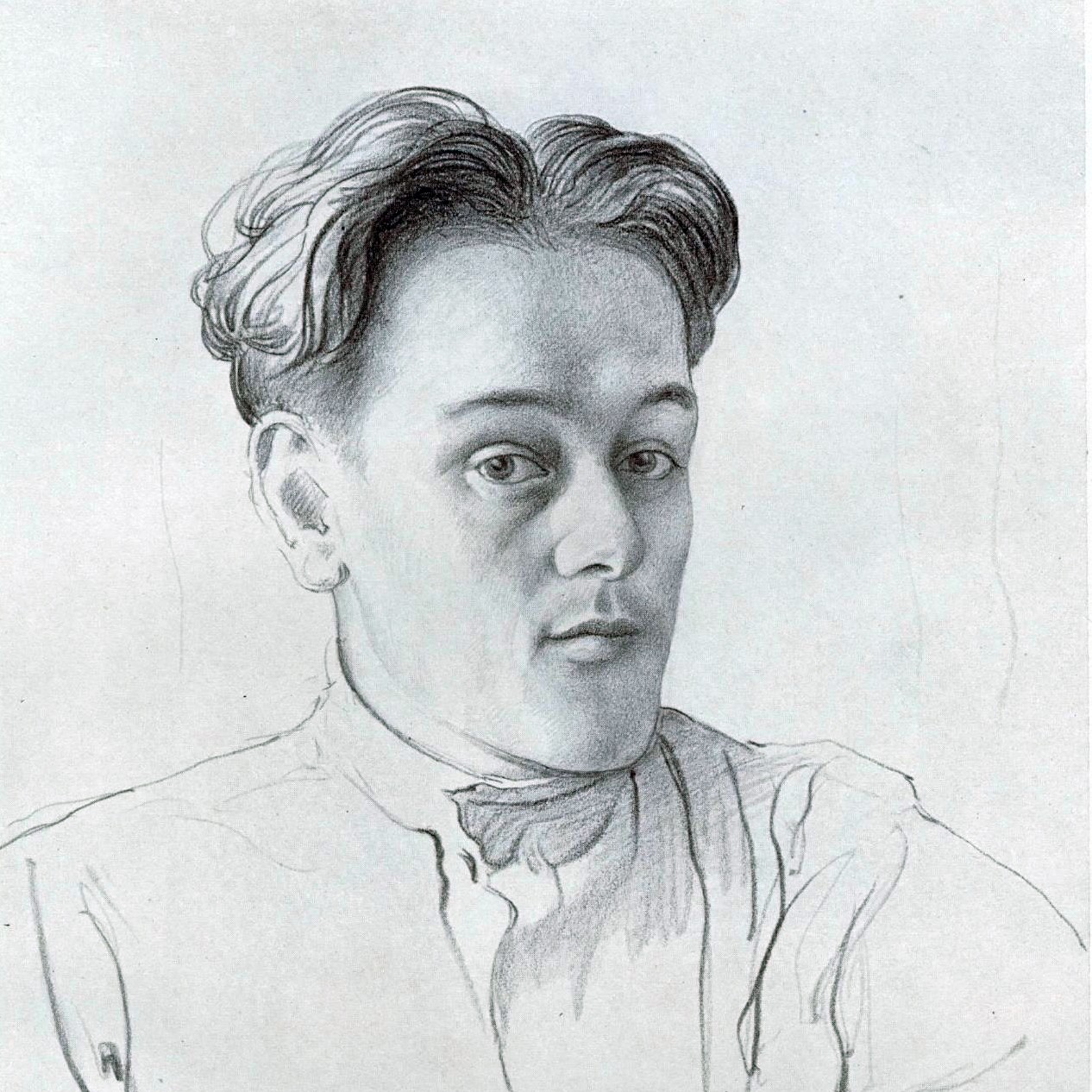
Principled anti-war internationalism from a central figure in the European Young Socialist, and later Young Communist movement. The German-born Münzenberg had moved to Switzerland in 1910 seeking work, there he he got to know revolutionary exiles such as Lenin and was involved in the Zimmerwald movement. Before his arrest and deportation back to Germany in 1918 he wrote this quite remarkable refusal to the German draft board, widely published in the anti-war press.
‘To the Imperial Military Board’ by Willi Münzenberg from Young Socialists’ Magazine. Vol. 11 No. 11. November, 1917.
To the Imperial Military Board:
I am in receipt of your order of Sept. 6, commanding me to report for military service on Sept. 17. This is not the first order of this kind I have received. Nor have I more reason, today, to comply with it, than on previous occasions. On the contrary. The reasons that lead me to refuse to render military service for Germany have increased with the months that have passed.
But even if my determination, not to comply with your order, is unalterable, my ideas concerning my attitude toward this order have undergone a change.
In the past years I ignored similar orders because I looked upon war as something in which I had no interest and, therefore, was none of my business. Today I look upon this idea as one of brutal egotism. The terrible suffering these three years of war have brought to all people and particularly to the working class of all nations, the loss of millions of young human beings, the senseless destruction of glorious works of art, the devastation of ancient forests and fruitful fields, and above all, the terrible political effects of the war, the unfettering of blackest and most heartless reaction, the bloody persecution and oppression of freedom that alone can become the basis of a lasting peace; the increasing exploitation of my class-comrades in every nation, the growing employment of women and children, throwing my class back for a decade in its struggle for better conditions–all of these things have brought to me the conviction that it is not sufficient to ignore this war, that it is rather the duty of every honest and humane Socialist to fight with his whole strength and energy against this war, for peace. In the past year I have striven to act in accordance with this realization. I am using the opportunity that your latest order offers, to declare this openly before the world.
The reasons that have led me to refuse to do military service in Germany are the outgrowth of my political conceptions. I will refrain here from defining the Socialist idea of fatherland. If you are even slightly familiar with Socialist literature, it must be familiar to you.
I desire to emphasize particularly that neither ethical nor pacifist arguments have led me to refuse military service. I do not by any means roundly refuse participation in all wars. On the contrary, I can conceive of wars in which I most emphatically would do my part: wars against old, decayed forms of government that hamper the progress of civilization, revolutionary uprisings, which aim to bring about economic equalization through a Socialist social state.
If I, therefore, refuse to render service of any kind in the present war, it is because nowhere, not even in Germany, it is being fought for greater freedom, for democracy, for higher culture; because it serves simply and only the defense and the increase of capitalist interests. In 1914 this opinion was ridiculed as an empty phrase of irresponsible Socialists. Today it is openly admitted by all serious statesmen and economists. The working-class is as little interested in the defense and increase of capitalist power, as the sheep is interested in the welfare of the wolf. The greater and the more glorious Germany’s victory in this war will be the heavier will be the weight of oppression that will crush the German working-class. This is a fact that can be easily proven. 1813 brought to the German people not freedom, but the terrors of a black reaction before whose onslaughts men like Jahn, Arndt and others fell. 1870 brought the Socialist exception laws to the German working class. 1914 has placed the whole nation under military law, and each new military victory has meant new reactionary measures. The recent conquest of Riga has resulted in the complete suppression of even the most modest democratic and parliamentary rights. Perhaps they may again be revived if things at the front come to a standstill. But it is certain that the last breath of freedom will be stamped out, if Petersburg falls into the hands of the German army.
You can find countless similar examples. I desired only to prove to you with the few facts I have mentioned, how diametrically opposed the interests of the working class, of democracy, of progress are to those of Imperialists, Generals, of war. And since I have always stood, with all my heart, on the side of the former, you will understand that I will not fight against myself by accepting your invitation.
Furthermore, it is not unimportant that, in my opinion, the German government bears the heavy responsibility for the outbreak of the war in 1914. I know that the economic and industrial causes this war, overspread not only Germany, but every capitalist nation. But that these conflicts should find political expression, that they should have been driven to this climax of bloodshed and slaughter, for this Germany is not entirely without blame. You may perhaps tell me that the numerical supremacy of Germany’s enemies places every German under the obligation of defending his country. But I answer that this but proves conclusively the complete inefficiency of German diplomacy and of the German government. It was their duty to prevent German intervention before the war, to avoid an increase in the number of its foes during the war. But the German policies, and the methods of conducting this war, have made the world our enemy. The invasion of Belgium, with its ridiculous motive, “Not kennt kein Gebot,” not only furnished England with an excuse for intervention, but robbed Germany of the last vestige of sympathy of the leaders of the smaller countries as well.
When Germany declared its ruthless U-boat warfare, it did so, again, out of purely material considerations, without for a moment considering its moral effect upon the countries that were still neutral at that time. That is, in fact, the kernel of German political bankruptcy.
Germany relied implicitly on brute strength and forgot that, in spite of cannon and U-boats, humanity is living in the twentieth century, that moral and mental forces play their important part. It is in accord with the political philosophy of a government like this–to ask its subjects to pay in blood the price for the inefficiency of its rulers. You will understand, dear sirs, that I have not the slightest inclination to do so. This same inefficiency has characterized the actions of your rulers at home. Absolutism is victorious. The people must sacrifice their sons, but the power to declare war and make peace lies with the crown alone. Nor can the parliamentary manoeuvres that are performed peculiarly whenever military operations have come to a deadlock, conceal these conditions. Increased autocracy and oppression of those elements which are honestly anti-imperialistic and for peace, have usurped democracy. We have not forgotten the awful penalties visited upon those who participated in demonstrations to which only the crying needs of the masses had driven them. Does it not give the lie to all your protestations of democracy and peace that a Liebknecht, a Luxemburg have been confined behind prison bars since the beginning of the war, while your loud-mouthed war-barters are enjoying the greatest measure of freedom, and may speak and write as they like?
If I believed that I could carry on revolutionary propaganda within the army, be assured that I would respond to your command at once, that I would try my utmost to spread my ideas among the ranks. But today that is out of the question. And so there remains for me but one possibility for effective anti-militaristic propaganda, the open and absolute refusal to do military service.
I am confirmed in my decision by my activity during the last years as International Secretary of the Federation of Young People’s Socialist Organizations. In this capacity I have issued a number of manifestos and resolutions to the young workers of all nations, which have led the young Socialists in America as well as in other countries to refuse to participate in the present war. My political friends in Russia are fighting even today against every offensive, against every war-measure. To my mind it is impossible for a man who is honest in his political convictions, to be for peace today and for war tomorrow, to extend the olive branch today, only to throw the hand-grenade tomorrow because circumstances have become more favorable. Such a policy is possible only in a nation that safely escorts revolutionaries home to the country of the enemy and throws their political friends into jail at home. Such a policy is possible only in a government that can speak of peace without annexations when things go wrong, only to rant of “freeing” Riga when the situation turns in its favor.
It cannot be my duty, that I am sure, gentlemen, even you will understand, to support or defend a government, a government that tramples upon the most elementary rights of my class. On the contrary, I can have but one duty, to fight against such a government with every measure that lies in the interest of the international working proletariat. And this, as it has been in the past, shall be my life-work.
Wilhelm Munzenberg, Secretary of the International Federation of Young People’s Socialist Organizations.
Zurich, Sept. 15, 1917.
Young Socialist’s Magazine was the journal of the original Young People’s Socialist League and grew of of the Socialist Sunday School Movement, with its audience being children rather than the ‘young adults’ of later Socialist youth groups. Beginning in 1908 as The Little Socialist Magazine. In 1911 it changed to The Young Socialists’ Magazine and its audience skewed older. By the time of the entry into World War One, the Y.P.S.L.’s, then led by future Communists like Oliver Carlson and Martin Abern, had a strong Left Wing, creating a fractious internal life and infrequent publication, ceasing entirely in 1920.
PDF of full issue: https://www.marxists.org/history/usa/pubs/youngsocialist/v11n11-nov-1917_Young%20Socialists.pdf
 Revolution's Newsstand