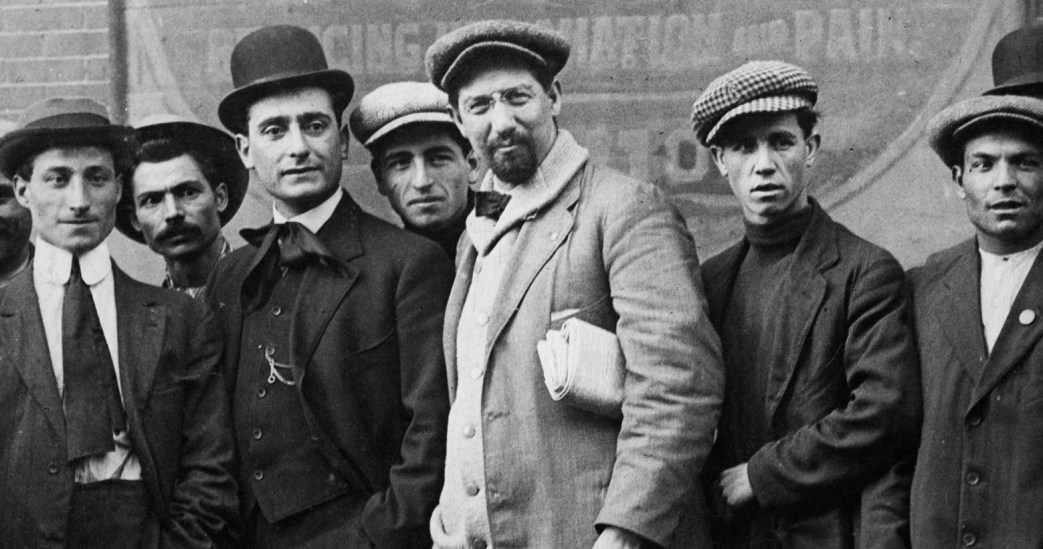
Carlo Tresca was sent to Atlanta Federal Penitentiary in January, 1925 to serve a year-long sentence for publishing ‘obscene’ material in his Il Martello newspaper–a two-line advertisement of a book on birth control. Tresca was a target not just for his radicalism and labor activities here, but by Mussolini for his militant and effective anti-fascism among Italians in the U.S. The outcry of Tresca’s imprisonment led President Coolidge to commute his sentence after four months in jail. On January 11, 1943, Tresca would, after numerous attempts, be assassinated by fascist agents, shot to death on the streets of New York City.
‘Carlo Tresca Enters Prison’ from The New Leader. Vol. 2 No. 2. January 10, 1925.
Declaring him a victim of Fascisti influence in the United States, the American Civil Liberties Union has forwarded to the Attorney General a request for executive clemency for Carlo Tresca radical editor, sentenced to one year and a day in the Atlanta Penitentiary.
Tresca meanwhile, was committed to the penitentiary this week. To numerous friends who gathered to see him off in the custody of a U.S. marshal the veteran of countless Labor and civil liberties battles expressed the hope that others would take up the interrupted work against the spread of Fascisti sympathy here.
Tresca was convicted, following a trial, for publishing a two-line advertisement of a book on birth control in his paper Il Martello.
The request for executive clemency was forwarded to Washington by the Civil Liberties Union at Tresca’s request.
The union asks for clemency on the ground that the sentence is disproportionate to the offense, and that it is the first prison sentence ever imposed in the United States under the statute penalizing the advertising of matter on birth control. The previous Federal cases have resulted either in acquittals or small fines. Even under State laws the maximum sentence imposed for giving such information was six months, and the average less than one month.
The union contends that the real reason for Tresea’s conviction was not the birth control advertisement, but his anti-Fascist activities. The union alleges that the Italian Ambassador, Prince Caetani, inspired the prosecution on behalf of the Italian Government by making representations to the State Department. It characterizes the case as “a political persecution at the instance of a foreign Government, wholly out of keeping with the American tradition of freedom for agitation against foreign Governments by political refugees in the United States.”
The union further contends that the offense, itself independent of the aspect of political interference by the Italian Ambassador, did not justify a conviction. It is stated that the undisputed evidence at the trial shows that the advertisement was inserted by an agent of Il Martello, named Vella, at the instance of Umberto Nieri, proprietor of the book store, who took full responsibility for it. Nieri was later indicted, convicted, and served a sentence of four months in the Westchester County jail for the offense. The union contends that in any event it was improper to impose a longer sentence on Tresca than upon the principal in the case. Further, the issue was complicated at the trial by the introduction in Tresca’s cross-examination of a mass of irrelevant evidence concerning his activity in strikes and Labor disputes, which the union holds prejudiced the jury.
The conviction was recently affirmed by the United States Circuit Court of Appeals. The indictment was returned in October, 1923, after weeks of effort to find violations of the law in Il Martello following the Italian Ambassador’s complaint. These efforts are described by the Civil Liberties Union as follows:
“At a dinner of welcome in July, 1923, to Judge Gary, who is an honorary member of the Fascisti, the Italian Ambassador suggested that a ‘certain Italian paper in New York ought to be suppressed.’ The Government’s attentions to Il Martello began immediately thereafter. The July 21st issue of the paper was held up in the mails without warning and without specific charges. On August 10 Tresca was arrested for an article, then three months old, criticizing the Italian monarchy. The charge was later dropped. On August 18, he was ordered to delete from his paper the announcement of a raffle, although two other papers carried the same notice unmolested. The September 8 issue of Il Martello was held up for containing a two-line advertisement of a birth control book. Although the advertisement was deleted and the paper allowed to pass through the mails, Tresca was indicted for this a month later. Even after the indictment the Government continued for a short period to harass the paper. On October 27 Tresca was forced to reprint an entire edition of the paper, omitting an account of how the Fascisti forced a woman to take castor oil. The November 10 issue was held up because of a letter from a reader prophesying that Mussolini would come to the same end as Rienzi, although an earlier issue of Il Martello had quoted the same statement by Arthur Brisbane which appeared in the Hearst papers. The November 24 issue was declared unmailable for charging that Mussolini appropriated for his election fund a sum intended for D’Annunzio in Fiume.”
Tresca was tried for the two-line birth control advertisement before Judge Henry W. Goddard of the United States District Court at New York, and was convicted on November 27, 1923. Until recently he was out on bail while the appeal was pending. He has been represented in the proceedings by former United States District Attorney Harold A. Content. The Government was represented by Assistant District Attorney Mattuek.
Other factors in the case to which the Civil Liberties Union has called the attention of the Attorney General are that the same advertisement appeared in two other papers without interference; that the advertisement was deleted from Tresca’s paper at the instance of the Post Office Department before the issue was mailed, that the Assistant District Attorney suggested in court at the time of conviction that the Government would not ask for the imposition of a prison sentence if Tresca would agree to leave the country, and that the original complaint against Tresca before the birth control advertisement was discovered was based on an article entitled “Down With the Monarchy.” Tresca’s application for clemency was endorsed, among others, by Congressman F.H. LaGuardia, Judge Freschi, Judge Cotillo, the late Albert DeSilver, the Rev. John Haynes Holmes, Roger N. Baldwin, Margaret Sanger and Judge Mancuso.
New Leader was the most important Socialist Party-aligned paper from much of the 1920s and 1930s. Begun in 1924 after the S.P. created the Conference for Progressive Political Action, it was edited by James Oneal. With Oneal, and William M. Feigenbaum as manager, the paper hosted such historic Party figures as Debs, Abraham Cahan, Lena Morrow Lewis, Isaac Hourwich, John Work, Algernon Lee, Morris Hillquit, and new-comers like Norman Thomas. Published weekly in New York City, the paper followed Oneal’s constructivist Marxism and political anti-Communism. The paper would move to the right in the mid 30s and become the voice of the ‘Old Guard’ of the S.P. After Oneal retired in 1940, the paper became a liberal anti-communist paper under editor Sol Levitas. However, in the 1920s and for much of the 1930s the paper contained a gold mine of information about the Party, its activities, and most importantly for labor historians, its insiders coverage of the union movement in a crucial period.
PDF of full issue: https://www.marxists.org/history/usa/pubs/new-leader/1925/v02n02-jan-09-1925-NL.pdf
 Revolution's Newsstand