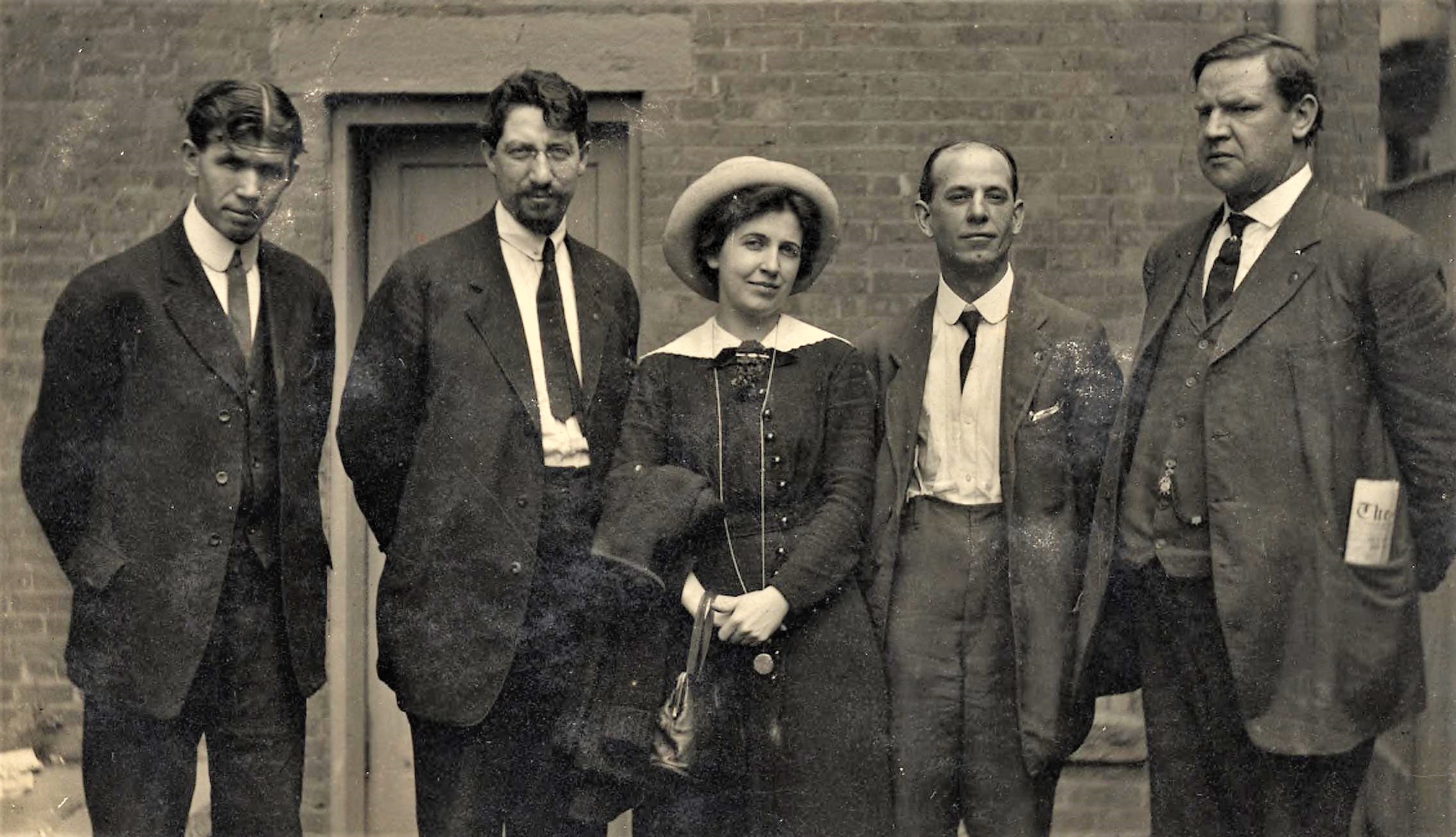
Carlo Tresca shares the priceless memories of his experience leading the era-defining Paterson silk strike with William D. ‘Big Bill’ Haywood in 1913. Haywood had recently died in Moscow exile, and with his passing a generation of activists found themselves looking back and taking stock. The imposing figure of Haywood looming large not just in memory, but as an example of what the larger workers’ movement had lost in the intervening decades.
‘On Strike With Bill Haywood’ by Carlo Tresca from The New Masses. Vol. 4 No. 9. February, 1929.
For years prior to 1912 two names were almost continually ringing in my ears: William Haywood and Eugene Debs. I was a new arrival in America then, had little knowledge of English, spent my time working among Italians, but somehow or other those two figures loomed up in my mind, illuminated with an almost super-natural light.
It was only in 1912 that I was destined to meet Bill.
We were conducting a vigorous propaganda in Lawrence, Massachusetts, for the release of our comrades, Ettor and Giovanniti, leaders of the Lawrence strike, who had been accused of murder. Haywood himself was at that time under indictment for conspiracy in connection with the strike. We were bending all our efforts to mobilize the masses in favor of the innocently imprisoned comrades. We used up all our resources. Months passed and our comrades were still languishing behind iron bars. To give impetus to the movement, we decided to invite Big Bill.
We had first of all to overcome the resistance of the local I.W.W. Union, which was afraid that his presence might only increase the antagonism of the authorities and thus make the situation more dangerous for the prisoners. I was one of those who particularly insisted on Haywood’s coming. Let it be admitted that a strong desire to meet the famous leader was not the least of my motives. We finally won our point. Haywood was to appear. We staged his appearance with all possible ostentation.
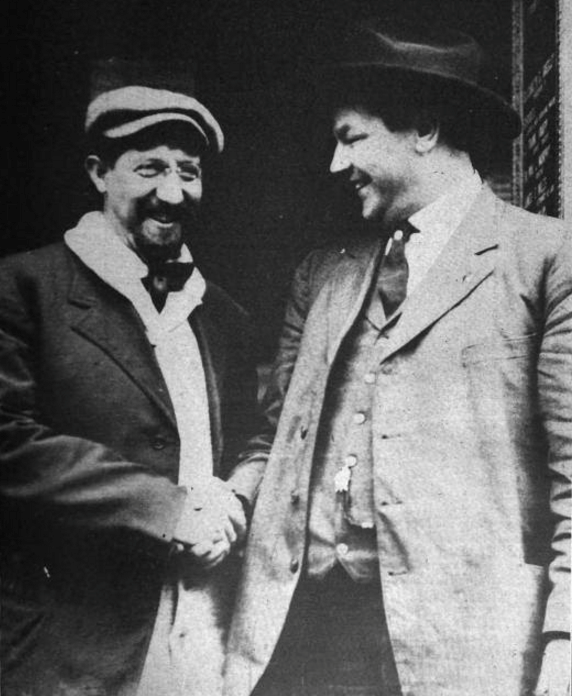
The meeting was called (July, 1912) to assemble at the Boston Commons. We invited strikers to come from Lawrence. I had promised them Bill, expecting that some 500 would follow the call. They came from Lawrence 4,000 strong: they were going to see their father, their friend, their general. “Go to see Bill” seems to have been the most captivating slogan of the day. We marched through the streets of Boston singing the Internationale in twenty- eight languages. A crowd of 60,000 met at the Commons. Under the wooden platform Big Bill was hiding. (This was my personal little ruse. Bill had not yet furnished bail and there was a standing order to the police to arrest him on sight.) There were speeches and singing; but when we announced the name of William Haywood and he climbed from his hiding place into broad daylight, a tremendous wave of enthusiasm surged over the huge gathering. There was no end to singing, shouting, waving of hats. The detectives rushed to seize Bill, but the Lawrence strikers formed a solid wall around him, keeping the invaders back. Bill was allowed to speak. When he finished he was seized by detectives. My Lawrence crowd (I was marshall of the parade) went marching to the railroad station under the red flag. No sooner had we arrived when we found Bill was waiting for us. He had in the meantime furnished bail and had been released. He had come to see his brood, his children. Never in my life have I witnessed men and women so frantic with joy, as those several thousand Lawrence strikers. No children ever greeted a beloved father with such an outburst of almost ecstatic elation. He made a little speech, a very brief one. Then he put his big arms around my shoulders. I, a young man, just beginning my career in the labor movement, thought this compensation enough for all my work. The general recognized the services of his lieutenant. The general was appreciative. On the following day the papers published a photograph of the scene, the caption reading, “Big Bill Haywood and his Lieutenant.”
Afterwards Bill came to Lawrence to help us free the prisoners. There had been organized in Lawrence a Vigilance Committee which combined manufacturers, Chamber of Commerce members, detectives, and generally respectable citizens, intent on breaking the strike. The Vigilance Committee was preparing to organize a Columbus Celebration on October 12. That was supposed to be a decisive blow to the strikers. Detectives and other dark personages were pouring into the city by the score. The Catholic Boy Scouts and Catholic Clubs, led by one of the Irish priests, himself a large shareholder in one of the largest factories, were becoming cold. Every night some of our boys with strike buttons in their lapels were attacked and beaten up. Haywood was literally showered with anonymous letters promising to kill him. Of course, he remained unmoved. There was, however, one letter that made him suffer terribly. The letter promised to “close his second eye” if he would not leave town. (One of Haywood’s eyes was gouged when he conducted the miners’ strike in Colorado.)
The Lawrence atmosphere was becoming ever more feverish. An attack was obviously being prepared against the workers. A day or two before October 12, an I.W.W. striker was beaten to death with fists. There was no doubt in our minds that that was an act of the Vigilance Committee. We had to strike back, so we organized a huge funeral demonstration for the victim. The day of the procession arrived. Haywood was making the last arrangements in Lexington Hall. We all expected the Vigilance Committee and the police to make an attack on our march. I communicated with Bill by ’phone. He had an idea that we ought to postpone the march. This, however, would have been a setback to our movement. We had to go through with the undertaking. I told Bill to meet me at the cemetery. He retorted I was a fool. The only concession we made was not to pass through the Common, where police were waiting for us with machine guns and hose, but to use side streets. This made a change in the original plan (we were supposed to march through Park and Main Streets), but it was a way of avoiding bloodshed. We arrived at the cemetery without appreciable mishaps. Bill was there waiting. For five minutes a shower of red carnations was poured on the casket from a crowd of 20,000 workers. Above the crowd, towerlike, stood Bill. We were all nervous; we had just evaded a danger that might have cost us many lives; we were still half panicky, half indignant. Still, when Bill spoke there was absolute silence. He had cast his spell over the mass. There was no way of avoiding the influence of this bulky, towering figure.
In the vicissitudes of a mass struggle against overwhelming odds, we had thus gained a point. The funeral march was a success. Bill Haywood was not the man to sulk when his advice had proved wrong. Bill shook hands with me saying, “Carlo, you have a good head on your shoulders.” I do not know if anything in the world has ever thrilled me the way these words of a general to his junior officer did.
Columbus Day was approaching and the situation was becoming very tense. On October 11 Bill received word from newspaper men, among whom he had many friends, that the Vigilance Committee had obtained reinforcements from the outside for an attack on our men. I was in Boston conferring with lawyers, when I received a telephone message from Bill advising me to come back to Lawrence. In the streets of Boston newsies were selling “extras” containing the sensational information that the Vigilance Committee was in command of Lawrence, while Haywood and Tresca had run away. In Lawrence I found Bill at headquarters. We were in a besieged city. Something had to be done. Bill was sure of an attack. Still he would not leave headquarters. “If we die, better die in our own home.” It took some persuasion before I conducted him to a safer place. We had a section on Common Street which was known as Fort du Macawli because it was almost impregnable against police attacks. The street was inhabited by Italians only, and as soon as a bluecoat would appear, women would raise a howl, children would scream, windows would be opened, and missiles, sometimes quite sharp and quite effective, would be hurled at the invaders. As a matter of fact, the police did not like to appear in that section of Common Street. It is thither that we brought Bill. We gave him a room with an Italian family. Eight husky Italian young fellows were sleeping on the floor in the same room, guns in hand. The house was patrolled outside by armed comrades. That peaceful Italian house certainly looked like a fort. All through the eleventh of April Vigilance detectives were preparing for an attack, but we had undertaken a counter-move. We had summoned sympathizers from surrounding cities, and in they came, armed and determined groups from Providence, Nantucket, Quincy, Needham, Plymouth, Lynn, etc. We even had a little skirmish with the Providence detachment. They knew where I usually spent my nights, and instead of trudging the streets of Lawrence all night long, they decided to visit me in the dead of night. About 3 A.M. our patrols sighted a group of sinister-looking individuals approaching our fort. There was no doubt in their mind that the Vigilance forces were launching an attack. Shooting began. Fortunately the guests had the presence of mind to realize the mistake of our comrades. They were allowed to approach closer. Inside, Bill heard the shouting and sprang up, ready for action. He looked somewhat like an elephant on his hind legs. “Boys, here they are. They are coming,” was his only remark. He placed himself before a window to fight the invaders. When the error was cleared up, nobody went to sleep until morning.
In the morning we had devised a new item of strategy. We called our men to a picnic out of town. We had to overcome the resistance of some of our members who were eager to fight. However, it would have been foolhardiness to precipitate a head on collision when the enemy was armed to his teeth. By organizing the picnic we withdrew our forces from the city in perfect order. We had to admit, however, that our orders were not literally obeyed. Some workers were too fascinated by the spectacle of that parade to let it go. So they kept on walking in and out of the lines, purposely disturbing the march. There was no bloodshed, but it was obvious to everybody that we were undaunted. The comment of the papers on the following day practically amounted to the same. Bill was pleased. “Eh, these Italians are good soldiers,” was his comment. Soon he decided to go back to Chicago, as our case had been practically won. In a few days Bill departed. One month later the prisoners were released.
I admired Bill greatly during those crucial weeks. I realized his influence over the masses, but wherein lay his real strength I recognized only a year later, when we were working together in the Paterson strike. At the beginning there were only Elizabeth Flynn and myself in the field. We were doing our best, but day in and day out we were confronted with the insistent questions: “Where is Bill?” “When is he coming?” “Why is he not here?” It was upon the insistence of the strikers that we were compelled to invite him.
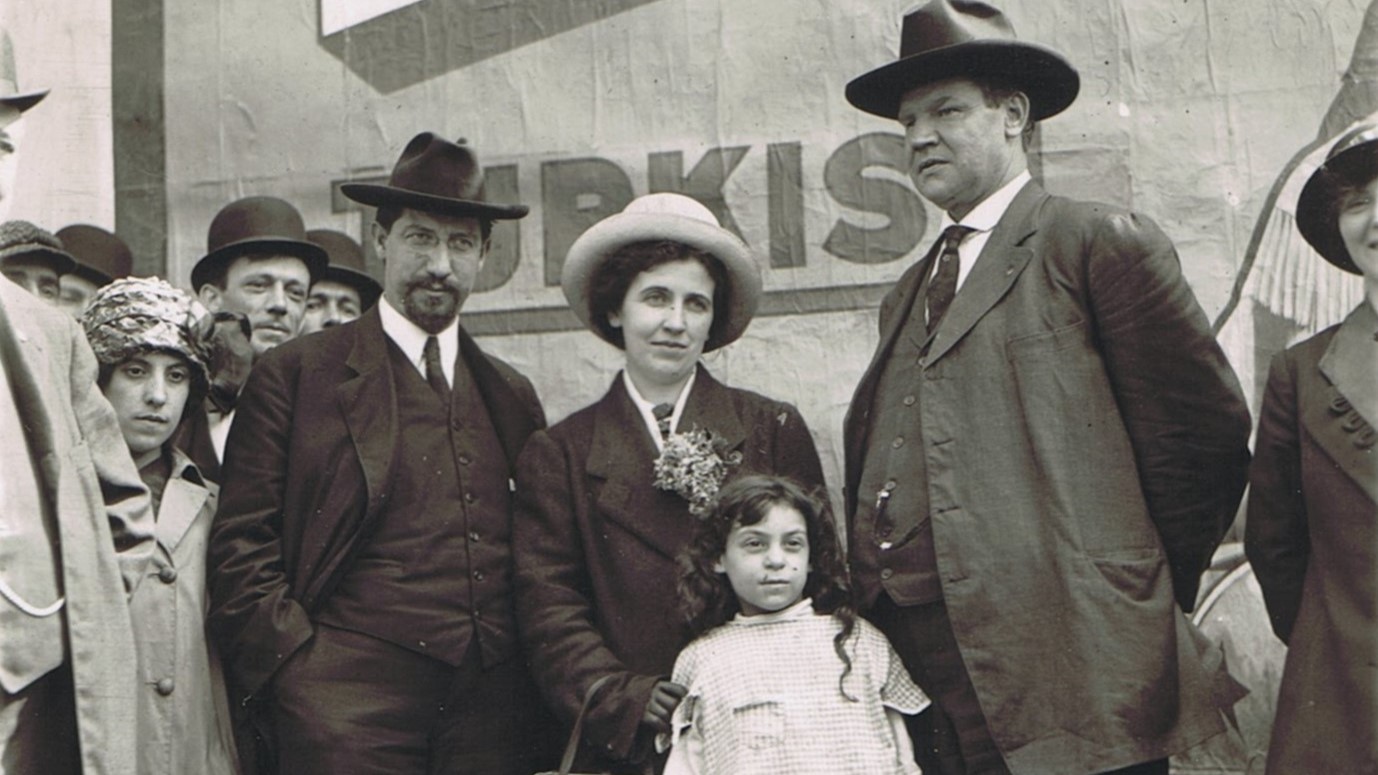
Those were days of epic struggles. We had several halls in Paterson proper: The Turnhalle, where the crowd was mostly Italian; the Helvetia Hall, with an overwhelming German attendance; we had many other halls; but our great gathering place was Haldon, New Jersey, which at that time had a socialist mayor. On Sundays, when due to the blue laws, no meetings could be held in the rest of New Jersey, we addressed between 30 and 40,000 workers from the roof of the Haldon city hall. It was into that crowd that Haywood threw himself with all the power of his unique individuality.
The number of persons involved in the strike, including strikers’ families, was no less than 125,000. All the strike relief collected for six months amounted to $72,000. The strike lasted from February to July, 1913. How could the strikers hold out? Through the power invoked in the masses by this huge, towering figure. He was not elegant. He was just one of the mass. He was immensely convinced of the righteousness of his cause; he had a deep feeling regarding the I.W.W. labor movement, and his place among the workers. He was a simple man with a simple purpose. He never harangued a crowd. He explained things in the simplest, most beautiful, imaginative words. It was remarkable that people like the Italians, who had a scant knowledge of English, understood his speeches. He had the unusual ability of reducing issues to their simplest realities, but these realities he knew how to present in a magically compelling way. Many speakers had talked to the workers about the necessity of holding together. Bill, however, would do this. He would lift over the crowd his huge, powerful hand. He would spread the fingers as far apart from each other as possible. He would seize one finger after the other with his other hand, saying to his audience: “Do you see that? Do you see that? Every finger by itself has no force. Now look.” He would then bring the fingers together, close them into a bulky, powerful fist, lift that fist in the face of the crowd, saying: “See that? That’s I.W.W.” The masses would go wild. Not the least factor in his successes was his physical vigor, the unusual amount of vitality that throbbed in every one of his gestures. One certainly could not repeat Bill’s demonstration with a puny fist.
Never in my life have I heard anybody giving in words an idea of the industrial society of tomorrow as Bill did in Paterson. The strikers were hungry, miserable, hounded by police, scared by the sufferings of the children and the aged. Still, for months they were living in an imaginative world, in a world of emancipated labor. This was Bill’s work. Other speakers would take up “high- brow“ topics like evolution, economic laws. Bill never dwelt on such things. He never lost much time in reading or getting his ideas of socialism from others. He received his inspiration from his own life of labor, and from the surrounding workers. He made Paterson strikers realize, not in thought but with all their being, that there is a world to gain. Somehow he managed to make them realize that the city hall is theirs, that the theatres and all the beautiful things will be theirs in due time, that there will be a brotherhood of men — free, careless, unbent human beings who dance, sing, create, work. The Commune of Paterson lived in the minds of the strikers, and this was Haywood’s work. He elevated them above the sordidness of their everyday life. He made them see the light of a new, beautiful society.
He was a proletarian by birth and choice. All workers of all nationalities and all trades, whether weaver, carpenter, miner, or ditch digger, were one family to him. It was through his influence that women and children were drawn as an active factor into the strike. I shall never forget the ripples of laughter that shook an audience of Italian women when he spoke to them on the strike. What was his topic? He was trying to make it clear to them that he eight hour working day was needed, not only for the men, but also for the women. He said in substance: “When a man works twelve hours, he comes home exhausted; he is morose; he gulps down his meal and soon is fast asleep. He has no strength to be a husband to his wife. The woman is suffering as well as the man.” That provoked mirth, but it struck home.
Bill wished to speak to the kids. We had never thought of that before. The meeting was organized with myself in charge of the hall. It was a big event. One hundred teachers came from New York, crowding the galleries in a desire to witness the unusual performance. Many local teachers were in attendance. When the doors of the hall swang open, there was a terrible rush. In no time 4 to 5,000 children, shouting “Solidarity forever,” and “Big Bill,” crowded every corner of the hall. First we called upon the children to make speeches. I remember one of them saying: “I ain’t going to school no more. Teacher says father is bad because he’s a striker.” The little fellow lifted his head, scanned the galleries, and pointing his finger to one of the teachers, exclaimed, “That’s her! She tells me my father is bad. I don’t like her.” This aroused the children to a frenzy. Cries of “Strike, strike” filled the hall. There seemed to be no way of quieting the young audience but to introduce Bill.
I can still see him standing on that platform, — before him a sea of children’s heads. The platform is crowded with children, some clinging to his huge legs, some hanging on to his coat, all of them looking up at him with adoration. All faces are lit up with ecstatic joy. Bill had no difficulty in speaking to children. He spoke to them with the very same simplicity with which he addressed adults. There was something of the child in his own makeup. He told the crowd a simple story of how he worked in his own childhood, and what he went through; he explained the meaning of the I.W.W. He held every child’s heart throbbing in his big hands. The following day the picket line was crowded with children who proved to be the most faithful fighters. Subsequently Mr. Bimpton, the Paterson Chief of Police, asked me whether I could not withdraw the kids from the picket line. “For God’s sake,” he said, “remove those kids from the field. My men can’t fight children.” Later we began to place the strikers’ children in the homes of workers’ families in surrounding cities. This too was Big Bill’s idea. He lived like one of the people. During the six months of the strike his salary was eighteen dollars a week. He was not only what you call a leader. He actually loved to spend time with the workers, to talk with their women and children. He went to supper with the strikers nearly every night.
Few knew that this hulking figure of a notorious fighter was kindness itself. His great craving was to possess a family, to be surrounded by little tots. He hated to stay alone in the evening. He begged me to take him somewhere, anywhere. He would sleep in the houses of Italians, Syrians, Irish, Poles, Letts. People were all brothers to him. Still, how he enjoyed those little Italian families full of genuine fondness, crowded with children, with numerous other possessions that give zest to life! How he would fondle the little ones, rocking them on his huge knees!
After six months in Paterson his health was completely shattered. Even Bill, with his powerful constitution, could not stand the strain. He had a trying stomach ailment which made him feel miserable. As soon as the strike was over, friends took him to Europe. It was not before a year that he completely recovered.
Bill Haywood was not only a picturesque fighter. He was the type of a practical idealist who never lost sight of the realities of life, while keeping a firm hold on the ultimate goal of the movement. He will live in the memory of the working class.
The New Masses was the continuation of Workers Monthly which began publishing in 1924 as a merger of the ‘Liberator’, the Trade Union Educational League magazine ‘Labor Herald’, and Friends of Soviet Russia’s monthly ‘Soviet Russia Pictorial’ as an explicitly Communist Party publication, but drawing in a wide range of contributors and sympathizers. In 1927 Workers Monthly ceased and The New Masses began. A major left cultural magazine of the late 1920s and early 1940s, the early editors of The New Masses included Hugo Gellert, John F. Sloan, Max Eastman, Mike Gold, and Joseph Freeman. Writers included William Carlos Williams, Theodore Dreiser, John Dos Passos, Upton Sinclair, Richard Wright, Ralph Ellison, Dorothy Parker, Dorothy Day, John Breecher, Langston Hughes, Eugene O’Neill, Rex Stout and Ernest Hemingway. Artists included Hugo Gellert, Stuart Davis, Boardman Robinson, Wanda Gag, William Gropper and Otto Soglow. Over time, the New Masses became narrower politically and the articles more commentary than comment. However, particularly in it first years, New Masses was the epitome of the era’s finest revolutionary cultural and artistic traditions.
PDF of full issue: https://www.marxists.org/history/usa/pubs/new-masses/1929/v04n09-feb-1929-New-Masses.pdf
 Revolution's Newsstand