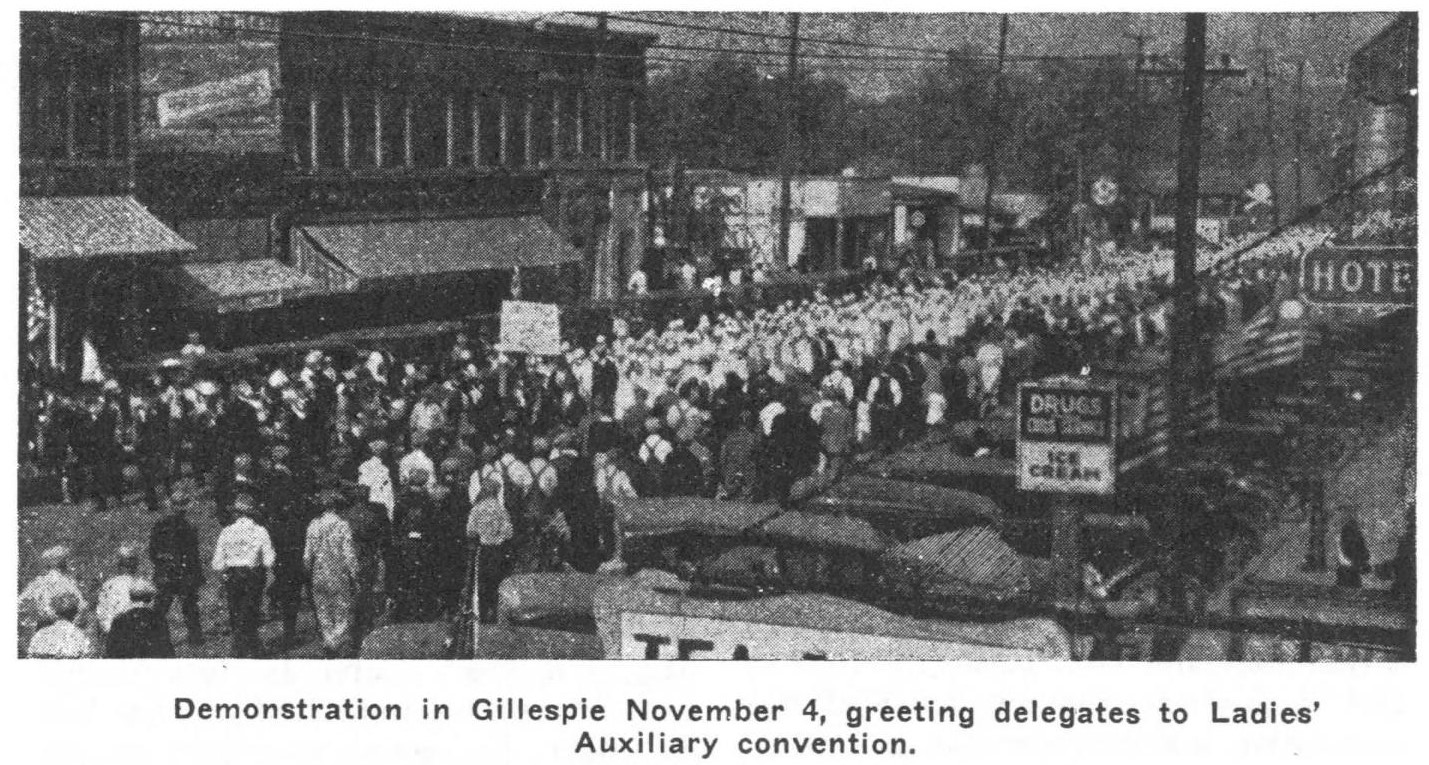
A still-inspiring report from the 1932 Women’s Auxiliary of the Progressive Miners of America gathering in Illinois.
‘Marching Women of Illinois’ by Jean E. Rosinos from Labor Age. Vol. 21 No. 11. November, 1932.
DOWN here in this little midwestern town of Gillespie, Illinois, in the heart of the soft coal industry, two great events in the history of the labor struggle have taken place within the short space of five weeks.
On the third of October, delegates to the first constitutional convention of the Progressive Miners of America met here, and in the midst of the depression and a seven months’ strike they laid the foundation of a new and honest union which will carry out the mandates of the rank and file.
On November second, as this is being written, the first constitutional convention of the Women’s Auxiliary of the Progressive Miners of America has met in Gillespie to lay down a definite program of concerted action which will, to a very great extent, determine the outcome of the present conflict and the future destiny of the miners.
Such enthusiasm! Their hearts yearning for the emancipation of their class, these wives and daughters, mothers and sisters of the coal miners of Illinois, have taken a real and courageous step toward the accomplishment of their goal.
You don’t see the silks and satins, furs and jewelry, or the pampered faces and figures of women of the leisure class; you see a gathering of women who have tasted the bitterness of poverty, and who know what it means to brave the guns of the company thugs and the bayonets and teargas of the military police.
They are dressed in white uniforms, with the initials of the Women’s Auxiliary of the P.M. of A. on their caps. They came in battered cars and trucks that have seen heavy duty on the picket lines in Christian and Franklin counties. In their faces you see the determination to carry on.
The fight has cost much in years past and these women know it will cost much in the future, perhaps for years yet. Tears come to their eyes as they listen to the accounts of the brutality of hired gunmen against the miners. They know what it means, gunmen hired by corrupt officials of a coal union, the mine bosses and politicians, but they are unaware that they are doing a heroic thing.
Magnificent and Inspiring
The whole thing is magnificent and inspiring. The mass of women gathered here today will be remembered as pioneers, and what they are doing will, in time, be a source of inspiration to working women and the wives and families of working men.
The first Auxiliary was organized in June in Franklin county under the name of the United Mine Workers of America. That was in the first heat of the miners’ struggle. The necessity for a new union, free from corruption, was later found to be the only recourse left the rank and file to fight for miners’ rights. The inspiration for the Auxiliary movement came from the wives and daughters of the miners of Indiana. Almost overnight numerous branches sprung up, the women going side by side with their men, feeding and encouraging the picket lines, and rein- forcing their ranks. They went in for a stupendous amount of relief work. They supervised soup-kitchens, collected clothing, operated relief stations and organized money-making affairs. All these activities, so necessary to the miners in their fight, have been under the supervision of the Auxiliaries.
Convention Opens
Today the delegates meet from all parts of Illinois where there are coal mines. One hundred and sixty delegates are here from 37 locals with a total membership of nearly five thousand. The convention had been called because they feel the need of a state- wide program of action in order to combine the full strength of all the Auxiliary units.
The convention opened in an unused theatre; William E. Brown, mayor of Gillespie, and a militant union leader, led off with a welcoming address. He asked the women to work out a program of action that would carry them shoulder to shoulder with their men in the battle for the new union. Songs were sung—
“When the union’s inspiration
Through the workers’ blood shall run—
There can be no power greater Anywhere beneath the sun.
Yet what force on earth is weaker Than the feeble strength of one;
But the union makes us strong!”
Barney Flaherty, veteran of the Virden riot and other labor struggles, then spoke — “pinch hitting’ for Claude Pearcy, temporary president of the P.M. of A., who was away on business.
“The sacrifices you women have made have given strength to the miners to make a good fight. Seeing your efforts, they would be ashamed not to do their best! It is the first time in history that husbands and wives and fathers and mothers and sweethearts have gone together to the picket line!
“With you with us,” he said, “we will not lose the victories we have already gained, even though we have arrayed against us the highway police, the militia, the sheriff and all his deputies!
“The constitution you write here today, as well as our own union constitution, will mean something not only to the mine families of Illinois, but to miners and their families everywhere, and to all workers, men and women.
“Capitalism is about dead,” Mr. Flaherty told the convention. “We all have our own ideas how its death is finally to be brought about.”
There was much cheering.
Then followed the main speaker, Mrs. Agnes Burns Wieck, of Belleville, Illinois.
We Must Fight On and On
“We, sisters, have got one fact to face—There is no peace for labor! We must fight on and on – because capitalism makes us fight.
“This movement is going to educate you and some morning you are going to wake up and wonder if it is really you. You are going to be radical. Do you know what radical means? I looked it up in the dictionary. Rad means root—radical means getting at the root of things. And that’s what we are going to do—get at the root of our troubles.
“Some day, women, we are going to be the ones to do the interviewing of presidents and governors.”
The speaker spoke of children. “Think of teaching children hygiene when you know they don’t have milk to drink! Teaching little boys the beauty of art when you know that they must go to work in the coal mines! The five years that I taught school now seem to me a mockery.
“I was a good teacher. I didn’t know any better. I taught my pupils the pledge of allegiance to the flag of the United States: ‘I pledge allegiance to the flag and to the republic for which t stands, one nation indivisible, with liberty and justice for all.’ And then one morning I read in the paper of the battle of Ludlow where women and children were shot by the soldiers and burned to death. Liberty and justice for all! Think of it!
“I vowed that I would never again teach the children to say the pledge of allegiance to the flag.
“Liberty and justice for all? Yes, when we get it, and that’s our job!
“If the new president, when he goes into office, doesn’t do something, and how can he? you will get more and more radicals as time goes on. It is our job to organize, to go into other fields and organize and to keep eternally at it.”
Speaking again in the afternoon Mrs. Wieck told about the brutality, cruelty and coercion used in Franklin county by the officials both of the old union and the county to keep the miners at work although they are “ninety per cent” with the Progressive movement and only await a chance to break from their bondage.
Women from Christian county told of the horrors of the rule of the military police. The people there, they said, must stay within doors and are warned even to keep out of their own yards, and are not allowed to go on the streets. They told how the soldiers prod them with bayonets when they are caught on the streets, and how they are teargassed. Women from Taylorville and Tovey told about the nastiness of the soldiers on the day that the annual memorial services were held in memory of Mother Jones.
It is no easy fight, the fight that the women in this convention are carrying on, and how Mother Jones, who never cared for women because she thought they wouldn’t fight—how she would be inspired by what these women are doing! These women have organized into a militant, aggressive association of miners’ wives, and bound in spirit, vow to go ahead shoulder to shoulder with the men folks in their struggles. No danger that there will be any laying down on the job. When their immediate purpose is accomplished they will go out and organize women in other fields.
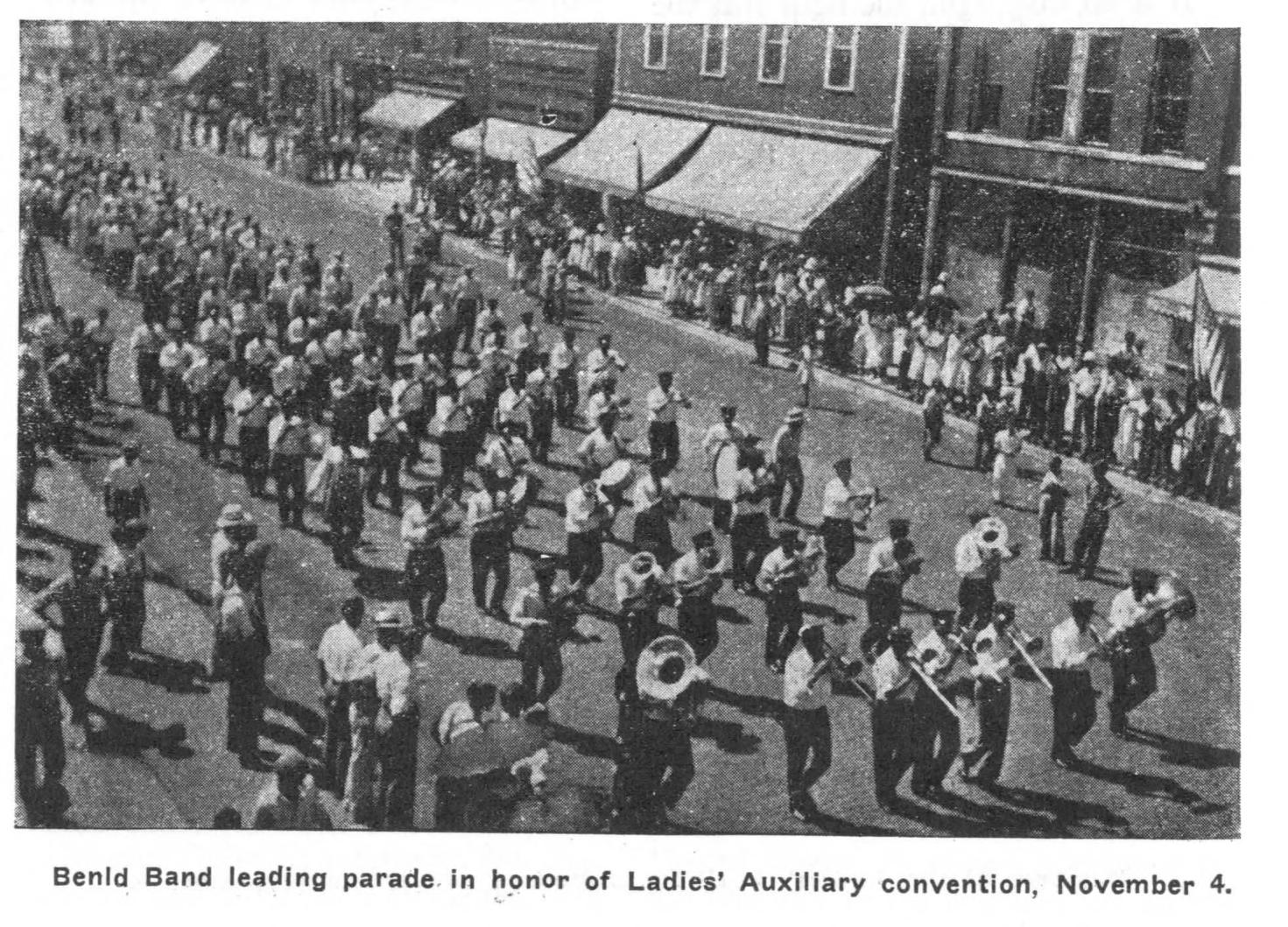
In some sections of the state victories have been won; more companies are signed up with the new union every day. The last one to sign up was the Superior Coal Company with mines in Gillespie employing about twenty- five hundred men. News of the signing of the contract came to the delegates in the early morning hours at a dance. Upon hearing the news, they rushed out, hastily arranged a parade, called the Wilsonville band, and marched through the business districts of the town at 3 o’clock in the morning.
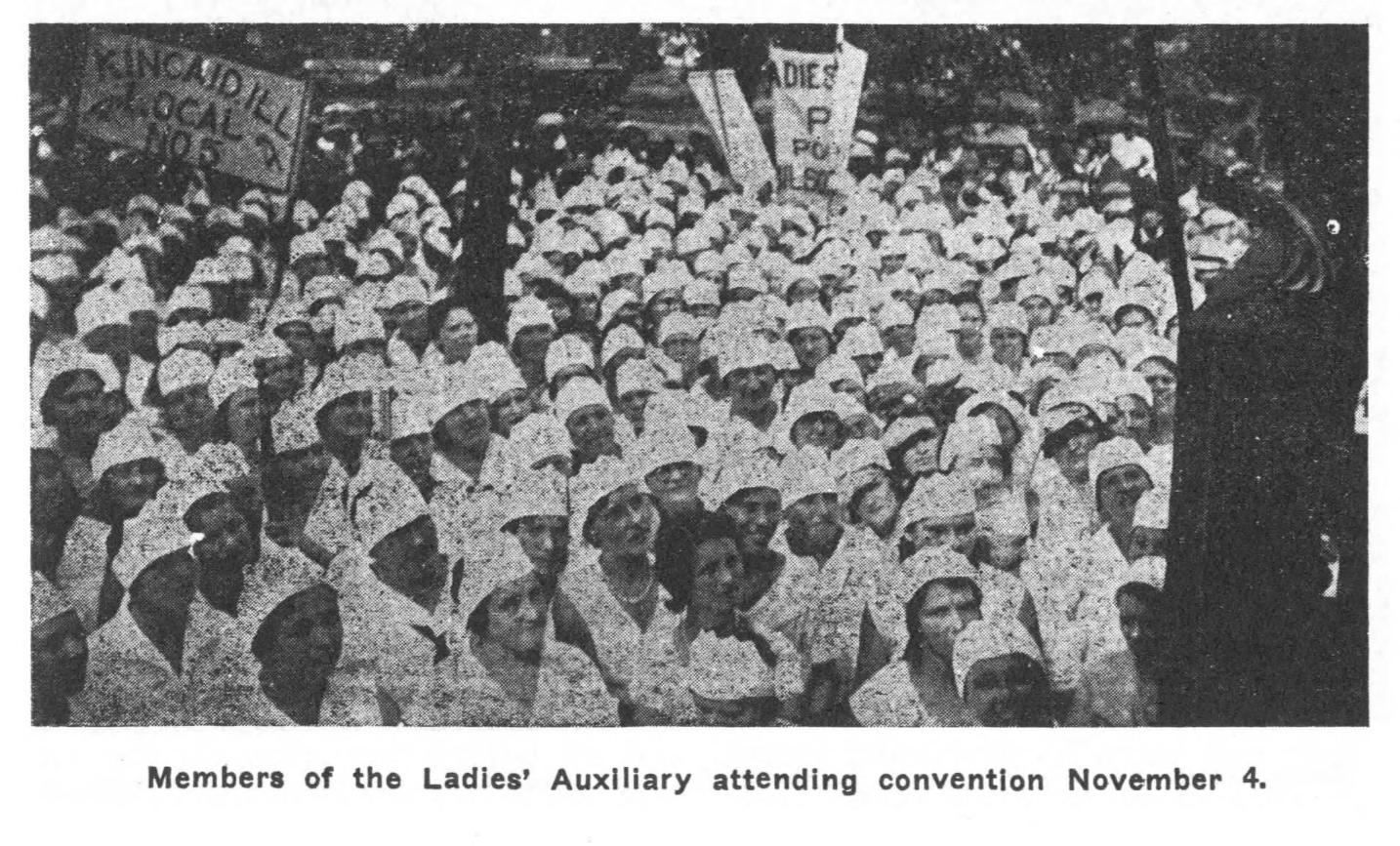
On the second day of the convention, resolutions and a constitution were submitted by committees. Gerry Allard, editor of the Progressive Miner, the official organ of the new union, spoke in the afternoon on educational methods to be used in furthering their program. A mass meeting and parade were planned at the conclusion of the third day. This was the third parade and mass meeting. Leading speakers of the new movement were present and talked to the assembly. Each meeting reinforced the spirit of the strike.
Was the convention a success? A great success! Genuine and real and wonderful. The women of the Auxiliary movement realized as never be- fore that they are all striving toward the same end, that one’s trouble is an- other’s, and that they all, women and men, must work side by side to solve the problems of the laboring class.’
Labor Age was a left-labor monthly magazine with origins in Socialist Review, journal of the Intercollegiate Socialist Society. Published by the Labor Publication Society from 1921-1933 aligned with the League for Industrial Democracy of left-wing trade unionists across industries. During 1929-33 the magazine was affiliated with the Conference for Progressive Labor Action (CPLA) led by A. J. Muste. James Maurer, Harry W. Laidler, and Louis Budenz were also writers. The orientation of the magazine was industrial unionism, planning, nationalization, and was illustrated with photos and cartoons. With its stress on worker education, social unionism and rank and file activism, it is one of the essential journals of the radical US labor socialist movement of its time.
PDF of full issue: https://www.marxists.org/history/usa/pubs/laborage/v21n11-nov-1932-labor-age.pdf
 Revolution's Newsstand