
Katayama on the traditional systems of prostitution in Japan as practiced under industrialization.
‘The Japanese Geisha Girls’ by Sen Katayama from International Socialist Review. Vol. 15 No. 2. August, 1915.
THE Japan of today is a snug home of modern capitalism. There is plenty of cheap labor and the population is increasing by about five or six hundred thousand every year. There are no factory or labor laws in the land that might protect the workers. Even a mere child, five or six years of age, can be put to work in a factory. They work in two shifts of 11 1⁄2 to 12 hours each, thus compelling girls to work in the spinning factories at night.
Girls in Japan are not only worked like mules in the mills, but are subjected to the most disgraceful life, I mean the brothel. There are approximately 200,000 legal prostitutes in Japan proper. Besides these there is probably the same number of geisha girls, who sing and dance in the restaurants. They are a sort of higher type of prostitute who serve the rich, entering their families as professional entertainers of guests. The only difference between the legal prostitute and the geisha girl is that the latter has freedom and independence in her way of living. However, a large number of them are owned by slave-holders, who buy and sell them only in the manner of gentlemen’s dealings. In each case it is done mostly after getting her consent and choice. While in the case of the former, it is entirely different. Every prostitute must be legally certified and she must be kept in a fixed quarter. She cannot get out without permission or a responsible guide from the quarter. Usually the quarter where these poor slaves are kept is surrounded by a wall and the gates are watched by the police. Moreover, legally instituted brothels are permitted to open up show windows where the girls stand in rows, human beings for sale.
For instance, Yoshiwara, that is the quarter of Tokyo, has been the infamous legal institution of prostitutes for centuries. There are several thousand slave girls in Yoshiwara who are kept like birds in cages. The public does not wonder at the institution as such, although many youths are corrupted on account of it. Yoshiwara is the biggest of the brothels in Japan and some of the finest buildings are there and an enormous amount of capital is invested by the rich and equally big profits are realized. In this respect Japan is no exception to the rule expounded by Bernard Shaw in his “Mrs. Warren’s Profession.” Only in Japan prostitution is more open and exploited than anywhere else. According to bourgeois morality it is virtuous for a girl to become a prostitute for the sake of her parents. When a new, nice-looking girl is bought and brought to the place, it is advertised in the best dailies that she became a public woman to help out the troubles of the poor mother or some such story that might get sympathy from the public. Quite a number of brothel keepers hunt out good-looking girls in some out-of-the-way country villages and make contracts with the parents of the girls, usually for three years. But once dragged into this life, there is hardly a chance of escape and they end their lives in misery and despair.
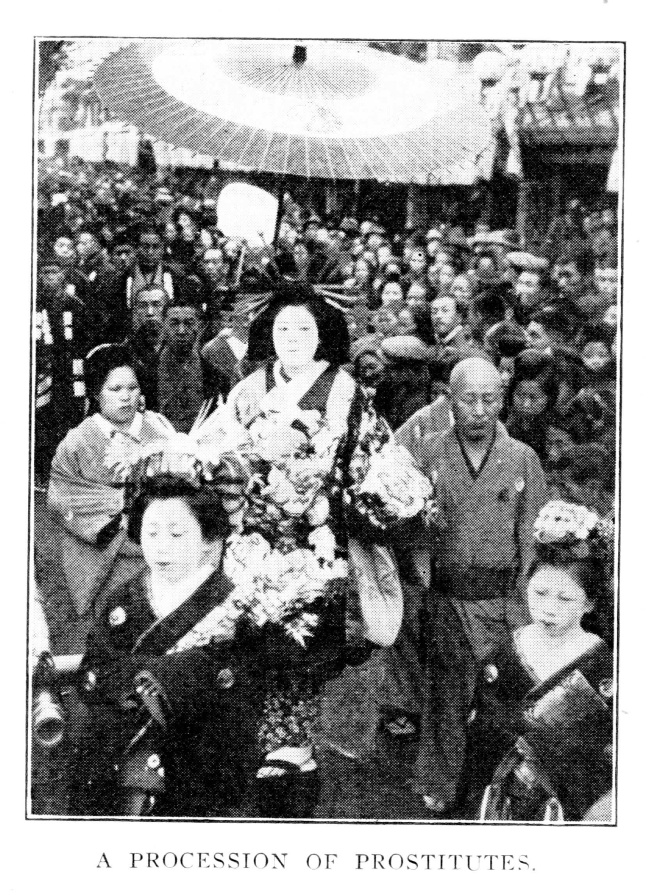
The brothel keepers at Yoshiwara advertise girls not only in newspapers, but also through some direct and striking means. The accompanying pictures are the advertisements gotten up this year, when the cherry trees were in bloom. The best looking prostitutes from the three principal brothels are attired in their prettiest dresses. Each puts on high crogs, some over a foot high, and go around the streets in a procession, as is shown in the pictures. The attire of each prostitute some times costs as much as several thousand yen. The show continues for a month or so on every day in fine weather. The onlookers crowd there each day and they are not only men, but also women and young girls of all classes, and the parade is talked of and advertised all over the country. This procession has now been going on for weeks and card stores are adorned with pictures of it.
Such is the state of things in Japan. The rich are financially interested in the legal institution of prostitution and the government gets taxes from the business. Every charity organization gets a rich contribution from the brothels, as do also the religious bodies. Even the Salvation Army, that was imported from England, is well Japanized by this time and is advocating only the reform of prostitutes and their manner of living. Thus, the time honored institution of prostitution, unhindered, serves as a means of money making for the rich. It is true that keeping a brothel is not an honorable profession in Japanese society, generally speaking, but it is an institution that is well supported by the people, especially by the rich capitalists.
Some two years ago the Yoshiwara was entirely destroyed by fire, leaving the prostitutes homeless. But soon bigger and better buildings were put up and the business is again flourishing.

Such is the ethics and customs of Japan, and held up as sound by the bourgeois public. No one questions its injustice and immorality. Only a few years ago it was legally established at the court that one cannot compel a girl to serve a creditor in person that is, the brothel keeper cannot keep her against her will and compel her to lead a life of shame, and any prostitute can leave this disgraceful life at her own choice. There were some who really left the business by the help of the Salvation Army, but it was only temporarily. Now, again, the prostitutes are kept like slaves and there is no means of escape from the evil life.
We have no statistics about prostitutes, showing how long they live, etc., but they are better taken care of by their masters or owners. They have medical examination often and are treated in a special hospital; so perhaps they are far better off than the spinning girls.
A few years ago the government investigated seven provinces which supply most of the spinning girls. In one year these seven provinces sent out 16,789 girls. Of these, 7,320 girls returned to their homes. Out of these, 938 girls went home on account of illness, 109 girls took sick after returning home, and 279 girls died after they returned, making a total of 1,326 girls. About a half of these are consumptives. One province, Niigata, sent 6,000 girls, and within three years about one-half of them returned to their homes on account of sickness.
Thus our poor girls are terribly exploited and, as I said above, there are no protective laws for women and children. This is the direct result of the Japanese bourgeois civilization and it must be destroyed at any cost.
The International Socialist Review (ISR) was published monthly in Chicago from 1900 until 1918 by Charles H. Kerr and critically loyal to the Socialist Party of America. It is one of the essential publications in U.S. left history. During the editorship of A.M. Simons it was largely theoretical and moderate. In 1908, Charles H. Kerr took over as editor with strong influence from Mary E Marcy. The magazine became the foremost proponent of the SP’s left wing growing to tens of thousands of subscribers. It remained revolutionary in outlook and anti-militarist during World War One. It liberally used photographs and images, with news, theory, arts and organizing in its pages. It articles, reports and essays are an invaluable record of the U.S. class struggle and the development of Marxism in the decades before the Soviet experience. It was closed down in government repression in 1918.
PDF of full issue: https://www.marxists.org/history/usa/pubs/isr/v15n02-aug-1914-ISR-riaz-ocr.pdf
 Revolution's Newsstand