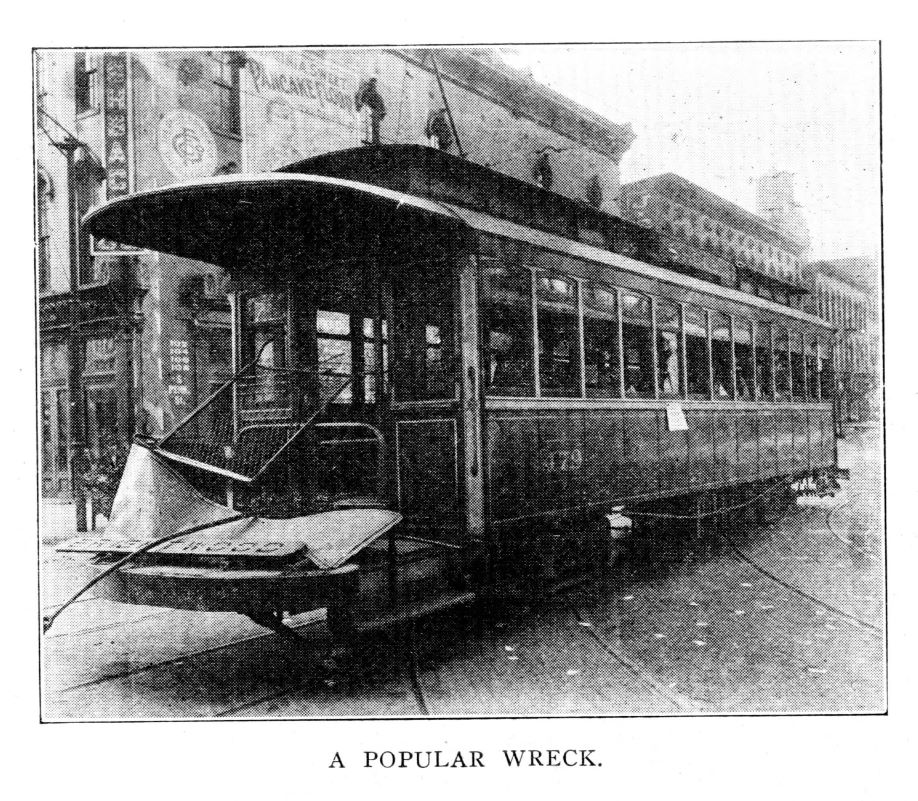
The street-car strike was a feature of the class struggle and reached hundreds of cities and towns, resulting in many deaths. An I.W.W. take on the strike in Indianapolis lasted a week, which saw intense conflict on that city’s streets; hundreds wounded and six dead.
‘Victorious Defeat’ by John Rhine from Solidarity. Vol. 4 No. 46. November 22, 1913.
(Special to Solidarity) Indianapolis, Ind. Napoleon, after a terrific battle, is attributed with saying, “Another victory and we are lost.”
This well applies to the tragedy that has been enacted in the city of Indianapolis during the last week, in the strike of the street car men, generaled by the Amalgamated Association of Street Railway Employes, affiliated with the A.F. of L. This strike should make the laboring world sit up and think. We skeptically look for the result of the “great victories” the A.F. of L. so much boasts of. We sometimes even question the validity of their struggles. It has long been argued that the A.F. of L. has lived its day; that it is no more adequate to deal with the labor problems of the day. Today the A.F. of L. is obsolete; all its victories are but the last convulsions of a dying body. The car men’s strike in Indianapolis proves the contention.
The story runs thus: After much wrangling on the part of the men with their employers, a strike was called. The attempt to organize the street car men was met by the company with professional sluggers, who were known as inspectors, beating men up unmercifully. Men were laid off for being suspected of having any connection with the union. Some were taken to the office of the company and made to swear that they were not members of the union. The climax came on Friday, October 31, when the men revolted and came out on strike. Saturday, 11 a.m., not a car was running.
Sympathizers had taken a hand in the matter; women boarded the cars run by non-union men and took them off. News of the strike spread like wildfire. Mobs of thousands thronged the streets, boarding the abandoned cars, putting them out of commission. Trolley ropes cut, and wires down, gave one the impression of a battlefield.
Saturday, strikers were busy formulating demands. Although the strike came unexpectedly the company had 300 scabs at hand in the barns. An attempt to run the cars with scabs failed, cars running off the tracks. During the day 137 arrests were made. Mobs attacked scabs, hurting some. Sluggers were arrested, charged with carrying concealed weapons, the car company bailing them out. All cars left on the streets were smashed. The day ended with rioting.
Sunday, the second day of the strike, a strikers’ mass meeting was held. Leaders order strikers to maintain order. Enthusiasm prevails. Sympathy of the general public runs high.
Everybody in the city is tagged with “I Will Walk” tag. The streets are jammed. Attempts to start cars causes mobs to attack them; inspectors (sluggers) hurt. Some cars on the streets were burning; police powerless to check the mob; 150 deputy sheriffs summoned, only 23 answer call.
Monday: Attempt to run cars; Supt. Hyland and majority of the street car company stoned by sympathizers. Arrests up to date, 187. Heavy bail placed upon men, exceeding the offense.
Tuesday: Police refuse to protect scabs; 28 officers offer to resign. Stranger shot by scab. Scabs fight among themselves; one killed.
Wednesday: Awful riot; 1 killed, 6 wounded, 2 police hurt.
Thursday: Eight more police turn in badges; positively refuse to ride cars with scabs. Public sentiment for the strikers. Governor calls out National Guard.
Friday: Troops are stationed in the State House. It is rumored that the National Guard will not act, being in sympathy with the strikers. 6 p.m., strike is over! Great rejoicing. Strike leaders claim victory; men going to work within 12 hours.
Saturday: Cars are all running. Men have returned to work: find scabs on duty. Some strikers leave cars again; are advised by leaders to go to work with scabs, and swallow all the abuse heaped upon them.
And so the farce is ended.
The newspapers are congratulating the men on their “victory.” But those who watched the battle closely look in vain for any semblance of a “victory.” Let us see wherein lies the victory they so boast of. The men came out demanding recognition of their union, better conditions of labor, and better pay. The company ignored their demands. Arbitration they asked for was ignored. And now, after a week of the most splendid show of solidarity on the part of the men, after paralyzing traffic, with all the chances in the world to whip their masters, they go back to work pending the decision of an “arbitration board” composed of bankers, lawyers and business men. And worst of all, this decision of the “State Public Service Commission” shall be binding for three years.
The recognition of the union, around which the fight centered, is not won. The company has the right to fire and hire whom it sees fit. It will not deal with the men as an organized body. Article 3 of the agreement states that the agreement shall be signed by a committee of employes, and under this arbitration scheme this said committee shall consist of Herbert Stewart, representing the United States government; Samuel M. Ralstone, governor of Indiana, and by the proper officials of the Traction and Terminal Company.
Where does the union come in at?
M.L. Clausen, attorney for labor unions, in a statement said: “We consider that a complete victory for labor has been won. It is the first big battle in the state where capital has been forced to bow to the will of the public and submit industrial grievances to arbitration.” Yes, the public was subject to discomfort, won or lost. The public will ride. But where is the will of labor? Yes, it might have been a victory, but as it is, is nothing more than throwing sand in the eyes of the men.
The street car company was whipped by the men. They had proven that through solidarity they can make their masters look up to them for their very existence. Just then comes in! the A. F. of L. with its obsolete methods and principles and turns the biggest victory into defeat.
The time is ripe for organization of the working class. Dissatisfaction is spreading everywhere. The workers are fast approaching a state where it is becoming desperate, and the only thing they need is to be shown that the only way to get out of their misery is to organize industrially and fight their masters to the bitter end and not wait for socialist politicians and labor leaders to lead them out of the wilderness.
From the socialist politician to the sky pilot, who like vultures follow the battlefield, these carrion crows in human form are ever ready to make capital out of human misery. Thus while war was on in Indianapolis, the streets resounded with the braying of the self-appointed “saviours.” Vote my ticket and solve the problem.
Some say we learn by mistakes. But it does not seem true with the A. F. of L. How many times will they go on with their “mistakes” until the workers will finally shake them off? Will the workers ever learn that they have nothing to arbitrate? Will they ever learn that they cannot save themselves through politicians and labor leaders? Will they ever learn to distinguish defeat from victory?
JOHN RHINE.
PDF of full issue: https://www.marxists.org/history/usa/pubs/solidarity-iww/1913/v04n46-w202-nov-22-1913-solidarity.pdf
 Revolution's Newsstand