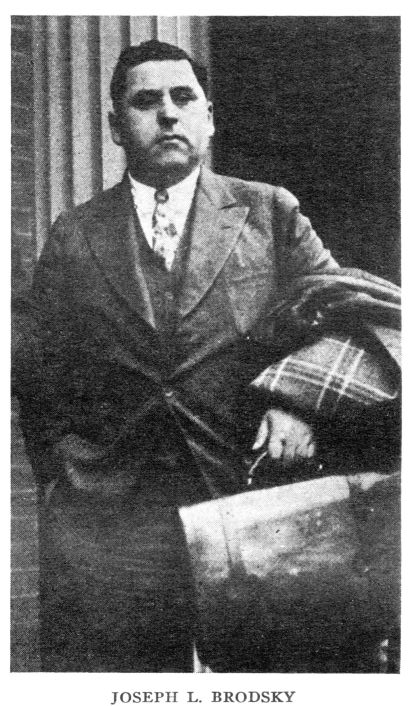
A valuable look at the history of deportation laws until 1929 from one who defended many under threat. Joseph Brodsky was among the leading civil rights attorneys of the 20th century; general council for the I.L.D. in the 1920s and 30s, he worked on many of the era’s most important political cases, and close to the Communist Party for two decades until his death in 1947.
‘Deportations—1929 Style’ by Joseph Brodsky from Labor Defender. Vol. 4 Nos. 5 & 6. May & June, 1929.
THE menacing shadows of rapidly approaching war–the inevitable sequel to a swiftly ripening imperialism–loom large upon the American scene.
War preparations are in full blast. Appropriations for military purposes increase by leaps and bounds. All the means of waging annihilating war–navy, army, aeroplanes, chemicals, coaling stations–are being increasingly strengthened and developed.
Ideological preparations are not being neglected. Compulsory military training in our colleges, reserve officers training camps, boy scout movements, jingoism, flag-waying, patriotism–all the mental dope necessary to be injected into the workers, who do the fighting and the dying, in order that they may unprotestingly goose-step into the trenches, is being dispensed daily through our schools, colleges, newspapers, radios, pulpits and lecture platforms.
Likewise harsh and repressive measures are being prepared and are already being put into effect against the class-conscious militant worker, who is arousing his fellow workers to the understanding that the coming imperialist war must be turned into a war against their capitalist exploiters.
The agencies of state power–judicial, legislative and executive–created to maintain the economic dominance of the capitalist class, are, through injunctions, frame-ups, criminal syndicalist statutes, stringent immigration laws, increasing police terror in strikes, active in threatening, browbeating, punishing and suppressing the ever growing militancy of the workers, who in larger numbers, in more diversified industries, and in wider spread sections of the country, are developing stronger resistance to the rationalization and war program of our capitalist overlords.
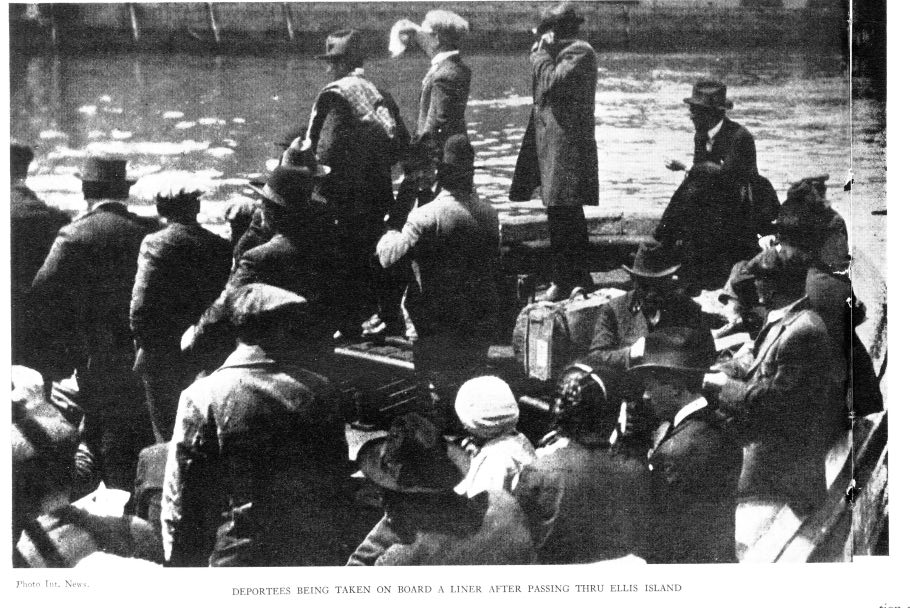
In this article I wish to enlarge on just one of the above mentioned methods of threat and terror being developed and used against the foreign-born worker who dares to struggle against his oppressors–the threat of deportation.
Prior to 1875 immigration into the United States was unrestricted. In that year Congress passed legislation forbidding entry of prostitutes and convicts, but expressly exempting political offenders from the operation of the statute.
In 1882 the Chinese Exclusion Laws were enacted, and in the next twenty years they were tightened and extended, until in 1904 the exclusion of Chinese was made permanent.
Up to 1903 the only persons, besides Chinamen, subject to exclusion, were alien defectives, prostitutes, criminals, public charges and those who violated the contract labor provisions of the law. In that year, using the assassination of President McKinley as an excuse, but in reality in order to threaten and hinder the slowly developing workers’ organizations, both industrial and political, which had come into existence in response to the pressure of a more rapidly developing capitalism, which had already had its first open militaristic conflict–the Spanish-American War in 1898–Congress passed a law excluding anarchists and persons advocating violent overthrow of government or assassination of public officials. The act also contained a provision against naturalization of anarchists and provided for their deportation within three years after entry, and set a two-year limitation of deportation for illegal entry into the country.
In 1917, the year of our entry into the World War, Congress passed an act which became the basis of our present deportation and exclusion policy and procedure.
This act increased the already existing restrictions, added illiterates to the excluded classes, and while it fixed three-year and five-year limitations for deportation of certain excluded aliens, it specifically excepted from the limitations politicals, and as to the latter, provided that they could be deported at any time, regardless of date of entry.
In 1918 a comprehensive law applying specifically to deportation of aliens for holding and expressing prohibited political doctrines was passed. In 1921 the first of the quota immigration acts was passed, to be followed by similar statutes in 1924, and in 1928 Congress adopted a stricter basis for quota entries; this last act has already been put into effect by proclamation of President Hoover.
In 1929 illegal entry, in addition to subjecting the alien to deportation, was made a criminal offense.
This process of stricter exclusion laws and speedier deportation of “undesirable aliens” was hastened during the same period by court decisions and administrative edict.
In 1888 the United States Supreme Court upheld the constitutionality of the exclusion laws.1 In 1891 the same court decided that final determination of whether an alien came within the provisions of the law could be left to the executive officers appointed to administer the law; jury trial of aliens charged with violation of the Act was thus excluded and denied.2
In 1892 the court held that the deportation laws do not violate the equal protection provision of the federal constitution.3
In 1903 the same court concluded that the provisions of the deportation and immigration act for the exclusion and deportation of anarchists did not violate the free speech and free press sections of our constitution.4
In 1923 came the finding that although the government must prove alienage in order to deport, silence of the alien was sufficient to establish alienage.5 The court found that the right of protection against self-incrimination–a right which is basic in our jurisprudence, and to which the meanest criminal is entitled–does not apply to deportation proceedings, the argument of the court being that it is not a criminal proceeding nor does it involve punishment of the alien. The fact that deportation inflicts the cruelest kind of punishment the breaking up of all relations of family and friendship, no matter of how many years standing; the forced return of the alien branded as a political outcast to his homeland, where black Fascism and white terrorism stand ready to seize upon him to jail or murder him–all this is not punishment in the opinion of the United States Supreme Court.
In 1924 that court announced that “mere error, even if it consists in finding an essential fact without adequate evidence, is not a denial of a process of law.”6 In the case in which this decision was made the court further decided that knowledge of the character of the proscribed literature could be inferred merely from the company he kept, regardless of the fact that it appeared conclusively that the alien could not read the literature the possession of which constituted the deportable offense.
In 1925 the United States District Court of New York did its bit by declaring that upon the alien rested the burden of proof to prove that he was not in the excluded classes, and again confirmed the decision that silence warranted deportation.7
The situation today, therefore, is as follows. Mere possession or expression of proscribed opinion or membership in or mere association with an organization whose doctrines are held to be violative of the law, subject the offending alien to deportation, regardless of date of entry. The alien can be compelled to testify against himself, because if he denies that he comes within the excluded classes his testimony may be disbelieved by the Secretary of Labor and deportation ordered; if he admits, then of course he will be deported; if he remains silent, his silence will be translated into an admission he will be deported.
Although he is the one accused, he must sustain the burden of proof to prove that he has not violated the law; he is not entitled to a jury trial, and in fact, is denied even the right of counsel at the preliminary hearing, which almost always determines the decision of whether he is to be deported or not; finally, the decision of the Secretary of Labor is final and will not be disturbed by the courts, regardless of the insufficiency or meagerness of the evidence.
Immigrants from foreign lands thought the much vaunted and advertised American rights of free press, free speech and free assemblage entitled them to freely utter their thoughts, to freely meet with their fellow workers, discuss their problems and organize to defend themselves against the damnable exploitation that condemns them to grinding poverty and starvation. They thought that the sweat and blood they have poured out in building up the textile industry, the steel industry, the mining industry, entitled them to speak. They are wrong. They are aliens. As such they are entitled to live here just so long as they are willing to slave submissively and humbly take the pittance offered by their bosses. They may stay here just as long as they are willing to starve and suffer in silence. Their cardinal crime is to be intelligent, class-conscious, militant.
But millions of foreign-born workers may say that this problem does not concern them. They have fooled the capitalist. They cannot be deported. They have become citizens of the United States, and as such are now entitled to the full protection of the law.
But they have underestimated the cunning, the trickery, the viciousness of capitalism.
Last month in the state of Pennsylvania, home of the mounted Cossacks, John Tapolcsanyi, a citizen of the United States of America had his citizenship cancelled.
Tapolcsanyi committed the crime of being intelligent; he had become class-conscious and was militant in the struggle against capitalism. Brutal exploitation had not succeeded in crushing him; he had used his brains for something more than a hat-rack, and so he had become dangerous to the exploiters.
The answer of the latter was swift and direct. Make him an alien and deport him.
The process whereby this was accomplished is enlightening. The government charged that he holds forbidden political and economic opinions; therefore it follows that he must have held them when he was naturalized; therefore the government is justified in cancelling his citizenship.
Now he is again an alien, and since the government has already found him guilty of holding proscribed opinions, the next inevitable step that will shortly follow will be deportation, and one can well imagine the welcome that Horthy will have ready for him when he is forcibly returned to Hungary labeled by Uncle Sam “dangerous, Red and Bolshevik.”
Millions of foreign-born workers have hugged to their bosoms their naturalization certificates, believing that these certificates guaranteed them against exile and deportation. While they were asleep, lulled into a false assurance that deportation of radicals and militant workers in the cause of labor was no concern of theirs, American fascism, which never sleeps, cunningly and covertly prepared to crush them.
No matter how long you live here, no matter how long you have been naturalized, so long as you are foreign born, deportation is a threat that hangs over you unless you submit silently and meekly to wage cuts, speed-ups, long hours and the rest of the brutal rationalization program now being forced upon the American working class.
The American foreign born workers must awake to this menace. They must recognize that the real enemy is capitalism, the common enemy of all workers, since it is the common exploiter of labor.
Only by joining together with their fellow workers, regardless of place, race, color or creed, can they generate that strength necessary to smash capitalism and build in its place a new system where the worker will receive the full fruits of his labor, so that he may enjoy the good things of life which only his labor creates and makes possible.
IGNATZ SIMICH was released from Illinois Penitentiary where he entered on December 15th, 1927 to serve a one to ten year sentence as the result of the Ziegler frame-up.
NOTES
1. Chinese Exclusion Laws, 130 U.S. 606.
2. Nishimura Ekiu v. U.S., 142 U.S. 651.
3. Fong Yue Ting v. U.S., 149 U.S. 704.
4. Turner v. Williams, 194 U.S. 279.
5. Bilokumsky v. Tod, 263 U.S. 149.
6. Tisi v. Tod. 264 U.S. 131.
7. U. S. ex rel Vajtauer v. Commissioner, U. S. District Court, Southern District of New York. April 20, 1925.
Labor Defender was published monthly from 1926 until 1937 by the International Labor Defense (ILD), a Workers Party of America, and later Communist Party-led, non-partisan defense organization founded by James Cannon and William Haywood while in Moscow, 1925 to support prisoners of the class war, victims of racism and imperialism, and the struggle against fascism. It included, poetry, letters from prisoners, and was heavily illustrated with photos, images, and cartoons. Labor Defender was the central organ of the Scottsboro and Sacco and Vanzetti defense campaigns. Editors included T. J. O’ Flaherty, Max Shactman, Karl Reeve, J. Louis Engdahl, William L. Patterson, Sasha Small, and Sender Garlin.
PDF of full issue: https://www.marxists.org/history/usa/pubs/labordefender/1929/v04n05-may-1929-LD.pdf
 Revolution's Newsstand