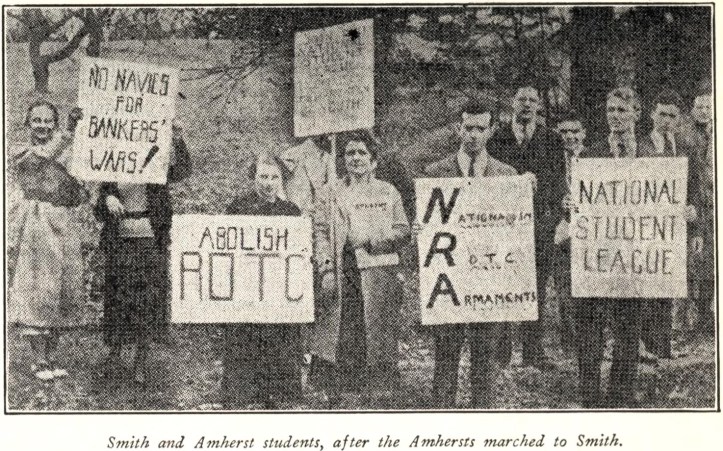
Issues confronting the second National Student League convention. Emerging from the 1931 free speech struggle at City College of New York, the N.S.L. was founded in early 1932 during a rising student movement. The N.S.L. would be the main C.P.-led student organization through the early 1930s.
‘Building a Student Movement’ by Donald Henderson from Student Review (N.S.L.). Vol. 2 No. 3. December, 1932.
On the Second National Student League Convention
On the 30th and 31st of this month the National Student League will meet at Chicago for its Second National Convention. In reality, this Convention will be the first truly national convention of the League. Here will be gathered representatives from high schools, colleges, art schools, music schools, etc., from every section of the country and from Canada and the Latin-American countries to discuss the problems and tasks of an organization national and even international in scope. The First National Convention of the League which took place last March during the Easter vacations, though it laid the basis for the building of a national movement, was the deliberations of an organization at that time largely confined to New York City.
Exactly one year ago, there crystallized in New York City a vigorous and militant student organization known as the New York Student League; a program, differing little from the present N.S.L. program, was adopted and published by this group during the Christmas vacation. During January and February, this Student League established contacts and cooperating groups in about twenty colleges outside of New York; in this connection the publication of the Student Review and its widespread welcome among students was of major importance. During March a call was sent out for the convening of a national convention to adopt a program and to lay the basis for a national revolutionary student movement. In brief outline, this is the origin of the present National Student League.
During the succeeding nine months, the League has grown to an organization with members and groups in approximately 200 colleges, universities, high schools, etc., located in every section of the country. From an organization limited to college students, it has established a rapidly growing High School Section of the League. It has branched out into music, art, and normal schools. And during the last month steps have been taken to organize the large numbers of unemployed students who have recently graduated or who have been forced out of college by economic conditions.
On the international field, the National Student League has established working connections with the revolutionary student movements and organizations in all the major countries of the world. It assisted in the holding of the International Student Congress at Amsterdam, Holland this summer and is the United States Section of the Revolutionary International of Students established there. In particular, the National Student League has concentrated successfully on the task of establishing connections with the revolutionary student movements in the Latin-Americas; several of these representatives will be present at the Second Convention. Its program and activities have been of direct and material assistance in the formation of similar student organizations in Canada and in England.
The phenomenal growth of the N.S.L. since March, 1932 (less than nine months ago) is one of the factors which lends such importance and interest to the coming Second Convention in December. A truly national and international reflection of this movement will be possible at this Convention. A more adequate discussion of the problems and activities facing us should be held, and a more truly national crystallization, both organizationally and ideologically, of the policies and activities which we must pursue needs to be accomplished. There exists, partly as a result of this rapid growth, a serious discrepancy between our ideological influence and our organizational strength. Thousands of students accept the program and follow the policies and leadership of the N.S.L. and yet remain outside organizationally. On the other hand, and equally important, within the N.S.L. there are a great many groups who, while part of the League, continue to act on their campuses as isolated groups; these groups follow much the same sort of policies and activities as they did before affiliation with us. The desirability and necessity of direct personal contact and guidance with these groups to establish closer bonds of loyalty and action and to reach a clearer understanding of the meaning of the revolutionary student movement is one of the main objectives of the Convention.
The danger of war has increased and actual warfare is going on in many places; the more open militarization of the campuses and the training of the student body for war have made a more adequate statement and program of activities for the struggle against war necessary. In this connection, the holding of the National Student Congress Against War in Chicago during the Christmas vacations, called to formulate a common basis for action by all student groups, puts new problems and new opportunities up to the League. We must realize that the program adopted there will not necessarily be a 100% N.S.L. program. At best it will be one which we can and will support on the basis of a minimum program of demands for immediate action by all students.
Connected with the economic changes, both on and off the campus, there has developed among graduate and professional students, as well as among undergraduates, a much wider recognition of the hopelessness of their condition. This has resulted in an increased “radicalization” of the student body and a pronounced leftward swing in their ideologies and actions. The student press on the campuses reflects this in the much greater amount of space devoted to student problems and difficulties. As yet, however, the vast majority of these students see little or no connection between the work of the N.S.L., its program, and its activities and the solution of their problems. They still look to the college administrations, the Boards of Higher Education, and the ingenuity of the individual to solve their difficulties. This condition makes imperative and pertinent a much wider use of the tactics of the “united front” in getting these students into action. The N.S.L. membership has shown during the last year a totally inadequate understanding of these methods. The discussions at the Convention must make a start in clearing this up and the revised program should state clearly the methods of dealing with this problem,
Related to this condition among the students, there are two very important developments facing us. Recognizing this leftward swing among the students, the Socialist Party and the L.I.D. in particular have intensified their work on the campuses during the last year in order to establish their leadership. Using the popularity of Norman Thomas among the students, Thomas-for-President Clubs were established throughout the country; the middle-class reformistic aspects of the Socialist program were played up; and widespread support was gained during the campaign. At present, energetic work is being carried on to transform this support into L.I.D. and Socialist Clubs. A second development, no less important, centers around the increased activities of the administrations themselves to retain the position of official leaders and spokesmen for the student bodies of their respective colleges. Speeches and conferences by administration heads and by faculties adopting fine resolutions regarding the necessity of educational reform, regarding opposition to ‘economy programs’, superficial activities for the relief of suffering students, have become extremely common. Active cooperation in energizing official faculty-student governments, which remain thoroughly under respectable control, is played up. A clear understanding of both of these developments and the methods by which they are to be handled and clarified to the student body must be achieved by the Convention.
There is another important condition which must be taken into account at our Convention in dealing with the tasks of the N.S.L. We have had nine months of active experience in building a revolutionary student movement. Essentially, the growth of our movement has been the result of our success in carrying on activities. Substantial achievements have been accomplished and many weaknesses have been revealed as a result. We must turn to this activity, this nine months of experience, to discover the causes of our weaknesses, and in the light of this critical evaluation we must revise our program and policies, ideologically and organizationally.
Ours is not a static approach or program. Charges in the objective situation with which we have dealt and in the relative strength of our movement must be constantly reflected in our policies. And on the basis of our past history. We must attain a clearer understanding of how to grapple with the immediate phases of development ahead of us.
Finally there is a basic necessity for achieving among N.S.L. members a better understanding of the meaning and tactics of revolutionary student action. This problem cannot be solved by merely setting up Marx-Lenin study circles. We have many students of Marx and Lenin, but we have few actual working revolutionists. This weakness is at the root of many of our mistakes and many of our difficulties.
Most N.S.L. members still regard the activities conducted off the campus in direct support of working class issues as the revolutionary side of their work while they look at those activities conducted on the campus around student issues as the student side. The result of this is that the so-called revolutionary activities of the N.S.L. lead to sectarianism and isolation from the student body, the production of a small group of “professional” radicals with no mass support or understanding. At the same time it leads to the carrying on of the so-called student activities along the old reformistic and liberal lines. Opportunism, academism, and reformism on the student issues; sectarianism and leftism on the working class issues. The greatest danger to our movement is the first; our greatest obstacle, the second.
In reality the relationship is dialectical and the issues are one. The student issues in school are the reflections on the campus and in the educational system of the class struggles and forces at present in society. In the war preparations on the campus, in the jingoism in the class room, in the worsening economic conditions facing the student, in the increased restrictive role played by administrations, in the progressive decay in educational content and method, and in many other ways, the world of class and social forces reveals itself on the campus. The problem facing the revolutionary student is the carrying out of activities on these concrete immediate conditions facing the student in the light of our revolutionary class analysis.
Students are not factory workers and the attempt to educate, arouse and organize students on the basis of factory issues and conditions as the immediate starting points of activity can only result at best in “taking a few slumming” and leaving the mass, which is ready material under present conditions for the reformers and liberals untouched. This does not mean that the students cannot and should not assist the revolutionary working class. On the contrary, it is precisely because these immediate conditions now facing wider numbers of the students, and more fully facing them after they graduate, are integrally connected with the conditions facing the worker, that their interests lie with the revolutionary working class. The problem is to make this clear to the student. Activities conducted on these issues lead the student up against the same basic forces and conditions facing the worker in his struggles and, in action, reveal the true nature of these forces and class alignments. And on this basis, a wider and truly revolutionary support for the revolutionary working class solution of these problems by students can be achieved.
Basically, the needed clarification on the theory and tactic of revolutionary student action can only be achieved through the actual carrying on of these concrete struggles. The Convention must, however, provide a basis for creating this understanding in its treatment of our problems and our policies; and it must take steps to provide organizational channels for constant guidance in our future activities.
In the light of these conditions, the Second Convention of the National Student League will approach its problems. The calling of the Convention during the Christmas vacations should make it possible for maximum student representation. The holding of the Convention in Chicago, Ill. in addition should facilitate the removal of a past New York City orientation in program and in organization. The basis of representation to the Convention is sufficiently broad to prevent “leadership from above.” Every N.S.L. group on each campus or in each school is entitled to one delegate for each ten members or fraction thereof. In addition, the National Executive Committee of the League extends an invitation to all other student organizations and clubs to send fraternal delegates to the Convention. These credentials for the Convention may be obtained from the National Office of the League at 13 West 17th St., New York City.
 Revolution's Newsstand