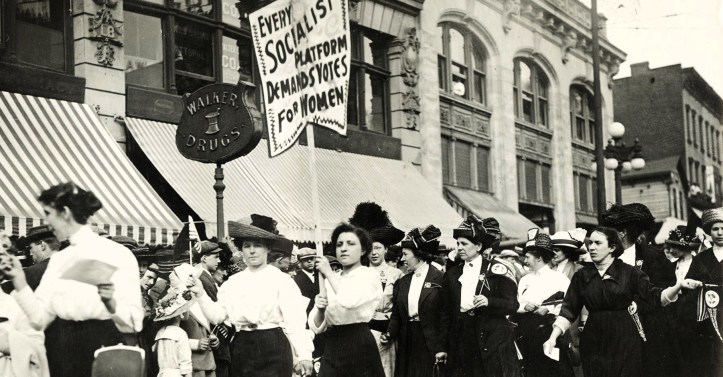
Theresa Malkiel reports from the Fourth National Congress of the Socialist Party held in Chicago in May 1910. Women delegates included Lena Morrow Lewis, Mila Tupper Maynard, Ella Reeve Bloor, Caroline A. Lowe, Kate Richards O’Hare, Harriet D’Orsay, Esther Laukki, Theresa Malkiel, Marguerite Prevey, Winnie E. Branstetter, and E.D. Cory.
‘Woman and the National Socialist Congress’ by Theresa Malkiel from The Chicago Daily Socialist. Vol. 4 No. 185. May 31, 1910.
Woman has of late become a part of our industrial life, taking her place side by side with her unfortunate brothers and, like them, gaining from day to day a livelihood at times insufficient to keep body and soul together. By leaps and bounds the woman question has taken hold of every intelligent mind. But, though all of us have long recognized the reality of woman’s ever growing influx into the economic field, though many of us desired to help woman alleviate her distress and better her condition, it fell to the lot of the delegates to the National Socialist Congress to make a move in that direction.
The above-mentioned delegated body was brought face to face with the necessity of treating the woman question not as a jest, nor an inevitable evil, but as a phase of the economic movement. And in all honor to our Socialist comrades — they were big enough for the occasion.
Every true Socialist believes in and hopes for the equality of the sexes, but at the present moment only few are fortunate to witness the actual working of their professed ideas, the perfect harmony, the blending of thoughts, the free expression of one’s convictions, which we all hope will in the future society constitute the true relation between man and woman. As an eyewitness I am glad to say that the pleasure of such spectacle fell to the lot of all those present at the National Socialist Congress.
If the skeptics and opponents of woman’s enfranchisement had taken the journey to Chicago during the week ending May 21, and had then gone to the trouble of witnessing the inspiring gathering of Socialists from every part of the country, a great deal would have been accomplished towards dispelling their longfostered, ill-warranted prejudice that woman could not and would not take her place alongside of man, deliberating freely and intelligently on all questions concerning the welfare of the human race.
The women delegates took their palace son the floor of the congress not as representatives of their sex, nor as privileged beings who are to be given special consideration, humored, and therefore treated with an air of chivalry and condescension, but as good, able representatives of the fighting proletariat.
Theirs was not a gift of mercy, but an unwavering trust placed upon them and their male co-delegates by the membership of their respective organizations. Hitherto in the race struggle for development, the issue had always depended on the masculine half of humanity; but at this last congress the feminine half also asserted its rights.
The hundred men delegates accepted their sisters at par value and not for a single moment during the seven days of continual session did they change their views or actions on that subject.
From the very first day the women were continually elected to serve on some of the most important committees. These honors were accorded to them, however, not as a courtesy, but on account of their wonderful ability and sound judgment displayed during the various discussions covering numerous topics on every phase of our political-economic activity.
Having come to the Congress in order to act as the mouthpiece of the bodies who had sent them there, our women comrades were prepared to take up the cudgels against all obstacles in their way. Like true daughters of the soil, the Western women argued in favor of the farmers’ platform, upholding their demands with facts.
When our esteemed comrade, Kate Richards O’Hare, said to the delegates assembled: “I’ve been born and brought up on a ranch and know the needs of my people as well as any mother’s 2 son living,” she immediately strengthened her words by facts that made many a man sit up and listen.
The woman from the Coast spoke on the immigration problem and the exclusion laws according to the sentiment prevailing in that part of the country, and she, too, was well versed in discussing, without being swayed by her womanly sentiment or the general tone of the assembly.
Our little Finnish sister fought like a tigress for the existence and welfare for the foreign organization, while all the others had a goodly share in the general activity of the delegation. But only when the propaganda of Socialism among women came up for discussion did our brave sisters show their real power for thought. For two full sessions they went into every detail of the work on that line of activity, fully determined to help their Socialist brothers to be the first torchbearers of a new society where sex impediments would not stand i the way of any human being. And even greater than my pride in my sisters was my joy at the interest with which our men comrades participated in this discussion.
Every man present recognized the disadvantages the working woman was doomed to find herself in as long as she remained a political nonentity, and all like one displayed a spirit of revolt against this unjust deprivation. Their determination to work for woman’s enfranchisement was at once self-evident.
But, eager as they were to see woman as equal member in our body politic, they were even more anxious of enlisting her as an active member into the great army of our fighting proletariat.
The cause of the lengthy discussion was nothing more or less than an earnest desire to find the easiest path through which the downtrodden and suffering woman would be reached. The conclusion they have come to, after the long discussion, was that for the present at least, since neither sex has as yet freed itself from the peculiar viewpoint towards the other, it would be futile to try and reach both by one and the same method.
Hence the decision of the congress to place the Woman’s Committee on the same basis of election as the National Executive Committee; give it greater autonomy than heretofore, pay out of the party treasury funds necessary for the special propaganda among women; create a special Woman’s Department with a paid secretary at the national headquarters and recommend to each state to start a vigorous campaign for the purpose of enlisting women in our ranks. With one strong effort our wise comrades have torn asunder the chains of dependence, the universal prejudice, so old and deeply rooted was for once cast aside and our comrades of both sexes met on an equal place. Let us hope that this example of a peaceful, intelligent mingling of the sexes will serve as a guide for the future.
A member from a state that had not as yet emancipated itself so far as to send women delegates to our national congress, I remained most of the time a silent witness of the earnest, instructive proceedings, hopeful, nevertheless, that the splendid work accomplished will cause the membership of my state to look upon woman as a legitimate participant in the politico-economic struggle and not as a pure and simple sex being.
The last congress has done a great service to woman, and she will undoubtedly take the opportunity to turn this gift of grace not only to her own achievement, but the annihilation of suffering among mankind in general.
The Chicago Socialist, sometimes daily sometimes weekly, was published from 1902 until 1912 as the paper of the Chicago Socialist Party. The roots of the paper lie with Workers Call, published from 1899 as a Socialist Labor Party publication, becoming a voice of the Springfield Social Democratic Party after splitting with De Leon in July, 1901. It became the Chicago Socialist Party paper with the SDP’s adherence and changed its name to the Chicago Socialist in March, 1902. In 1906 it became a daily and published until 1912 by Local Cook County of the Socialist Party and was edited by A.M. Simons if the International Socialist Review. A cornucopia of historical information on the Chicago workers movements lies within its pages.
PDF of full issue: https://www.marxists.org/history/usa/pubs/chicago-daily-socialist/1910/100531-chicagodailysocialist-v04n185.pdf
 Revolution's Newsstand