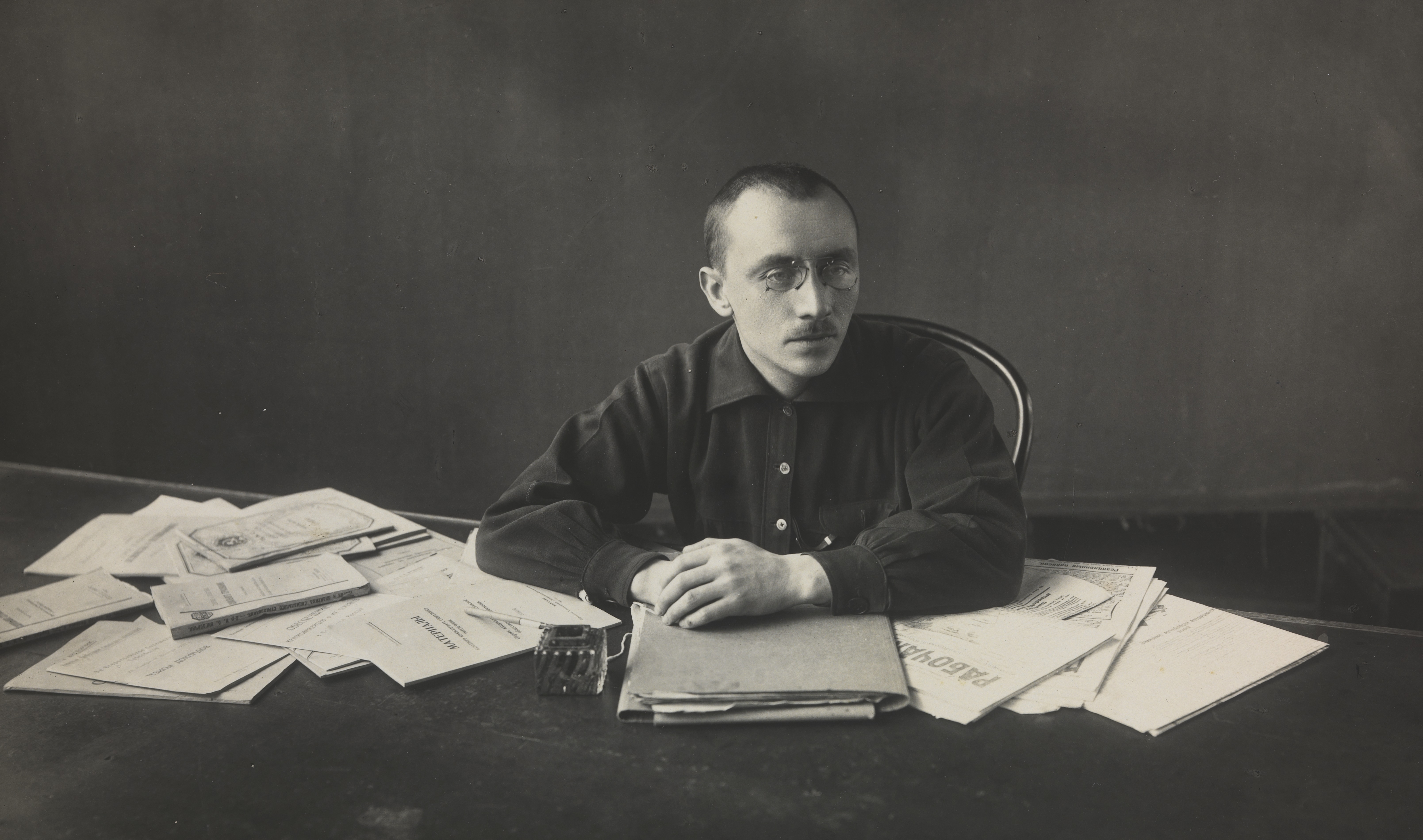
How the economy was organized and planned at the state level in the early Soviet experience. Nikolay Milyutin was a Bolshevik trade unionist, architect, and soldier who, literally, stormed the Winter Palace in October, 1917. After the revolution he was engaged almost entirely in planning and economy, being the Commissar for Finances for much of the 1920s, a city planner during the Five Year Plans and then as an academic of architecture. A member of the S.C.N.E. when he wrote this as Commissar of Social Security.
‘The Organization of Production in Soviet Russia’ by V. Milioutin from International Press Correspondence. Vol. 2 No. 87. October 10, 1922.
Its general principles–Its condition in 1920–The Supreme Council of National Economy–The Provincial Councils.
The economic administration of Soviet Russia is based upon two principles: 1. The direct participation of the broad masses of workers and their unions in the management of production; 2. The Socialist centralization of production, co-existent with the exercise of the broadest powers of initiative by the local industrial administrations.
From the beginning of the Revolution, from the time when the factory and shop committees formed, to be followed by unions embracing as early as 1920, 6,500,000 members, the Russian workers have taken a most energetic part in the organization of production.
The All-Russian Congress of the Supreme Council of National Economy decided in 1920 that “the organization of production must rest essentially upon the unions…” The most important questions of political economy are determined by the Supreme Council of National Economy in conjunction with the Bureau of the Central Council of Trade Unions. The actual operation of industrial enterprises in every instance controlled by the unions.
Their administration and direction, however, belong exclusively to the organs of the Supreme Council of National Economy. The representatives of the trade unions in the colleges of industrial centers are subordinate to the S.C. of N.E.
In case of a conflict between the S.C. of N.E. and the Central Council of Trade Unions the question is put before a joint general assembly of the two organs which gives the final decision.
These regulations are not derived from theory; they are the result of long, daily experience. All the members of the S.C. of N.E. as well as almost all the responsible workers, are moreover, appointed with the approval of the Central Council of Trade Unions. The most important positions in the direction of industry are assigned to persons judged the most capable both by the trade union organizations and the Soviet organs.
Finally, the central and local economic organs convene conferences of labor delegates chosen by shop and factory for the purpose of studying questions relating to work and production.
In this way the working masses of Russia are directly interested even in the functioning of production. In the future as in the past our political economy will aim to arouse in each worker an understanding of the importance of his task. We attach special importance to this characteristic of our plan of production as one to be broadly realized and appreciated; our goal, in one word, is conscious production.
Let us now pass to the management of production regarded as a whole. We will remark, first of all, that it is inaccurate to say, as has been done only, too often, that the Soviets proceeded. chaotically to hasty and to general nationalization.
By July of 1920 all productive establishments, large and middle-sized, had been nationalized; 4,5000 (approximately) small enterprises remained un-nationalized.
Of the 6,000 enterprises, 2,910 were directed by the Supreme Council of National Economy and about 3,500 by the local (provincial) Economic Councils. The S.C. of N.E. had the right to regulate production in those enterprises belonging to the second category; the distribution of the products of their labor cannot take place without its assent. The first category of enterprises nationalized were by far the most important.
In a general way the nationalized enterprises appear as follows:
By the force of circumstances we have been led to trustify the enterprises and to concentrate production in those best supplied with tools. In July 1920 we had 179 state trusts. Certain industries are completely trustified.
The most important trusts are: machine construction (16 large factories), electricity, textile (40 establishments), sugar refining.
All the branches of industry constitute with us an entirety, a united whole. For capitalistic competition the Soviet Power substitutes a unified plan of national economy.
This unity is also carried over to the relations between agriculture and industry.
A unified system of national economy, rationally centralized, organized by the organs of the Soviet Government, in the functioning of which the large masses of workers directly participate, this is the basis of our production.
According to the Soviet Constitution the S.C. of N.E., an institution equal to the People’s Commissariats, constitutes, as all the Commissariats, a section of the All-Russian Soviet Executive Committee. The president and vice-president of the S.C.N.E., appointed by the Executive Committee, belong to the Sovnarkom, or Council of People’s Commissars.
The S.C.N.E. is responsible to the Sovnarkom, which can annul its decisions, and to the All-Russian Soviet Executive Committee.
At the head of the S.C.N.E. is found a committee of 21 members appointed by the Sovnarkom upon the recommendation of the Congress of the S.C.N.E. and the Central Trade Union Committee. The composition of the Committee is revised each year; partial changes can be made at any time.
The Central organization of the S.C.N.E. is divided into three groups:
I. The Bureau has five sections with the aid of which it elaborates the general plan of production for the year and directs its execution. These are:
1. The Production Commission which studies the programs of production of the various industries.
2. The financial-economic section which studies the estmates of outlay and the budgets of the central and local economic organs, and subsidizes them.
3. The Utilization Commission which formulates the plan of the distribution of products (this commission includes a representative from the Provisioning Department).
4. The section of industrial statistics.
5. The Unity Section which maintains contact with the provincial Councils of Economy.
II. The industrial sections, 50 in number, corresponding to the branches of industry. At the head of each of them stands a director or a Committee of from three to five persons appointed by the S.C.N.E. with the approval of the Central Committee of the Union concerned. The social composition of these industrial sections was as follows in July 1920: workers 30 %, specialists (technicians, engineers) 35 to 40 %; various callings (accountants, clerks) 25 to 30 %. To recruit this staff for the direction of industry has been particularly difficult, most of the qualified specialists belonging to the bourgeoisie.
III. Each of the industrial sections is composed of sub- sections: a) technical-administrative; b) financial; c) educational, etc.
The industrial sections direct the trusts and the important establishments of the first category. Their contact with the local organs is assured by analogous sections in the Provincial Councils of Economy.
The latter, in each district, are organized on the model of the S.C.N.E. At their head is a Committee of 3 members.
The Provincial Councils of Economy are divided into metallurgical, textile, mechanical, electricity sections, etc., subordinated at the same time to the industrial sections of the S.C.N.E. to whom they present their estimates of outlay and from whom they receive general instructions.
The Provincial Economic Councils, direct the establishments of the second category (nationalized enterprises of secondary importance), supply them with raw materials, organize their administration, but dispose of the products of their labor only with the consent of the S.C.N.E.
They appoint the directors of the sections with the approval of the trade unions. They organize smaller united locals when the need for them arises.
The various Councils of National Economy hold congresses each year, and their resolutions on matters of political economy are immediately transmitted by the S.C.NE. to the Council of People’s Commissars and to the All-Russian Soviet Executive Committee which give them the power of law, if there is reason for it.
Beside the S.C.N.E. four economic commissariats function independently: Agriculture, Provisioning, Finances, Transportation. Their representatives take part in the S.C.N.E.
The connection between the Commissariat of Agriculture and the S.C.N.E. is accomplished as follows: the sections having charge of the Cooperatives, improvements, the management of the Soviet agricultural estates, are common to both bodies.
The S.C.N.E. is bound to the Commissariat of Transportation by a commission which formulates the monthly program for the transportation of merchandise. The plans of provisioning are devised jointly by the commissariat concerned and by the S.C.N.E. The food products are distributed by the commissariat, the material necessary for production is distributed by the S.C.N.E.
The Commissariat of Finance distributes the paper money among the Soviet administrations; but production is financed by the S.C.N.E.
This general structure and these relationships among new institutions are evidently not positive. All our attention, all our daily labor, tends to simplify this mechanism and to make it more elastic. It has its faults, we do not dispute that. The working class, taking power for the first time, has not been able to organize at once the desired staff of competent industrial administrators. None the less, its economic organization is solidly established. In the place of a chaotic capitalist economy we are witnessing the birth and development in Russia of an economic system based on Socialist principles.
International Press Correspondence, widely known as”Inprecorr” was published by the Executive Committee of the Communist International (ECCI) regularly in German and English, occasionally in many other languages, beginning in 1921 and lasting in English until 1938. Inprecorr’s role was to supply translated articles to the English-speaking press of the International from the Comintern’s different sections, as well as news and statements from the ECCI. Many ‘Daily Worker’ and ‘Communist’ articles originated in Inprecorr, and it also published articles by American comrades for use in other countries. It was published at least weekly, and often thrice weekly.
PDF of full issue: https://www.marxists.org/history/international/comintern/inprecor/1922/v02n087-oct-10-1922-Inprecor.pdf
 Revolution's Newsstand