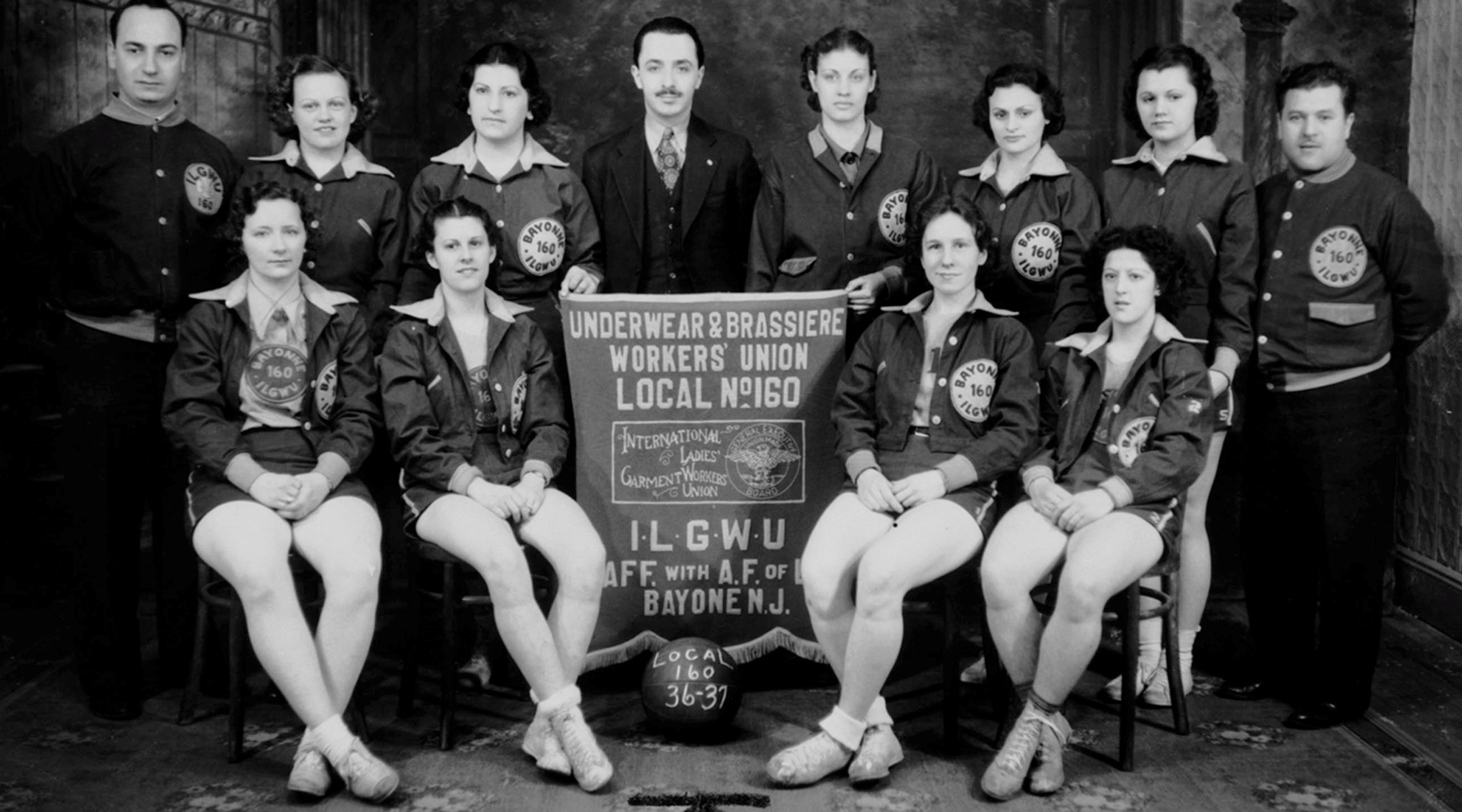
The I.L.G.W.U. had one of the most robust and successful cultures of social unionism. Fannia Cohn was a pioneer and life-long activist of workers’ education and head of the Educational Committee of the International Ladies’ Garment Workers’ Union. Here she reports on the multi-faceted learning, health, and recreation programs at the union’s Unity Center.
‘Strike Leaders in a Gymnasium’ by Fannia M. Cohn from Life and Labor (National Women’s Trade Union League). Vol. 11 No. 3. March, 1921.
THE other day I visited the Dress and Waist Makers’ Unity Center where the students were assembled in the gymnasium for a healthful and pleasant hour. The visit was prompted by a desire to learn at first hand who are the people who come to the gymnasium during the strike which is now being carried on by the Dress and Waist Makers’ Union. Are they those who serve on different committees which constitute the general strike committee, or are they those who keep aloof from all activities–merely enjoying the fruit of the labor of others–permitting others to struggle while they play?
But I was pleasantly surprised to note that most of the men and women who assembled in the gymnasium, laughing joyfully, dancing, and “straightening out their limbs” after a tiresome day’s work, were the very ones who had spent a strenuous week in the halls where the strikers assembled, using every influence at their command to organize the non-union workers, answering questions of union members, explaining to them why they are on strike and why they do not return sooner to their shops, cheering the gloomy and encouraging the weaker of their fellow workers.
Only those who are closely associated with the strike know how much aggravation and excitement there are in this work. In order to keep up their vitality and create new energy, these members come to their Unity Centers for recuperation. It is not only in the hall where the strikers meet, but also in the Unity Center, that they are under the wing of their union. And now, more than ever, it has been demonstrated that play is not inconsistent with action. Those who have the energy and will power to play and sing after a day’s tiresome work, are good human material. They possess inspiration, energy, love of life and pleasure, optimism, and hope for a bright future–the will to carry on the fight for a strong and powerful union.
Our members begin to realize more and more that workers’ education must be coordinated with the interests of their organization. Workers’ education cannot be called such, if it is carried on abstractly. Workers need not merely education, they need a certain kind of education. They must understand the general principles and practice of trade unionism, methods of collective bargaining, problems of their organization, and above all, they must learn how to solve those problems. They must understand the relation of the industry in which they are engaged, not only to the entire labor movement, but to society at large, and the place it occupies in our economic structure.
All this cannot be learned through one avenue alone. It can only be learned through practical knowledge of affairs and through experience which results from active participation in the activities of the union, strengthened by theoretical instruction received in the classroom. The one cannot be effective without the other.
For this reason, I was so delighted to see these young men and women, whose and personality character and are being strengthened and developed by the burden of a general strike and by their share in the responsibility for its success–these same young men and women who fill the classrooms in our Workers’ University and Unity Centers, where they take up courses in trade union policies, to give them an idea of the different kinds of trade unions and the problems of each, as well as the factors which have an influence on the character and development of trade unions.
These young people take up in our classrooms the history of civilization, in which they study the racial, social, political and industrial background of present society.
They take up a study of the economic basis of society, which includes a study of the surface, climate, resources, occupations and transportation of the important countries of the world, with special reference to the United States. In dealing with these topics, the relation between each one of them and the personal and social life of the workers is analyzed.
They by no means neglect to improve their methods of thinking. They attend courses in applied psychology and logic, in which they study and discuss the most important laws of this science, and find illustrations for these laws in their own daily experience.
They attend a course in sociology, which deals with group activity–how the crowd differs from the individual in its thought and action; the behavior of crowds in various circumstances, how existing social and industrial institutions were developed and what is to be expected of them, and the laws governing the growth and change of public opinion, etc.
They also take up work in our class in public speaking, in which they learn to formulate their ideas and to express them in a clear and effective manner.
In the class in tendencies in modern literature, they discuss the lives and works of the great modern writers.
Neither do they neglect to become acquainted with current economic literature. In their classroom they discuss weekly, books on economic problems, from every point of view, conservative as well as radical. And in the class in modern economic institutions, the study of all modern economic institutions, such as the state, town, village, bank, trust, corporation, factory, store, labor unions, etc., is followed.
These courses are provided free to members of our International by the Educational Department in order to increase the usefulness and importance of our members to their own organization, as well as to the labor movement as a whole, and to create leaders. Such education is not only important to the trade union, it is essential to its very existence.
Life and Labor was the monthly journal of the Women’s Trade Union League (WTUL). The WTUL was founded by the American Federation of Labor, which it had a contentious relationship with, in 1903. Founded to encourage women to join the A.F. of L. and for the A.F. of L. to take organizing women seriously, along with labor and workplace issues, the WTUL was also instrumental in creating whatever alliance existed between the labor and suffrage movements. Begun near the peak of the WTUL’s influence in 1911, Life and Labor’s first editor was Alice Henry (1857-1943), an Australian-born feminist, journalist, and labor activists who emigrated to the United States in 1906 and became office secretary of the Women’s Trade Union League in Chicago. She later served as the WTUL’s field organizer and director of the education. Henry’s editorship was followed by Stella M. Franklin in 1915, Amy W. Fields in in 1916, and Margaret D. Robins until the closing of the journal in 1921. While never abandoning its early strike support and union organizing, the WTUL increasingly focused on regulation of workplaces and reform of labor law. The League’s close relationship with the Amalgamated Clothing Workers of America makes ‘Life and Labor’ the essential publication for students of that union, as well as for those interest in labor legislation, garment workers, suffrage, early 20th century immigrant workers, women workers, and many more topics covered and advocated by ‘Life and Labor.’
Access to original issue: https://hdl.handle.net/2027/mdp.39015006961398?urlappend=%3Bseq=4%3Bownerid=13510798895545557-10
 Revolution's Newsstand