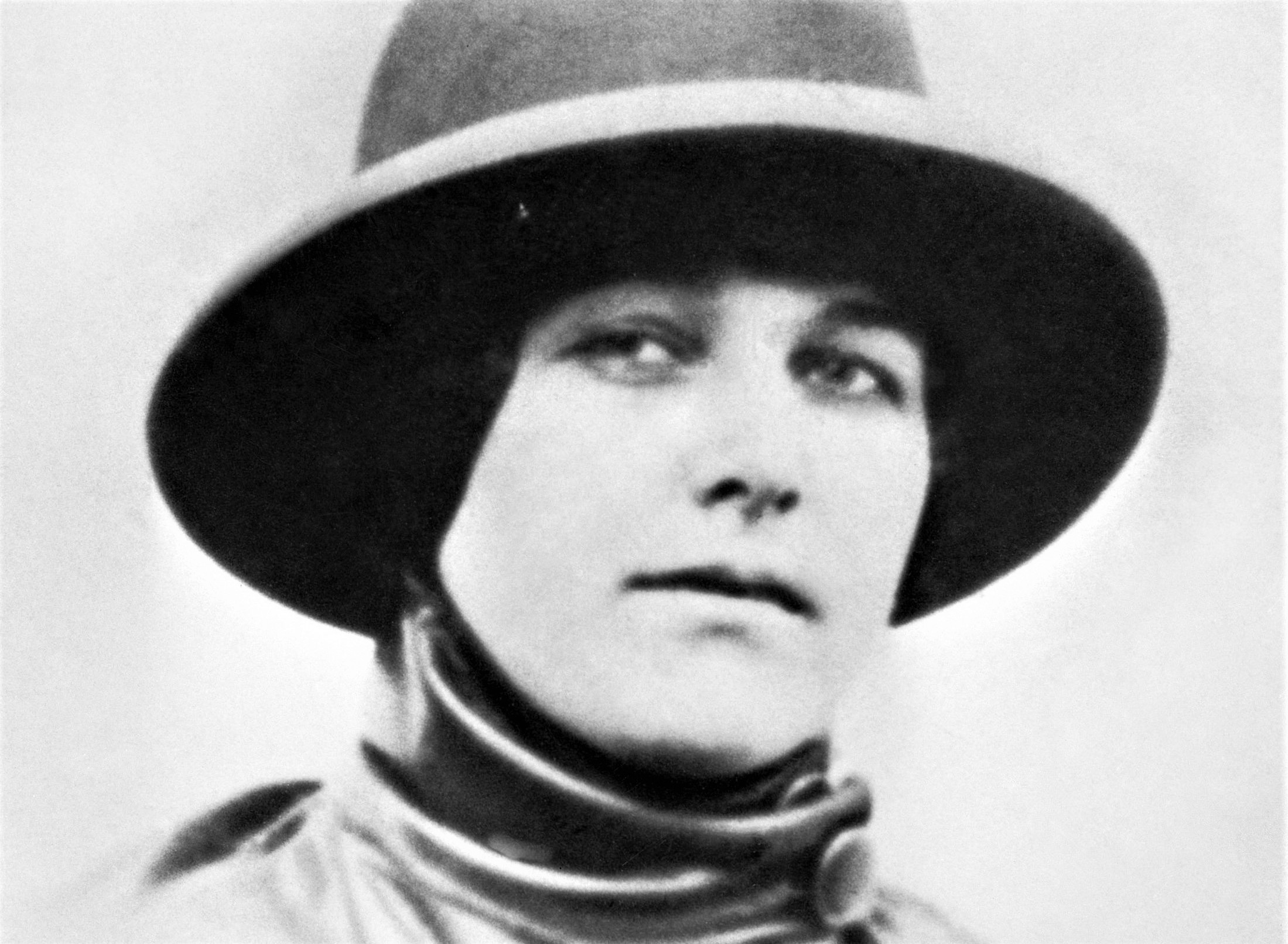
Larissa Reissnser, who died of typhus in early 1926 at only 31, had a remarkable life. Born into an aristocratic, academic, and revolutionary Social Democratic family, she became a leading woman Bolshevik, arts curator, Red Army combatant, commissar, Soviet diplomat, journalist, intelligence officer, historian,–a soldier of the revolution. A witness, Reissner wrote her book ‘Hamburg at the Barricade,’ on the street fighting in that city that was part of 1923’s ‘German October’, from which the below comes.
‘Barricades Which Arose Over Night’ by Larissa Reissner from The Daily Worker. Vol. 5 No. 265. November 8, 1928.
(October see the fifth anniversary of the outbreak of the Hamburg Insurrection of October, 1923. For nearly a year, Hamburg had been the scene of bitter fights for wages, for the eight-hour day, for the payment of wages in gold currency [the continually falling exchange value of the mark made paper money almost valueless before the workers could spend their wages]–and also for political demands, such as a workers’ government and control of production. In October, 1923, the whole working class of Germany stood on the verge of insurrection, but it was only in Hamburg that the movement developed into organized street warfare. Larissa Reissnar describes the battle in her book, “Hamburg at the Barricades,” from which this story is taken.)
THE Barricades grew up as if out of the earth, increased with incredible rapidity. There were no saws or shovels–they were obtained from somewhere. The inhabitants were set to work digging trenches and erecting barricades. Toiling and sweating they dug up the pavement and sawed down the sacred trees of the public gardens.
Piled up right across the street, the barricade renders it impossible for the enemy to see what is behind its rough, forbidding front; it diverts his attention and serves him as the only visible target. The barricade receives with its empty breast the whole of the furious fire which the troops direct against the invisible opponent.
The troops are compelled to attack in the open streets. The workers take up the fight in their own quarters. All attempts of the regular troops to capture Barmbeck on Tuesday, Octboer 23, proved vain against the scattered, invisible, and unseizable position of the sharp-shooters who, from somewhere or other, from the windows of the second stories, calmly take aim, while down below the helpless crowd of police send a hail of bullets against the empty barricades.
IN anticipation of an attack by armoured cars, the insurgents succeed without dynamite or other explosives in destroying a concrete bridge which looks as if it would last forever. The workers discover its vulnerable artery–a huge gas main–break it open and set fire to it.
One of the armoured cars drives blindly into a still and empty street. A halt is made in order to repair its mechanism. The next moment a barricade springs up in front of it. The car turns about–sawn down trees, their branches and limbs stretching right across the road, bar its retreat.
THE actual fights lasts the whole of Tuesday. The first attacks begin at about 11 o’clock in the morning. The most stubborn attacks take place in the Von-Essen-Strasse and along the line of barricades extending from both sides of the railway embankment. The police storm the railway station. Their detachments run along the railway embankment in order to dislodge the workers from above.
They are allowed to pass the first and second ambush unscathed. From the third they are swept by a murderous fire. The insurgents fire not only from behind cover, but also from the neighboring housetops. Snipers are scattered over the roofs of the houses, and keep whole streets, the most important crossings and squares under fire.
In the street below is a trench and a barricade. The insurgents have already held it for some hours. A detachment of police attacks with increasing fierceness. Then a cry is suddenly heard from above. “Away from the barricade!” The people do not know what is the matter. A young worker of about twenty-three, obviously wounded, comes down to them. He tells them to clear away from the barricade as the insurgents lying on the roofs are afraid of hitting their own people while firing at the police. The worker disappears again in the entrance of a house, and a few minutes after the fire from the roof forces the police to withdraw.
Another barricade has for hours offered the most obstinate resistance. From above, from the housetops, a number of snipers descend. From their observation posts they have noticed in the distance the approach of an armoured car, and have decided that it is better to attack the car from below, in the street. One of them succeeds with a lucky shot in hitting the radiator; the machine is out of action. The snipers return to their eyrie. So the fight proceeds.
ON Wednesday, the 24th, the group of leaders find themselves compelled to give the signal to retreat–not because the workers are defeated, but because there is no sign of a general revolution in Germany. What would be the use of continuing the fight which had broken out in Hamburg alone?
But it is not so simple to give the order to retreat in a city which is intoxicated with victory, in which the defense can at any moment go over to the attack, where there are hundreds of barricades, and where the workers are preparing for the general attack, for the last act of civil war–the victorious seizure of power.
Now the workers retreat. Cursing inwardly with vexation, as their last act they fling the enemy far back from the barricades. The insurgents take advantage of the resulting confusion in the ranks of the enemy in order silently to leave their trenches, barricades, watch-posts. They retreat and with their weapons, take their dead and wounded with them, wipe out all traces behind them, and disperse gradually, in the streets of the suburb which now have become silent.
The retreat according to plan is accomplished under cover of sharpshooters who are posted on the roofs. None of them leaves his lofty barricade before, down below in the streets, the last fighter has left his trench; before the last wounded man, supported by comrades, has disappeared in the doorway of a friendly house.
The whole day they still hold out, repel the Whites, run from one quarter of the town to the other–over the steep housetops, hanging over abysses, past attic windows through which the police begin to make their way–for they have noticed at last the empty silence behind the barricades.
The fight becomes a pursuit. The whole population conceals and rescues the heroic rearguard of the Hamburg October–these wounded, hunted solitary fighters who still keep up a fire high above the town; who suddenly make their entrance into strange working class homes–with bleeding hands, torn clothes, with black, patched lips, with crowd of pursuers at their heels who, cursing, threatening, seeking, run past the very door which has just been closed behind their victim.
ONE of the last to retreat was an old worker–staggering from exhaustion, his clothing in rags, drunk from weariness, and no longer able to cling to the smooth glazed bricks of the chimney-stacks. Arrived below in the shadow of the door of a courtyard which offered him the way to freedom, he halted again for a moment, raised his rifle, in order with fury and zest to fire off his last cartridges.
The whole of the corner of the wall against which he leaned was pitted with bullet marks. It was a blind chance that he was not hit. It was only with the greatest difficulty that he managed to get away at the last moment. Round his neck, over the open shirt and sweating hairy breast, there hung a brand new neck-tie.
“Whatever are you wearing that neck-tie for?” he was asked. “I wanted to die looking smart,” was his reply.
Such was the spirit of the proletarian fighters in the Hamburg insurrection.
The Daily Worker began in 1924 and was published in New York City by the Communist Party US and its predecessor organizations. Among the most long-lasting and important left publications in US history, it had a circulation of 35,000 at its peak. The Daily Worker came from The Ohio Socialist, published by the Left Wing-dominated Socialist Party of Ohio in Cleveland from 1917 to November 1919, when it became became The Toiler, paper of the Communist Labor Party. In December 1921 the above-ground Workers Party of America merged the Toiler with the paper Workers Council to found The Worker, which became The Daily Worker beginning January 13, 1924. National and City (New York and environs) editions exist.
PDF of full issue: https://www.marxists.org/history/usa/pubs/dailyworker/1928/1928-ny/v05-n265-NY-nov-08-1928-DW-LOC.pdf
 Revolution's Newsstand