
The revolutionary events in Cuba during 1933 saw a mass student rebellion and workers’ general strike overthrow formerly U.S.-backed dictator Gerardo Machado, and the coming to power of Batista, then as U.S.-allied kingmaker, in Cuba’s military as U.S. imperialism attempted to retain control of the island. President Roosevelt, who as former Navy Secretary, had a history in forging the U.S.’s dominance in the Caribbean, sent warships to ‘protect American interests’. Hardly the first, or last, time the U.S. would impose its will on the island.
‘Hands Off Cuba’ by Grace Hutchins from Labor Defender. Vol. 9 No. 9. October, 1933.
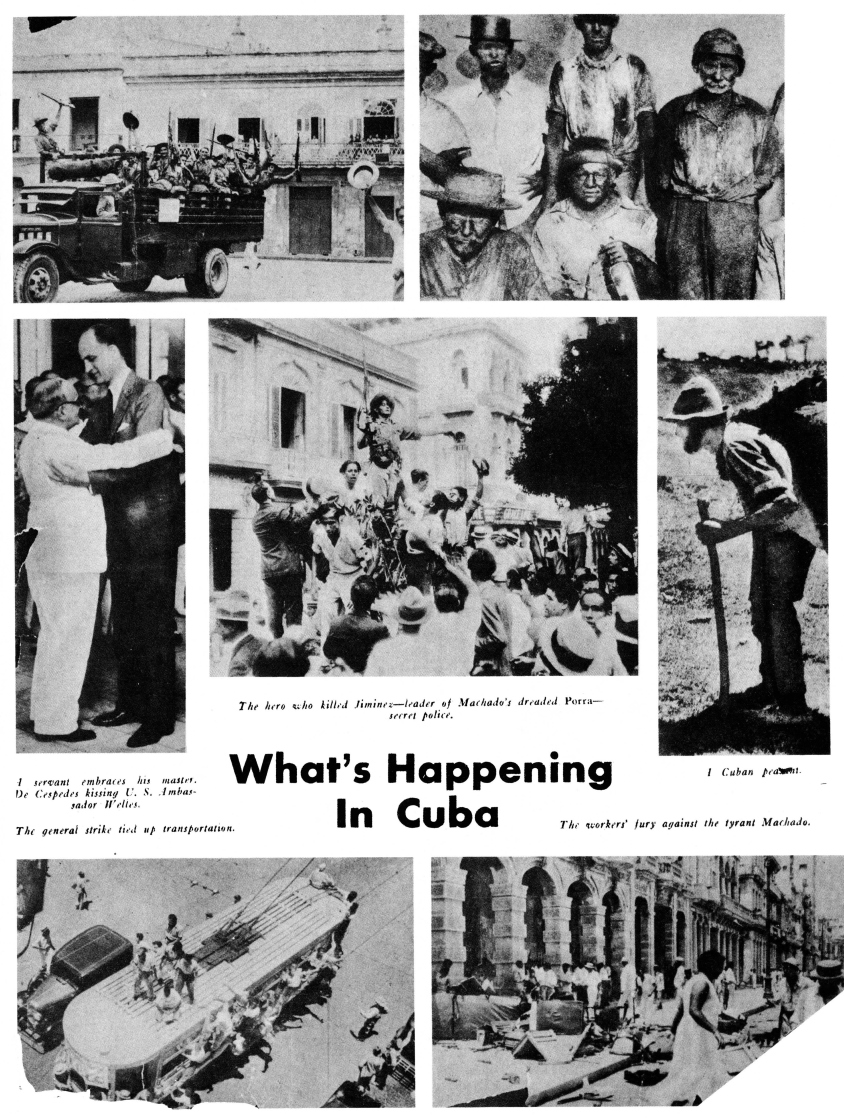
Gerardo Machado, president of a thousand murders, has fled from Cuba to hide in Montreal, Canada. His successor, de Cespedes, approved by American sugar capitalists and other Wall Street imperialists, was overthrown in less than a month by a so-called Revolutionary Junta.
But the present left-wing bourgeois program of this Junta does not and cannot satisfy the Cuban workers and peasants who have been tortured for seven long years under Machado’s shot-gun government and for 35 years under America’s sugared imperialism. The struggle is on–between the Cuban masses and the Cuban capitalists, these supported actively by Wall Street’s Roosevelt government and its battleships.
Today’s headlines tell much of the story:
U.S. NAVY DEPARTMENT PLACES CORDON OF U.S. SHIPS AROUND ISLAND. BATTLESHIP SENT TO HAVANA HARBOR. WORKERS PICKET ROADS TO PREVENT ESCAPE OF RAILWAY OFFICIALS. WORKERS SEIZE SUGAR FACTORIES. HERITAGE OF VIOLENCE LEFT BY MACHADO REGIME. 15,000 CUBANS AT FUNERAL OF MURDERED YOUNG COMMUNIST.
The few remaining members of the secret Porra, Machado’s gang of convict gun-thugs, dare not show their faces on Havana streets. Avenging students and workers killed several of this murder gang in August, during the first 10 days of revolt, and among them the murderer of Julio Antonio Mella.
Back of these events of August-September, 1933, lie seven years of torture and murder. That was Machado’s regime. And much of his bloody record is now set forth in a book called The Crime of Cuba, by Carleton Beals, a liberal journalist who is considered an authority on Cuba, Mexico and other Latin-American countries. He shows that Machado was “put into office by campaign contribution of America corporations and could not stay in office except for our State Department approbation.” Machado traveled “in a $30,000 armored car, a veritable army afore and aft.” Let Beals tell the story of one night under Machado’s terror:
“On the night of Dec. 30, 1931, the military authorities, wishing to do away with one of the students…armed the criminals in the castle (Principe Castle) and launched them against the defenceless student prisoners. Cesar Andino had his intestines and kidneys cut open and died; Manuel Varona Loredo was knifed in the back and his body stamped upon; Rafael Arguelles was knifed in the arm, had a wrist broken and suffered other injuries; four or five others were gravely wounded.”
One victim, typical of a thousand under Machado’s constant terror, tells his story: “I was imprisoned in an underground cell…horribly damp, full of cobwebs and insects and totally dark. Its floor was deep in mud.
“At night voracious rats came out of their holes and helped the mosquitoes and the cold, which goes into your bones, to make it impossible to get any sleep. In this Dante’s hell I remained for several days…
“A corporal and a sergeant took me into a dark chamber where my ankles were bound to my shoulders. Several of my bones were dislocated.
“I cried out in pain.
“’Talk and I will let you loose,’ said the officer, But, as I had nothing to say, they kept on pulling the ropes. A little later they put out all lights and left me there…
“Twenty one days have elapsed and I am still sick and showing in my body the black brands of the ropes and rifles.”
What was the part played by American bankers in this torture and terror, in the pauperizing of Cuban workers and peasants, in the desperate misery of the Cuban masses? A financial writer in the New York Times (Sept. 10, 1933) goes far toward answering this question:
“While Cuba’s former President has been described as a dictator who used harsh methods, there are some holders of Cuban Government bonds who say a good word for the erstwhile head of the island’s government. ‘While Machado was in office, Cuba did not default on a single bond issue which was held by American investors,’ a banker recalls. ‘The government kept up its interest payments under distressingly hard conditions, for not alone was Cuba hit hard by the world-wide depression, but the sugar industry suffered an especially severe affliction'”…
To protect these bankers’ investments and insure the prompt payment of interest on their bonds, to protect the property of sugar capitalists and to shoot down the sugar workers who ask for bread, the Wall Street government dispatches the battleship Mississippi, and surrounds the island of Cuba with a cordon of U.S. cruisers and destroyers, manned by marines ready to land on Cuban soil. This is the beginning of INTERVENTION, and it must be opposed with all the forces of the American working class. HANDS OFF CUBA.
Labor Defender was published monthly from 1926 until 1937 by the International Labor Defense (ILD), a Workers Party of America, and later Communist Party-led, non-partisan defense organization founded by James Cannon and William Haywood while in Moscow, 1925 to support prisoners of the class war, victims of racism and imperialism, and the struggle against fascism. It included, poetry, letters from prisoners, and was heavily illustrated with photos, images, and cartoons. Labor Defender was the central organ of the Scottsboro and Sacco and Vanzetti defense campaigns. Editors included T. J. O’ Flaherty, Max Shactman, Karl Reeve, J. Louis Engdahl, William L. Patterson, Sasha Small, and Sender Garlin.
PDF of full issue: https://www.marxists.org/history/usa/pubs/labordefender/1933/v09n09-oct-1933-lab-def.pdf
 Revolution's Newsstand