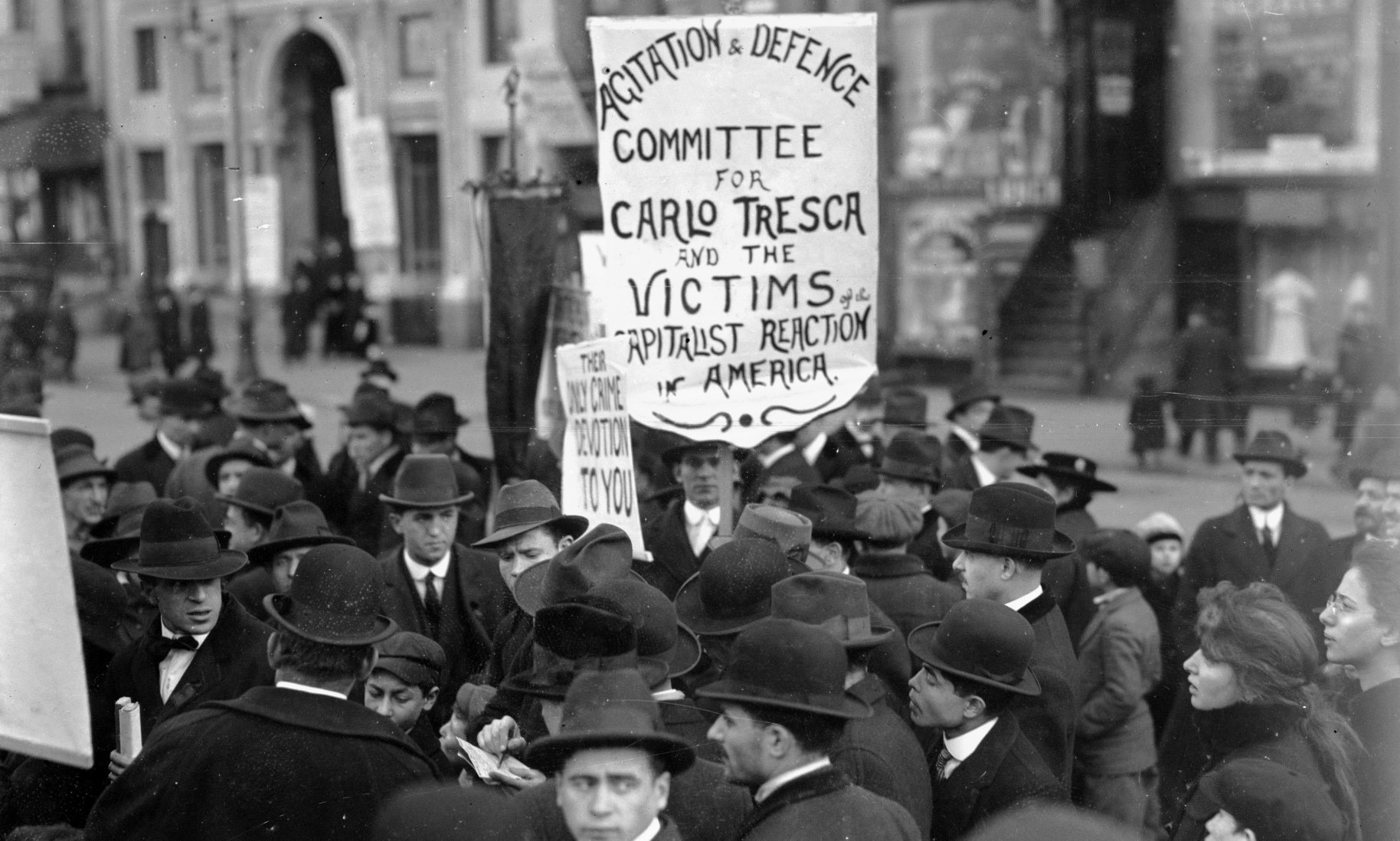
Tresca uses his time in prison to expose corrupt wardens, the police-controlled drug trade, and brutalities of Atlanta Federal Penitentiary. Tresca was sent to the Penitentiary in January, 1925 to serve a year-long sentence for publishing ‘obscene’ material in his Il Martello newspaper–a two-line advertisement of a book on birth control.
‘Carlo Tresca Home from Jail’ by Esther Lowell from The New Leader. Vol. 2 No. 20. May 16, 1925.
“Prison has not reformed me” says Carlo Tresca, editor of the Italian workers’ paper, Il Martello, who was sent to Atlanta Federal penitentiary charged with inserting an ad on a birth control book in his paper. The case against Tresca was prompted by former Ambassador Caetiani, Mussolini’s representative in the United States.
“I’ve come out just as determined as ever to go on with the fight against this economic order,” Tresca declares. “Prisons do not reform. In Atlanta there is no educational work to help the prisoners. No lectures, no musics and the prisoners laugh at the church services. The vaunted movies they show are the cheapest kind, either childish or sexey.”
The dope traffic which Warden John W. Snook is trying to curb is actually increasing under his many restraints upon the prisoners, Tresca reports. One-third of the more than 3,000 inmates are dope addicts and from the most careful observations Tresca became convinced that the narcotic traffic is furthered by inside operatives among prison guards, etc. The number of prisoners has increased from 2,800 to over 3,000 since Tresca’s incarceration in January, due, he asserts, to the Volstead law. Instead of four men to a cell, as before, there are now eight.
Tresca was assigned to A cell range, the worst of the three, and his work was scrubbing. He was put into the same cell with a syphilitic prisoner and forced to use the same soap and towel as the sick man. Tresca says that he knows of other syphilitics who prepare the vegetables in the prison kitchen.
The bribe system which brought former Wardens Sartain and Fletcher into Federal courts recently still exists in Atlanta, Tresca proved while he was there. A certain prisoner, number 19,806, who had a few hundred dollars with him when he went to Atlanta, was offered a job in the front office of the prison where he could dress in white instead of in the menial blue and where he could eat at a special mess. The man came to Tresca, as the price required to get the job was advanced by the runner for the deputy warden, who assigns jobs. Prison officials got scared and put the man in the tailor shop, the worst work, as punishment.
Sartain, former warden, convicted of bribe-taking from bootleggers and now appealing his case, in the idol of many of the prisoners, Tresca finds, because he is a politician type, rather genial and liberal. The new warden has taken away most of the men’s privileges in his war on dope, charging, for instance, that the outside baseball players would bring in narcotics. His repressions have, instead, increased the prisoners’ desire and the traffic in dope flourishes more than ever.
One other political prisoner, sent up for a criminal charge, was discovered in Atlanta by Tresca. He is Joe Roth, former president of the Postal Clerks’ Union in Cleveland, who was framed for his labor organization work and given five years for alleged misuse of the mails to the extent of getting $2.50. Roth could win early release, Tresca says, if he would comply with the judge’s ultimatum to withdraw his affirmation of innocence, which Roth will not do. He has a wife and children, but does not waver under prospect of over three years more in Atlanta when perjury is the price of release.
“In a land so rich and powerful, its prisons are a great blot, a disgrace and crime,” Tresca declares. “Most of the prisoners began their criminal careers from reformatories. There is George, who went from the army at 18 a fine young fellow, released a couple of weeks ago, one of the most degenerate men there. Almost all the degenerates in the penitentiary have come from the army or navy.”
Certain newspapers misrepresented Tresca’s visit to President Coolidge and the Italian editor wants it known that he went into the executive office unknown with a group of Philadelphia students who invited him along, and Tresca thought it a good one on the Secret Service that he was not recognized and hustled off. Tresca says he is a man without a country and that he is against all Governments instead of having affection for any, as erroneously reported in New York papers.
New Leader was the most important Socialist Party-aligned paper from much of the 1920s and 1930s. Begun in 1924 after the S.P. created the Conference for Progressive Political Action, it was edited by James Oneal. With Oneal, and William M. Feigenbaum as manager, the paper hosted such historic Party figures as Debs, Abraham Cahan, Lena Morrow Lewis, Isaac Hourwich, John Work, Algernon Lee, Morris Hillquit, and new-comers like Norman Thomas. Published weekly in New York City, the paper followed Oneal’s constructivist Marxism and political anti-Communism. The paper would move to the right in the mid 30s and become the voice of the ‘Old Guard’ of the S.P. After Oneal retired in 1940, the paper became a liberal anti-communist paper under editor Sol Levitas. However, in the 1920s and for much of the 1930s the paper contained a gold mine of information about the Party, its activities, and most importantly for labor historians, its insiders coverage of the union movement in a crucial period.
PDF of full issue: https://www.marxists.org/history/usa/pubs/new-leader/1925/v02n20-may-16-1925-NL.pdf
 Revolution's Newsstand