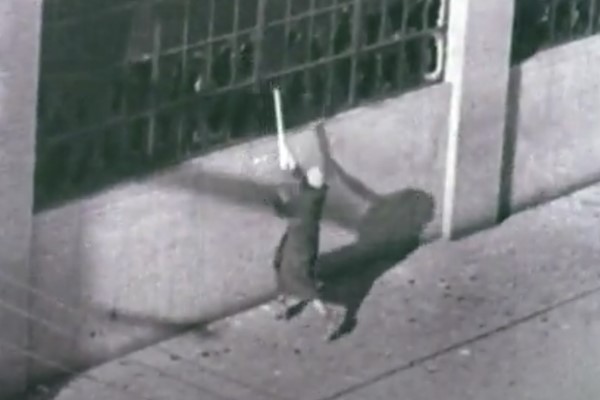
The story of the Women’s Emergency Brigade during the Flint Sit Down Strikes reported by legendary labor journalist Mary Heaton Vorse.
‘What the Women Did In Flint’ by Mary Heaton Vorse from Women Today. Vol. 1 No. 12. March, 1937.
“We must give our boys air,” cried the wives of sit-down strikers. The boys got air, food and support. Here’s how their women did it.
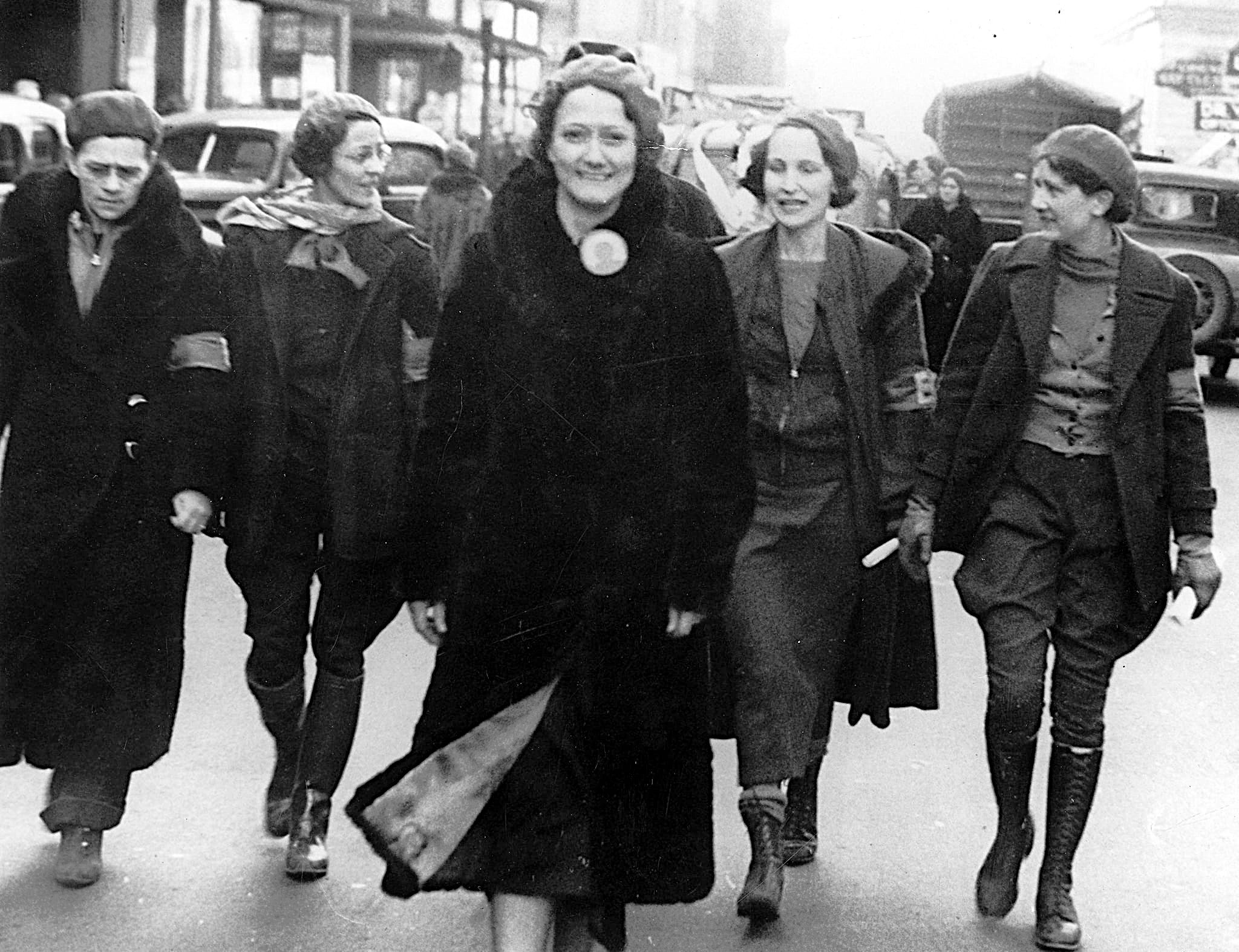
TEN WOMEN WITH red tams and red arm bands with E.B.- Emergency Brigade- filed onto the cat-a-cornered stage in the Dodge union hall in Hamtramck. It was my first sight of the Women’s Emergency Brigade of Flint, destined to make labor history in America. Mrs. Garrison of the Flint auxiliary was speaking:
“Our Women’s Emergency Brigade is ready for action day and night; we take food over to the sit-down strikers in the plants and we are on guard to protect our husbands. We can get fifty women together at a moment’s notice; we expect and are ready for any and all emergencies.”
Mrs. Bessie Garrison is slender, attractive and dark, with a humorous smile, and is a natural speaker. Many a· practiced speaker could envy her manner, although this is a first experience.
Mrs. Lamb spoke next, a big woman with twinkling eyes and a face that shows she knows how to be firm, when to get angry and how to laugh; a woman that the young men. strikers instinctively call “Ma.”
“I’m the mother of nine children and I have three grandchildren. I am on the Emergency Brigade. I want to tell you about the battle of Flint. We call it ‘Bull’s Run,’ because the police ran away. They tried to stop us from getting food to our boys. They were shooting and throwing gas bombs and some of them we threw right back at them. They came at me with the gas.
“‘Come right ahead,’ I said, ‘I’ve been gassed, and I can stand some more, but you’re not going to stop me from getting food to my boys.”
“My daughter is down at the kitchen, on guard all night. She hasn’t been home for three days, but we are going to see that no vigilantes break up our kitchen.”
You could feel life flowing into that meeting. The women of Flint had mobilized and they were in the fight for good. These were the women who baked the pies, helped the children off to school and kept the homes going. They were now defending these homes. One felt a completeness about them, the satisfaction and wholeness that people have when they are using all their powers instead of letting four-fifths of their potentialities rot, unused.
When I next saw Mrs. Lamb, she had just been through another gas battle-the battle in front of Chevrolet 9. She wiped her eyes continually and the odor of tear gas hung around her. She paused a moment to tell me about the fight.
“Our coming stopped them. There would have been lots more trouble if we hadn’t come.”
Ever since the four union organizers were kidnapped in Bay City and their cars sideswiped and wrecked on the road to Flint, sending three of them to the hospital, there has been a demand for action among the Flint workers. Chevrolet then began discharging men for union activity. Chevrolet workers held excited meetings; there was a demand for action. On February 1 Chevrolet sat down. Through a move of clever strategy, a demonstration was held in Plant 9 to divert the company police and the extra thugs from Plant 4, which can tie up all production.
A call came to the women’s auxiliary holding a meeting in Pengally Hall. The Emergency Brigade sprang into action. Down went the “red caps” to Plant 9. The American flag at the head, staves in their hands, down they marched. They could see the fighting dimly; gas bombs were being thrown.
“We must give our boys air.”
“We mustn’t break the windows,” someone cried.
“We’ve got to break them; they’ve got to have air.”
They got air, all right.
The sound car begged the women to go back to the hall to recuperate from the tear gas. They went unwillingly, but only to return a little later to picket Chevrolet 4.
Mrs. Genora Johnson’s voice came from the sound car:
“We women don’t want violence; we don’t want trouble. But we are going to protect our husbands. The women of the Emergency Brigade are soon coming back.”
The new sit-downers of Chevrolet + cheered. Some of those women were to remain throughout the freezing night, picketing the plant. There was no disorder, the pickets soon resolved themselves into a compact, singing line. Fires were built in tin cans.
Nevertheless the sheriff and the mayor called for the troops and a cordon was thrown around the plant. No one was allowed past and the women were not even allowed to go for coffee at a nearby restaurant, nor were the sit-downers allowed to give them water. Nor was food allowed to the sit-downers until nearly twenty-four hours later, when the Emergency Brigade triumphantly escorted in truckloads of food to the sitters in Chevrolet 4.
Two days after this, Woman’s Day was celebrated here in Flint. This day marked the launching of a movement which is destined to spread among the working women of the country. An Emergency Brigade had already been formed in Detroit and a large contingent came wearing green caps. Although there was almost no notification for Woman’s Day, delegations came from Lansing and even Toledo.
The first parade ever held by the Emergency Brigade walked through the heart of the business district in Flint, forerunner of marching thousands, wives and mothers of workers going to the aid of their men as capably as they look after their homes. The duties of the home have merely been extended- the women are going to its defense.
When the parade ended, the women went in cars to picket Fisher Plant 1. The injunction had been granted, the sitdowners told to leave the plant, but they were not leaving.
There occurred one of the most amazing labor demonstrations ever seen in America. A singing picket line, six deep, circled round and round that huge plant for hours. Hundreds of women pickets, hundreds of red and green caps added color to the scene. There was perfect order, because not a policeman was in sight, not even a traffic cop. There must have been ten thousand people among the pickets, sympathizers, and onlookers.
The auxiliary had called a mass meeting for that evening. By six o’clock the hall was full.
Here one could see a movement in its moment of creation. Women from half a dozen towns spoke. They clamored for more education, more pamphlets on industrial unionism. Mrs. Genora Johnson, who is one of the many leaders in this movement, said:
“A little while ago there were few women interested in the union. Today they have learned through the auxiliary that the workers have power. The workers are going to learn they have political power and when they do, we’ll elect every county and state official.”
The women from Detroit told of their visiting committee to recruit new women members. We heard of nurseries that are being formed so that women can join the Emergency Brigade and work in the auxiliary.
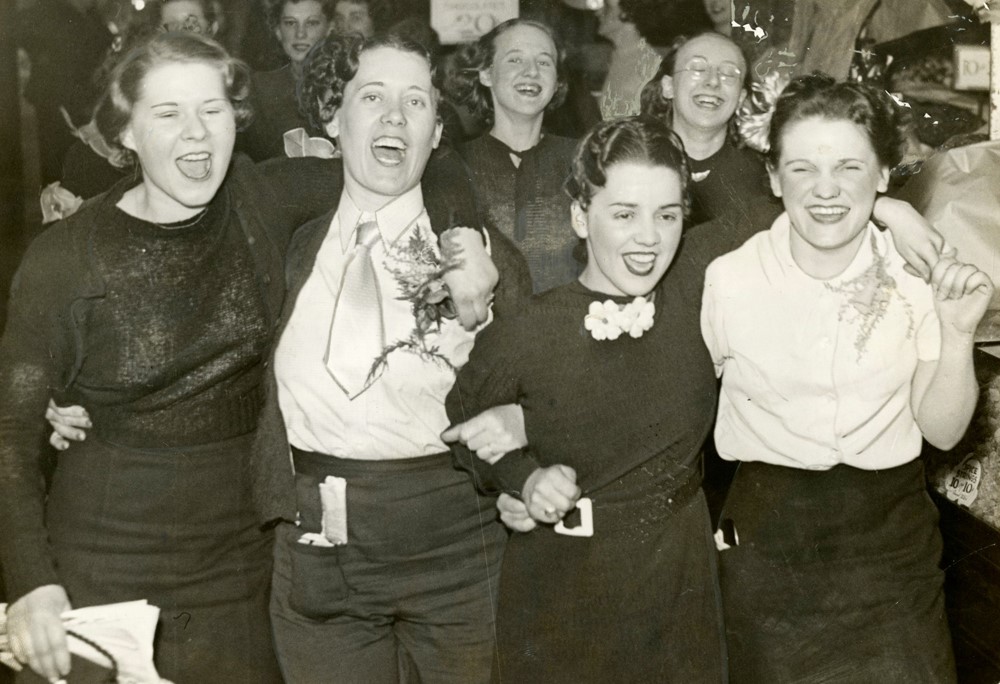
“I want you to know every woman in Lansing is behind you, but send a woman over to tell us what you’re doing and how to organize, because men don’t tell us anything,” one woman said.
The old cry: “The men don’t tell us anything.” The men going along leaving out the women like a person trying to hop on one leg. The labor movement will not long be crippled, a new breath has blown through it. A cultural movement has started. The women are making up plays which are based on actual strike happenings. They have classes for children in tap dancing and singing. The union is entering into every aspect of life; the home and the union are becoming fused.
The Working Woman, ‘A Paper for Working Women, Farm Women, and Working-Class Housewives,’ was first published monthly by the Communist Party USA Central Committee Women’s Department from 1929 to 1935, continuing until 1937. It was the first official English-language paper of a Socialist or Communist Party specifically for women (there had been many independent such papers). At first a newspaper and very much an exponent of ‘Third Period’ politics, it played particular attention to Black women, long invisible in the left press. In addition, the magazine covered home-life, women’s health and women’s history, trade union and unemployment struggles, Party activities, as well poems and short stories. The newspaper became a magazine in 1933, and in late 1935 it was folded into The Woman Today which sought to compete with bourgeois women’s magazines in the Popular Front era. The Woman today published until 1937. During its run editors included Isobel Walker Soule, Elinor Curtis, and Margaret Cowl among others.
PDF of full issue: https://www.marxists.org/history/usa/pubs/wt/v1n11%20%2812%29-mar-1937-women-today.pdf
 Revolution's Newsstand